How money came to Rome
The Rome that fought and defeated Hannibal was in many ways a somewhat old-fashioned city thriving on the old-fashioned virtues of loyalty and a citizen army. Rome was slow to adopt money, indeed the very word for money, pecunia, comes from the Latin pecus, a herd of cows, suggesting that cattle were the main form of wealth in early Rome. The first money in Italy was that used by the Greek colonies in the south of Italy: in the north, the Etruscans never really took to money (though there are coins imitating Greek coins at Populonia). The Etruscans were never a monetary economy: that was one of their problems.

The earliest Roman money is not really money at all. It is the so-called aes rude or rough bronze, and consisted of lumps or rather bricks of bronze, some of them crudely inscribed with the name of Roma: it was not the sort of stuff you could carry round in your pocket and it may have been more an ideal measure rather than something for practical use. Indeed even as early as the Twelve Tables of law, drawn up around 450 BC there appears to have been a rudimentary system of payments based on lumps of bronze which were weighed out. Ironically the first Roman coins were not proper struck coins at all but crude cast coins.
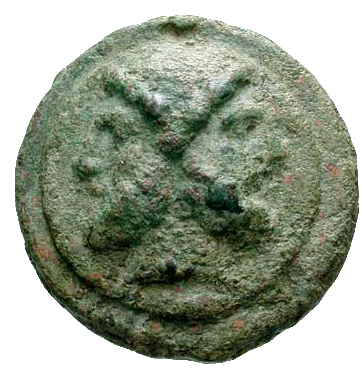
The first proper coins bearing the name of Rome were not used at Rome itself at all but in the areas of the Greek colonies to the South around Naples. It was as if the Greek towns in the south of Italy had all been monetised and when they fell within the Roman sphere, they demanded to use money. The Romans therefore allowed them to make coins stamped with the name of Roma but they did not want to have this new fangled means of exchange to circulate in Rome itself.
Even during the war against Hannibal, the Romans did not really use coins. It is said that Hannibal issued 70 times more coins than Rome did. The reason for this is interesting. These early coins were mostly minted to pay soldiers, and the armies of the Greek states and indeed Carthage were mainly mercenaries, who needed to be paid. The Roman armies were citizen armies who did not need to be paid, at least not in money; it is recorded that Roman soldiers were paid from 340 onwards, if not indeed earlier; but since money did not exist at that date, they could not have been paid in money – presumably they were paid in kind, as an agreed measure of corn to recompense them for the loss of their harvests in their absence. But is it perhaps this citizen army both of Rome’s own citizens and those of their allies, that gave Rome its formidable fighting strength?
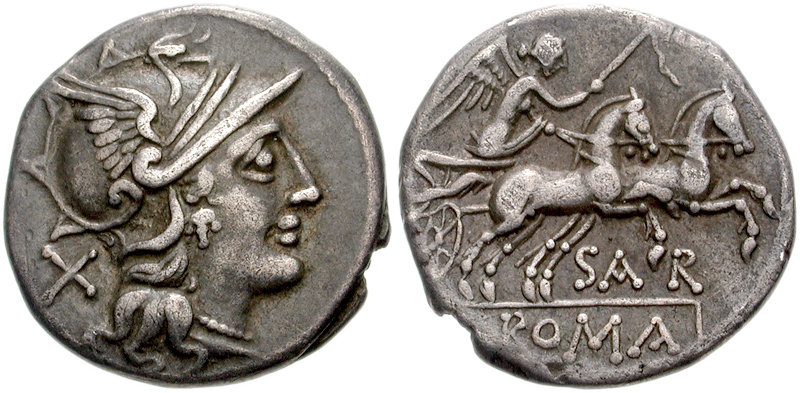
It was not until towards the end of the war with Hannibal, in around 212 BC, that the first real Roman coinage was introduced: the denarius, a coin which was to last for the next 400 years and is the ‘d’ in the term £sd, which survived in Britain down to 1971. However once the denarius was firmly established and once Hannibal was out of the way, the Roman economy roared ahead.
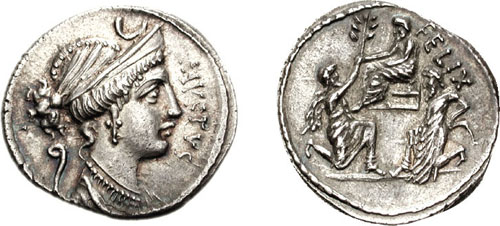
The history of the introduction of Roman coinage is extremely complex and controversial. The problem begins with the Roman writers themselves notably Pliny the Elder who gives a long and confused account about the origins of coinage, suggesting that the aes rude was introduced by the second king of Rome, Servius Tullius, traditionally dated 578 to 535 BC. This is clearly much too early and historians and numismatists have been steadily lowering the dates. There is now general agreement that the denarius coinage, which was the first ‘full’ coinage was only introduced at the very end of the war with Hannibal around 212 BC: Pliny implies an earlier date of 269, which for long confused everybody.
This whole subject was put on a new basis by Michael Crawford in his influential book on The Roman Republican Coinage published in 1974. It is now generally agreed that the denarius coinage was not introduced until the very end of the war with Hannibal, around 212 BC. There is also widespread acceptance that the crude aes rude does not begin until around 300 BC; however the introduction of these various cast coinages and early silver coinages between 300 and 212 is extremely controversial.