The workshop of the (Greek) world
Just outside the agora lay one of the great hidden secrets of Athens: the Keirameikos, or pottery quarter. For much of the 5th century, indeed for much of the millennium, Athenian pottery dominated the Greek world, being exported widely, notably to Italy, to the wealthy princes of the Etruscans who spent lavishly on Athenian pottery to decorate their tombs.
Minoan and Mycenaean pottery was often gorgeously decorated, but in the dark ages of the 11th and 10th centuries BC, painted pottery vanished. But gradually during the 10th century, wheel-made pottery returned and was occasionally decorated. The style is called ‘proto-geometric’ and consists of little more than horizontal bands and occasional circles or semi circles.
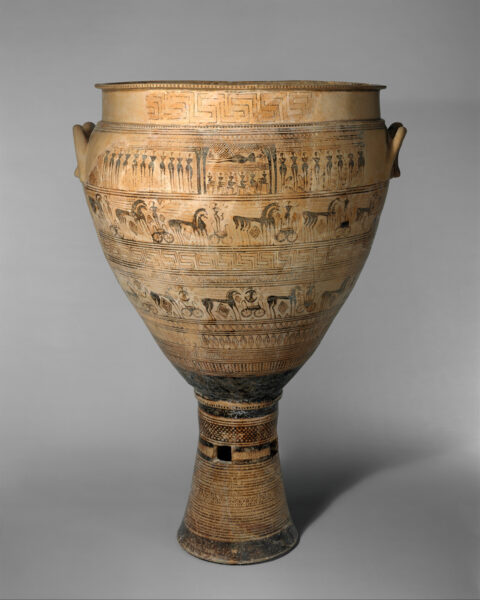
But during the 9th century BC, a distinctive style emerges known as the Geometric. The surviving complete vases were often funerary urns: at first they were decorated purely with geometric shapes but during the 9th century animal and human stick figures began to appear, often showing pictures of funerals; a narrative art began to emerge.
The 8th century BC saw a new spirit emerging: this was the age when Greek colonies were sent out all over the eastern Mediterranean and in return, oriental influences began to be felt in art. This was strongest in metal work, but a new spirit emerged in pottery too.
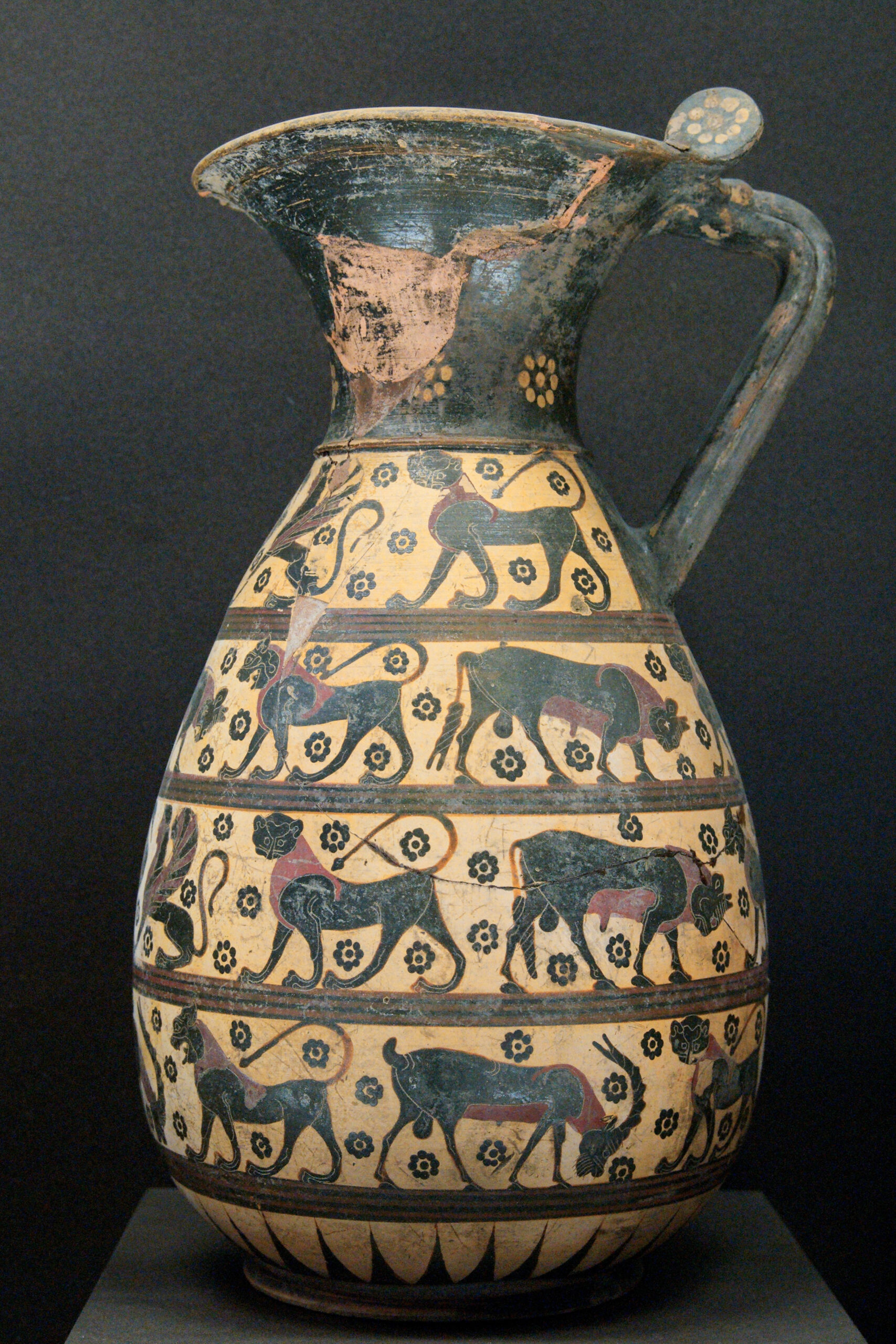
This was the age when Athens lost its leadership, and Corinth emerged as the leading city state and producer of the best pottery. Corinthian pots can be easily distinguished because Corinthian clay was much lighter coloured than the Attic clay. Attic pots came with the very distinctive red background, but Corinthian pots tended to be buff in colour. The finest pots were often smaller too, containing ointments and perfumes rather than wine. Human and animal figures began to be added and the characteristic rosettes. Among the animals that began to make their appearance were lions, which are not known in Greece and must have been adopted as the latest decorative fashion from the East and Egypt.
But around the middle of the 6th century BC, a new style of black figure pottery emerged and Athens once again became the leading centre for pottery production. This new style is known as “black figure”: instead of covering the red or buff colour of the vases with manic decoration, single figures were painted on the clay with a black slip or paint; details could be added to the figures by incision, cutting through the black slip to reveal the colour of the clay underneath.
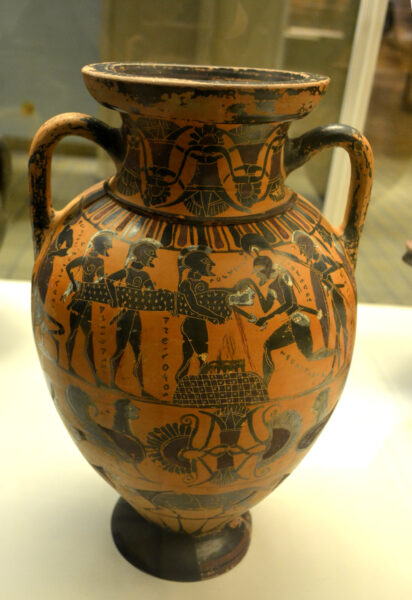
This enabled story-telling: no more animals wandering about, or rosettes to fill the gaps, but instead people. Myths could be portrayed – the Trojan war was particularly popular, while Hercules was fashionable, particularly in Athens where the tyrant Peisistratos fancied himself as a latter day Hercules. But there were many scenes of reality revealing secular behaviour: there were warriors putting on their armour or showing off their horses; there was wine, women, boys and song.
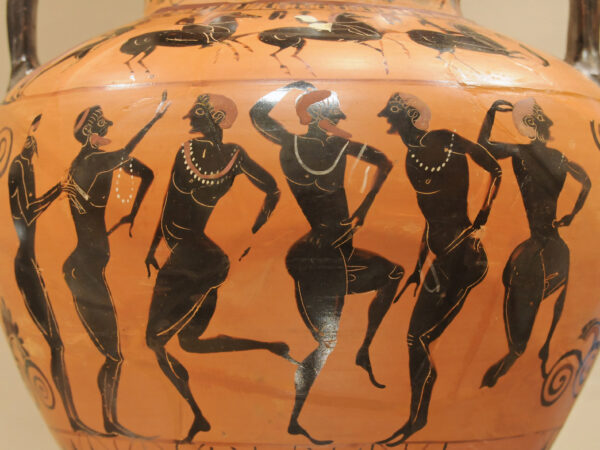
There were bowls decorated with the risqué Komast dancers who wore a tight padded costume and performed a bottom slapping, kicking dance, the forerunner of the Black Bottom craze of the 1920s. But though the black figure vases began in Corinth they were soon taken over in Athens which once again became the leading pottery centre in Greece; though perhaps surprisingly Sparta had a flourishing black figure industry.
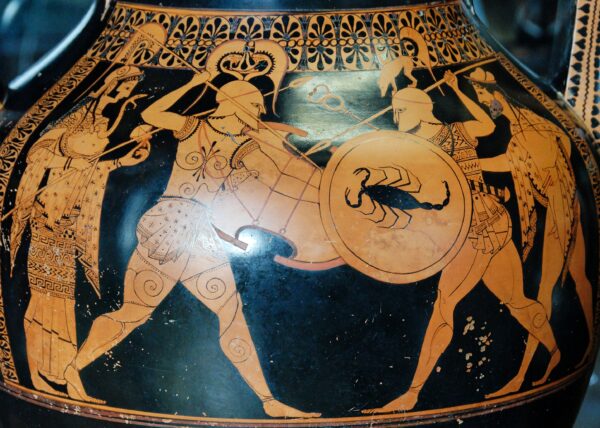
Towards the end of the 6th century around 520 BC, a new fashion swept the market: red figure. Instead of having black figures on a red background, why not have red figures on a black background? You can draw the details much more effectively this way. This meant lightly outlining the figures and then painting in the whole of the background in the black slip. The red figures thus remained showing the natural colour of the clay, but the figures could then be painted with black lines enabling details of limbs and clothing to be revealed. In the early red figure vases, faces and feet were shown sideways, but then foreshortening was invented and they could be shown realistically in three quarters view, or indeed whatever view was called for.

In the heyday of red figure from 520 – 440 BC, Athens dominated the market and pottery was exported in huge quantities throughout the Mediterranean, but particularly to Italy and to Etruria, north of Rome. Only in southern Italy was there significant local production of red figure ware.
Robin Osborne has argued that the transformation of Athens and the creation of classical Greece can be followed in the scenes chosen by the Red figure potters and painters. Thus there is a change from explicit to implicit, from focusing on action to focusing on the emotional. In the gymnasium, there is a change from vigorous male bodies ready for action to softer bodies displaying contemplation and self absorption. Similarly, military scenes change from scenes of battle to vignettes of the soldier parting from his wife or mother.
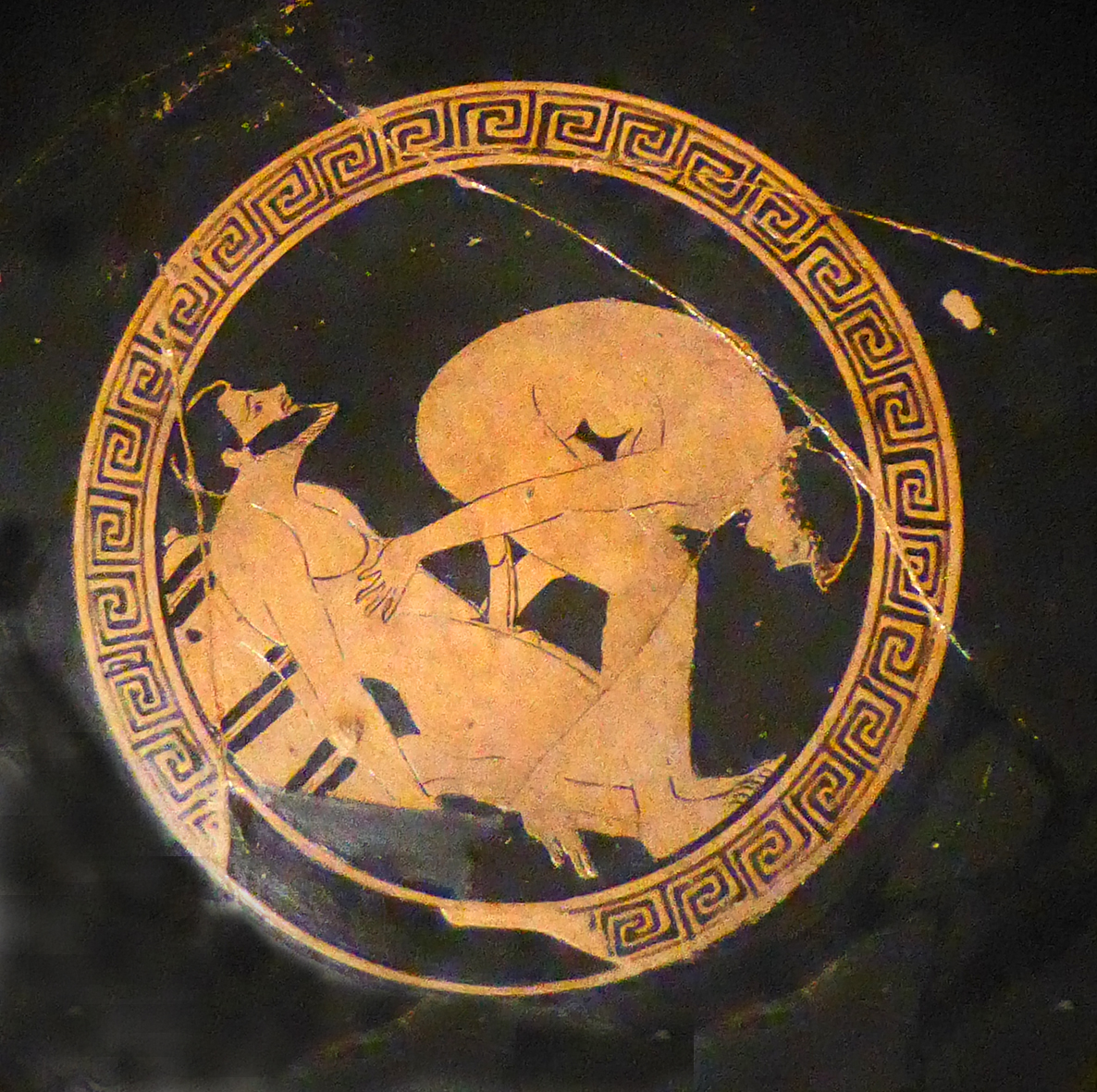
And then there are the notorious sexually explicit scenes which often appear on the base of the two handled shallow drinking cups, known as Kylikes. The scenes are hidden when the cup is full, but as the liquor is drained , they gradually appear and as the drinker becomes a little tipsy so an invitation to sex is revealed. However Athens became more prudish, and gradually they die out and are replaced by more romantic scenes of weddings, attended by Eros or Aphrodite.
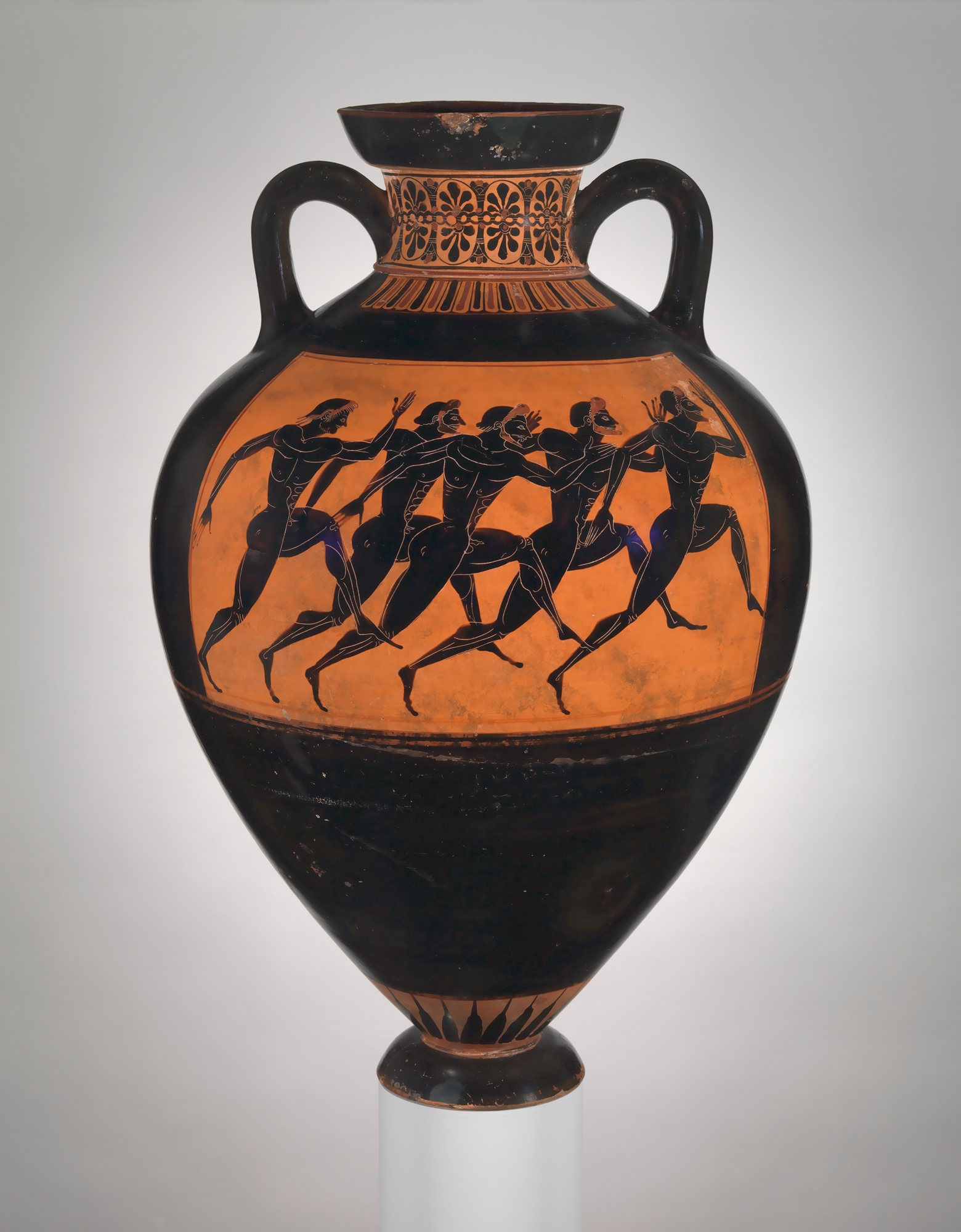
There was one exception to the dominance of red figure pottery, and that was in the Panathenaic amphorae. The Panathenaic Festival (= all Athens festival) was invented 9in 556 by the tyrant Peisistratos – tyrants are fond of inventing grand festivals – the opium of the masses. The Panatheniac Festival was a huge success: there were games and the winners of the games were given huge jars or amphorae filled with olive oil: the winner of the chariot race received no less than 140 amphorae of olive oil, a nice windfall for the potters. . These were commissioned and paid for by the state and their production was the high point of a potters’ career, so they contained the very best of the potters’ art. On one side there was a picture of the goddess Athena, and on the other side a picture of the sport concerned. However these remained in black figure: the market may have changed but the state remained unchanged.
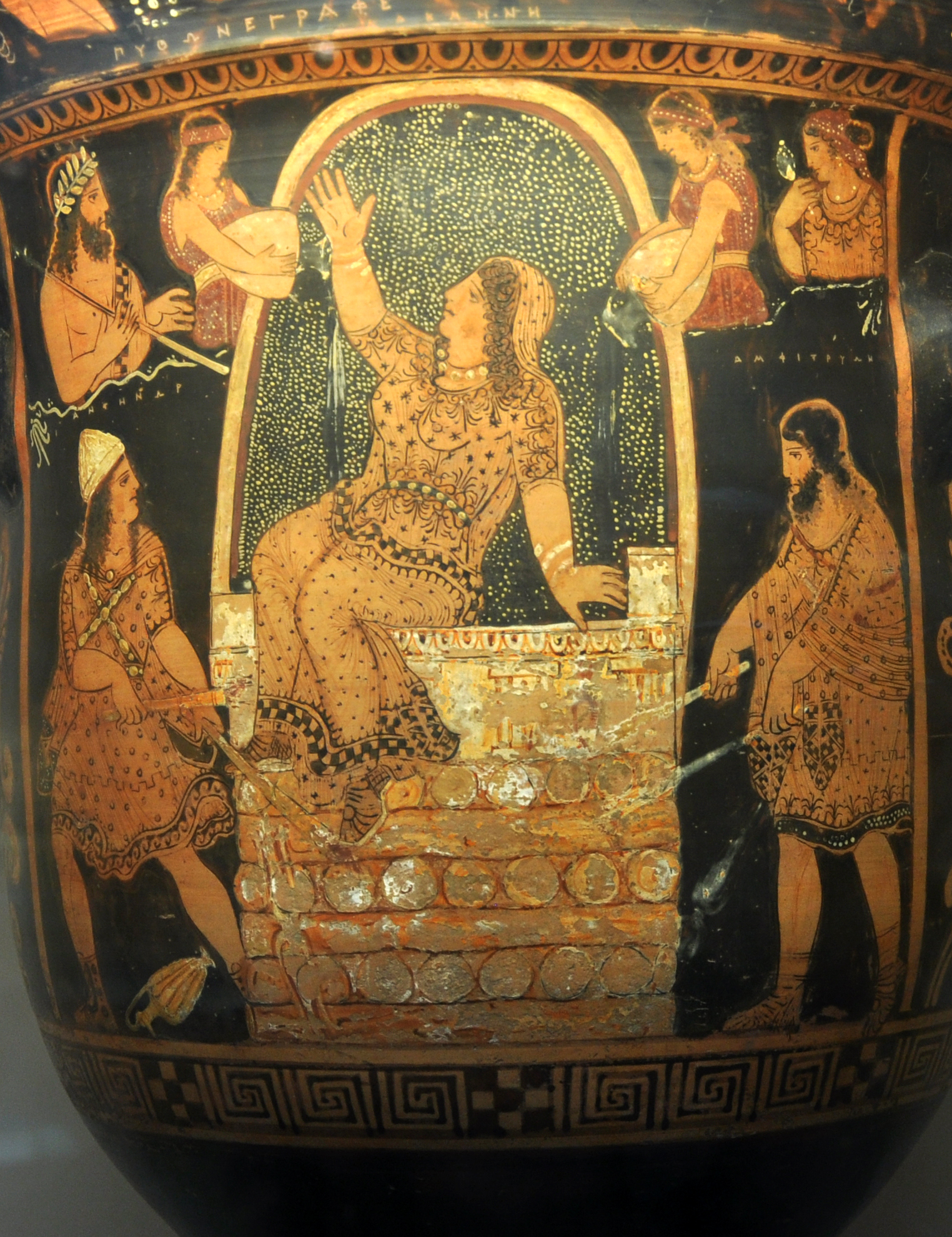
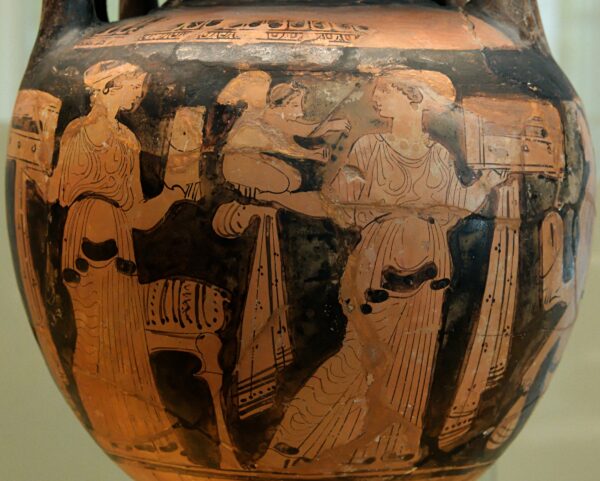
Later on there are elaborate scenes of mythology such as this fourth century vase from Paestum in southern Italy showing the story of Alkmene. Alkmeme was a beautiful girl who was raped by Zeus, became pregnant and gave birth to a ruffian son called Hercules. Her pregnancy made her very fat, and when her husband found out, he decided to burn her. However when she was sitting on her pyre waiting to be burnt, she appealed to Zeus to save her, so Zeus, sent a shower of rain –in the form of white dots poured down by young ladies to extinguish the flames. Alkmene was saved.
But the importance of Greek pots is not just in the industrial history of Greece, but also in the light they throw on the progress of Greek art. The Greeks virtually developed drawing and painting as we know it, but sadly none of this has survived directly. We know from the descriptions of their leading painters that they invented perspective and pioneered the control of shadow.
It is said that some of them produced paintings so realistic that when they painted a bowl of grapes, birds came down and tried to peck at the grapes. Similarly when one painter was asked to draw aside the curtains so that the rest of his work could be revealed behind them, he went up and showed that the curtains themselves were a painting. None of this has survived directly, though we know that the most famous of the stoas in the market place at Athens was the Painted Stoa, which was virtually an art gallery of paintings by all the leading painters.
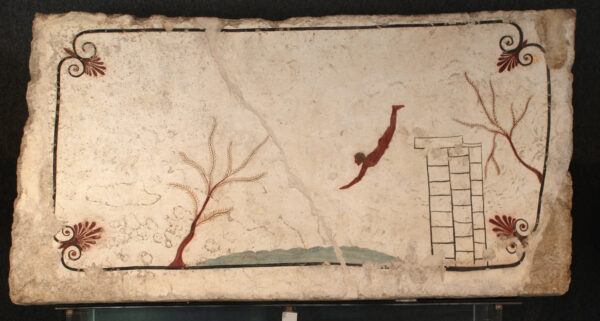
The best reflection of Greek wall paintings comes from outside Greece itself, from the elaborate tombs in Etruria and Macedonia, which were painted in Greek style but often without Greek elan. The finest is probably that from a tomb in the Greek colony of Paestum in southern Italy, where the Tomb of the Diver shows a young man presumably the deceased occupant of the tomb diving off a high diving board into the Sea of Eternity, while to the side are pictures of a homoerotic feast. Greek painting appears to have been one of the great Greek achievements, but sadly all that remains of these achievements can be seen in the market splendours of Athenian red-figured pottery.
But the pottery industry is a reminder of the industrial power house which underlay the glamour that was Athens. Just as 19th century Britain was the workshop of the world, so in the 5th century Athens was the workshop of the Mediterranean world, and the pottery industry provides a glimpse into the workings of this power house.
On to the city that rejected money: Sparta
20th January 2016