The Open Society and its Enemies
The Open Society is a term invented or at least popularised by Karl Popper, an Austrian philosopher who wrote a two volume book on The Open Society and its Enemies, the first enemy being Plato, the second enemies being Hegel and Marx. But how far was Greece an ‘open society’, and why was Plato an enemy?
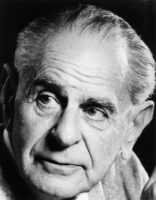 Karl Popper was an Austrian philosopher, born in 1903 in Vienna, who studied philosophy and soon became one of the leading young philosophers. In his book The Logic of Scientific Discovery, he investigated the meaning of Truth and argued that truth is difficult to define but it was better to do so from the negative point of view and investigate ‘Falsifiability’, arguing that it is easier to disprove a concept and show that it is false, rather than to try to prove that it is true.
However in 1935 with the rising threat of the Nazis, he fled to England and eventually found a job teaching philosophy in New Zealand, which was about as far away from the Nazis as one could get, but it had the disadvantage that there was no good library and no fellow philosophers to argue with. However it was here that during the war he wrote his great work on the open society, though he had to wait until he returned to England in 1946 before it was eventually published. But it was soon recognised alongside Hayek’s book on The Road to Serfdom as one of the leading books against the totalitarian ideas of the Nazis.
Popper’s most notorious attack was his designation of Plato as being an enemy of the open society. Plato is one of the most distinguished Greek philosophers, and one of the founders of the Western philosophy tradition, and so it was considered sacrilege to designate him as an enemy. We need to reconsider Plato.
Plato was born in around 425 BC in the middle of the war between Athens and Sparta, and in 404 BC, Athens was defeated by Sparta. This defeat of Athens, when Plato was in his 20s, had a traumatic effect on the democrats in Athens: how could you support democracy when democracy had been defeated? Should one not support the rule of ‘the best’ or an oligarchy like the rule of a council of the elders as at Sparta?
In Plato’s most famous work, the Republic, he set out to solve this problem, and he outlines how the ideal city should be ruled. There should be three classes. At the top were the rulers known as the Guardians, who were the gold class. They were not allowed to own property or touch money which polluted them, but their food and everything they needed was provided by the city, so they could concentrate on ruling well. Then in the middle there was the silver class who were the Warriors, clearly modelled on the Spartans who just concentrated on war. Finally underneath were the workers, the iron class who did all the work and were allowed to own property and use money, but they had just one craft which they had to stick to: they weren’t allowed to change, and because they spent all their life on this one craft, they became very good at it.
It all sounds very sensible at first, that the best people should rule. But how do you decide who the best people are? What if they rule badly, or the workers become fed up with doing the same job and feel they could rule better? Nevertheless the idea has had a great attraction to many of the ruling classes: Benjamin Jowett, the Master of Balliol college at Oxford , spent half his life producing a superb translation of the Republic, and did his best and largely succeeded in turning out generations of ‘guardians’ from Balliol, Boris Johnson being the latest. But Popper smelt a rat, and with devastating effect pointed out how close much of it was to Nazi philosophy. Plato has never been quite the same.
Like all the best religions, the creed of the Open Society has subsequently split into different schools. The main schism comes from the philanthropist George Soros, who was a pupil of Popper at the London School of Economics, and went on to become a very successful hedge trader, making a huge amount of money, famously betting against the Bank of England in the notorious black Wednesday in 2009, when Britain was forced to devalue and Soros made a huge profit by short selling. With his money he has set up various Open Society Foundations which give grants and scholarships to universities and other bodies round the world: some of his grants, for instance to American political parties, have attracted criticism. Many feel that his interpretation of the Open Society has become a little distorted.
But how far is the concept of the Open Society applicable either to ancient Greece or to our society today? Popper never really defines what is meant by the Open Society, though at the end of the book he compares a closed society, practising a tribal way of life, where institutions leave no room for personal responsibility, with an open society in which individuals are confronted with personal decisions.
Popper had a strong belief that the 5th century saw a social revolution at Athens which was based on the rise of democracy and individualism and he argued that this upset many. He saw too that Sparta echoed this disquiet and attempted to arrest all change and to return to tribalism. I cannot not help thinking that his ideas fit in nicely with my belief in the advent of money and the market economy, which would provide one of the major causes of the changes that he describes – and chronologically it fits perfectly. It is also fascinating that Plato considered money to be polluting. This is a belief that is still strongly held, and why I consider the true definition of money as being a ‘dark’ secret.
I like to think that this concept of the open society fits in well with my beliefs. I would place a different emphasis, based on choice, and with choice, freedom. The Open Society is a society that provides freedom of thought, freedom of speech, and freedom of action, which in turn provides the opportunity for, and the impetus toward innovation which has become an important driver of the industrial revolution. Certainly Plato’s concept of the ideal state looks quite appalling, and Popper’s criticism is spot on. But his concept of the Open Society is surely a valuable contribution to our current definition of the sort of society we should aim at.
or,