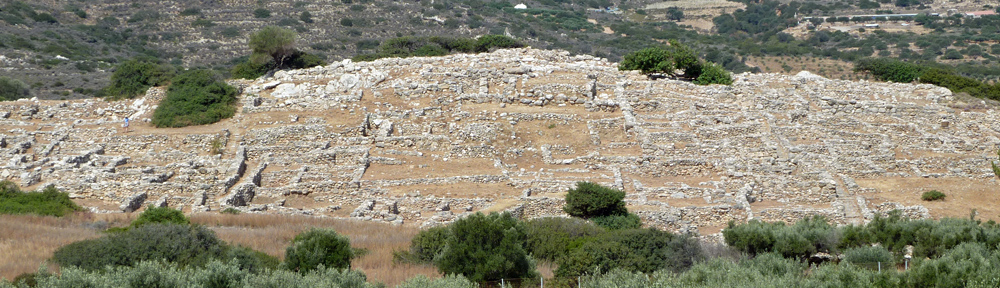
Minoan Towns and Countryside
The Minoan realm did not just consist of palaces: it was a thriving economy and Minoan remains are to be found everywhere. There are many major towns – the palace at Knossos lay to one side of a huge Minoan town, and in the countryside there were numerous buildings that are sometimes misleadingly called villas. Ian Swindale in his magisterial website on Minoan Crete lists 19 towns and settlements and 15 mansions and villas, but these are probably the tip of the iceberg of the extensive settlement of Crete in Minoan times. Let us take a quick look at some of these towns and country estates that tell us where people actually lived in Minoan Crete.
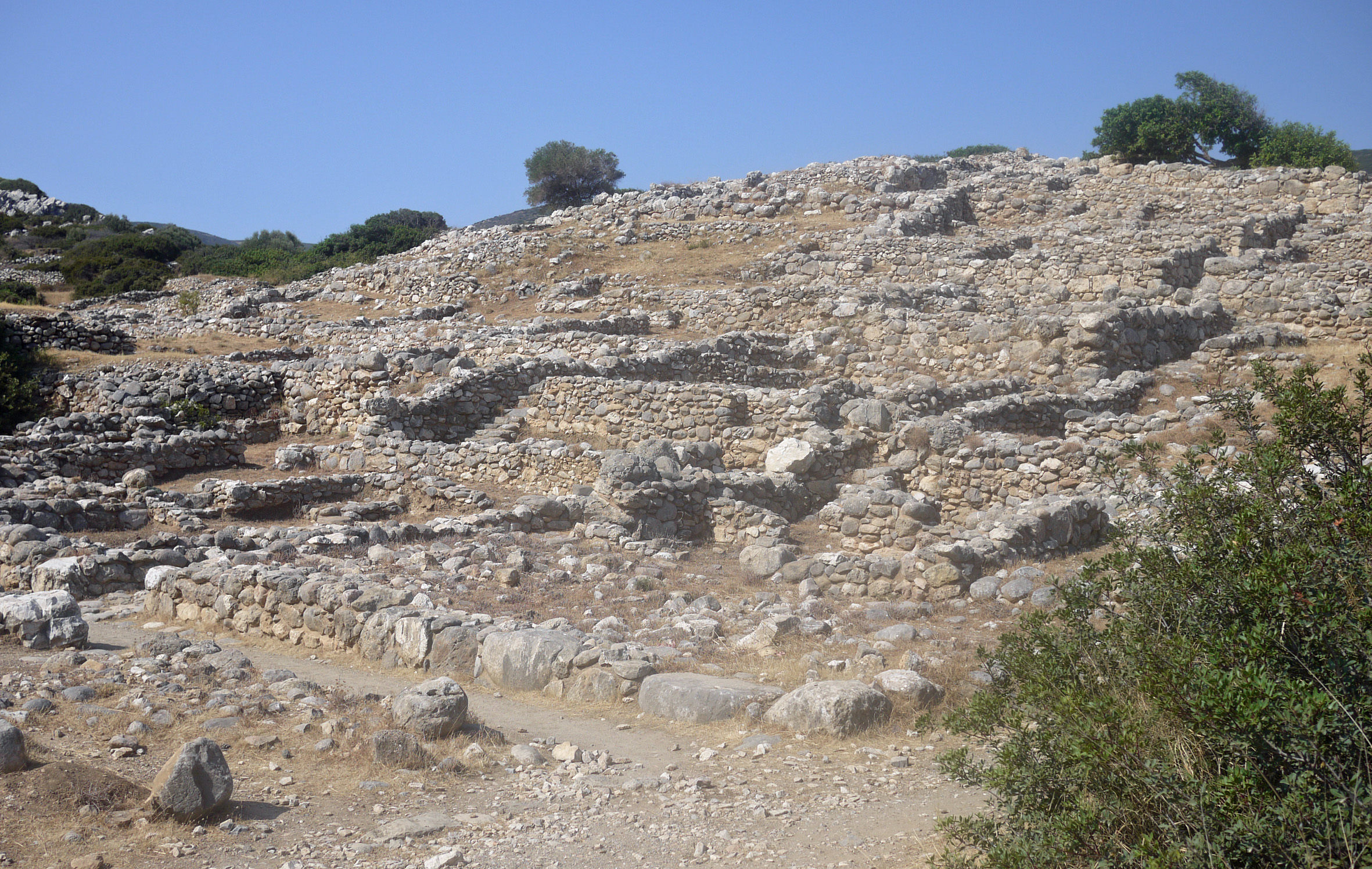
The best known Minoan town is Gournia which lies at the eastern end of Crete between the palaces of Malia and Zakro, and was excavated between 1901 and 1904 by a formidable American lady, Harriet Boyd. (It is amazing to think that the Minoans were discovered in a very short period of time in the first decade of the twentieth century, when the English under Arthur Evans were digging at Knossos, the Italians were excavating at Phaistos and the Americans were uncovering a Minoan town at Gournia. This was the time when Crete was throwing off Ottoman rule and discovering its independence – and its history).

The amazing thing about Gournia is that the entire town was excavated. It appears that Harriet Boyd, a lady in her early thirties, was exploring eastern Crete, and having been taken by a local to Gournia recognised its potential, did a quick trial dig with just 30 local workmen and then returned for three proper seasons, digging with a hundred workmen at a time. One wonders how she managed to pay for it all (private money?), while all the time admiring how safe it was in a countryside which was still in the process of escaping from Turkish bondage.
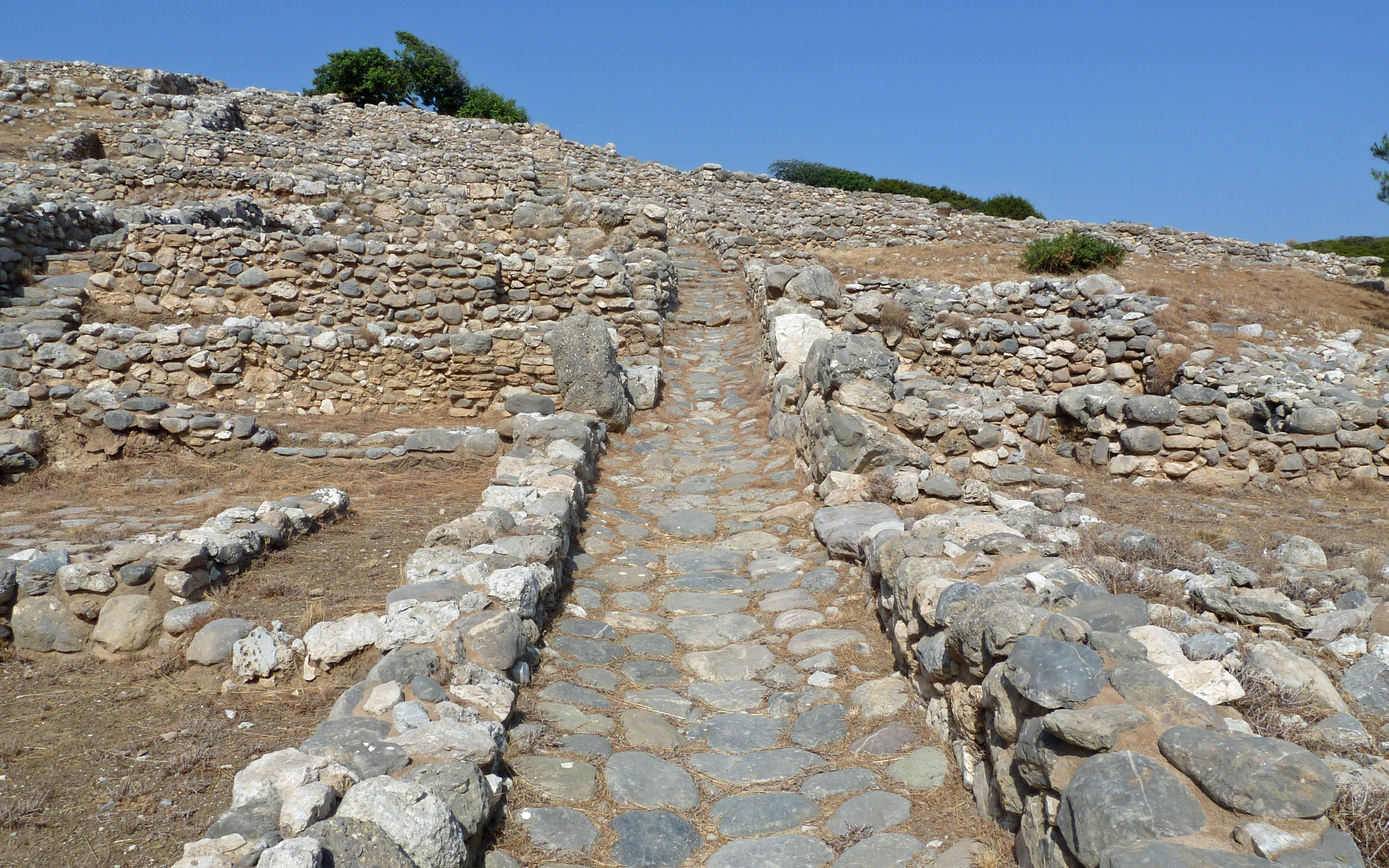
The town consisted essentially of small houses set on either side of a ring-road that ran around the base of a low hill. It was a paved road barely wide enough for two donkeys to pass each other. Many of the houses appeared to have been two storied, some of them with evidence of industrial activity including bronze working. The excavator remarked that they were mostly larger and more commodious than the contemporary Cretan peasant houses (but then Crete did not thrive under the Ottomans). ‘Farming, pasturing, fishing, building, weaving, shoe-making, bronze-casting, the manufacture of stone and terra-cotta vases occupied the people’s time’ wrote Harriet Boyd.
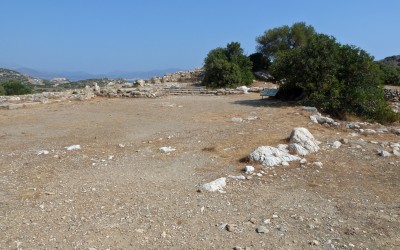
The open courtyard at the top of the town of Gournia: was this a Palace?
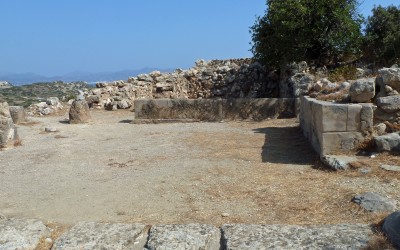
In the possible Palace at Gournia. Note the ashlar masonry on the right, that is stone that had been square cut indicating that it had been part of an elite building.
At the top of the hill however there is a more elaborate building and people have been arguing ever since as to how far it was a palace. It was certainly quite grand in parts. In places there was evidence for ashlar masonry (that is cut masonry), though it seems to abut onto dry stone walling. There was a row of magazines for storage purposes and there were several examples of pier and door uprights which usually indicate the presence of a ritual Minoan hall. At the centre there was a small courtyard, but it would certainly not have been big enough to indulge in bull leaping, and although the western wall had in places a series of recesses that normally mark the entrance to a palace, there is no sign of a western courtyard. So if the criterion of a palace is that it should have a courtyard big enough for the great palatial ceremony of bull-leaping could take place, then Gournia was certainly not a palace.
The biggest town in Crete was in fact at Knossos, for the palace of Knossos was surrounded by a very extensive town, or rather it lay at the south eastern corner of a very extensive town. The town was later covered by a Roman town: fortunately the site of the palace was largely ignored by later occupation, but the Roman remains at Knossos have been spasmodically excavated: there was a basilica and a theatre, but the prize of the Roman remains is a rich town house with a very fine mosaic of Dionysus. It would be a fascinating exercise to explore Roman Knossos, for it lies basically in the open countryside. When the Arabs invaded Crete in 824, they founded a new town on the coast which is today Herakleon, the capital of Crete, 5 miles to the north of Knossos, so as a result the old town at Knossos was abandoned. The Roman town therefore survives well, but if you want to explore the Minoan town, you must first explore the Roman town: the Minoan town is likely to remain safe from the archaeologists for the foreseeable future. (Though current surveys suggest that the town was even larger than is generally realised)
There are several other Minoan town sites that have been excavated, the best known being Palaeokastro in eastern Crete near the palace of Zakro, where a long length of a winding street has been excavated with houses on both sides. But no sign of a palace has been located: did depend on Zakro only ten miles away?
Country houses

At this point we should perhaps mention Hagia Triada which is rather grander than a country house, but not quite a palace. It lies two miles away from the Phaistos Palace and was perhaps a sort of annexe to the Palace, or was perhaps the residence where the rulers actually lived while performing all the ceremonial duties at Phaistos itself?
It is laid out in an L-shape with the main part being in the bottom part, while the upper branch has the offices. It has many of the features of a palace, a set of Minoan halls and some granaries, but no courtyard. It has however wonderful views and the excavators found rather more rich objects than they did at Phaistos itself.
Then there are the country houses – English archaeologists tend to call them villas, but the term tends to have overtones of ‘Roman villas’, so it is perhaps safer to call them mansions. But in addition to the towns and the mansions, the main settlement of Minoan Crete must have been the small farms on which its wealth depended. Archaeological surveys of the island have revealed many pottery scatters indicating settlements of various sizes, but few of these have yet been excavated or rather have not been excavated in sufficient detail to become a classic example. But this was where the olives were grown and the sheep were kept and the wool was woven on which Minoan Crete grew rich; and grew rich it did.
On to: Tombs and Religion
18th December 2016