Theodosius – the Great?

What does it feel like when a society teeters on the edge, when decline is about to become fall? Let us examine the story of Theodosius ‘the Great’, the last emperor of the combined Roman Empire, east and west, who ruled for 16 years. One of his great achievements was that he removed the Altar of Victory from the senate, regardless of the views of the traditionalists who said that to remove the Altar of Victory risked the fall of Rome. And 15 years after his death, Rome fell.
He is called Theodosius the Great, but I always feel we should put a question mark after ‘The Great’ because he was an enigmatic, rather unsatisfactory figure, interesting perhaps from a psychological point of view, but someone where one needs to sum up the pluses and the minuses. His greatest achievement was to pass a number of Decrees outlawing Christianity, and we need to examine the evil genius, the Svengali of declining Rome, who held this rather weak Emperor in his sway and bent him to his will

The obelisk of Theodosius, originally dedicated to Thutmose III, now standing in the Hippodrome at Constantinople. The base shows scenes from Court, illustrated right.
Top right shows Theodosius at the games, awarding a laurel leaf prize to the winner. Note the water organ at the bottom right to provide music, and a similar musical instrument bottom left.
The lower panel (bottom) shows barbarians bringing offerings.

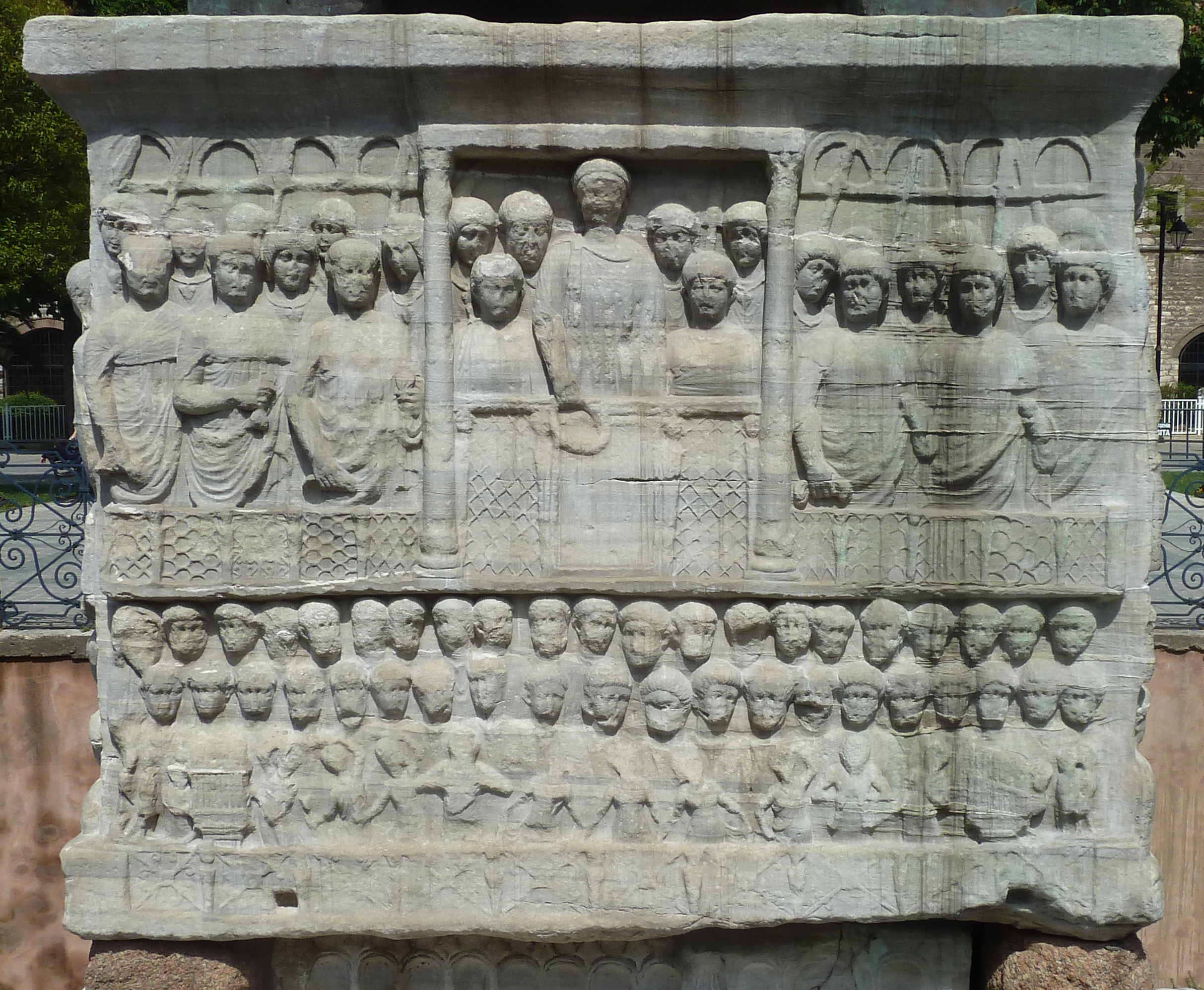 Let us start with the pluses. He was the last emperor of the combined Roman Empire, east and west: Justinian a century and a half later partially reconquered the West, but by that time Gaul and northern Spain were both long gone. One should also give him credit for erecting the Egyptian obelisk that still stands in its original form in Constantinople. It lay on the spine of the Hippodrome, set on a pedestal that depicts Theodosius and his court. It is one of the finest achievements of the art of Late Antiquity, indeed the art of his reign is often referred to as being a Theodosian Renaissance
The first minus is that following his death he left the Empire to his two sons aged eight and twelve, though he can scarcely be blamed for his early death. But the major problem concerns Christianity, for it was Theodosius who finally outlawed the pagans so that in less than a century, Christianity turned from being a spasmodically persecuted religion to a religion that persecuted all other religions. (It does not help that there is no satisfactory history of this era: the history of Ammianus Marcellinus ends with the death of Valens and thus the story of this period has to be constructed from very unsatisfactory sources).
Becoming Emperor
But let us begin at the beginning. How did Theodosius become emperor? The answer as is usual in the late Roman world was by inheritance. His father, normally known as Count Theodosius, was a successful general who rose not from the Balkans but from Spain. He is best known for his work in Britain. In 367 Britain was faced by a “Barbarian Conspiracy”: the Picts and the Scots attacked south from Hadrian’s Wall, and the Franks and Saxons attacked from across the sea. Count Theodosius landed at Richborough, marched on London and recaptured the country, reorganising Hadrian’s Wall as a single unit for the last time. But he then fell foul of the court and was executed (a fatal reward for success), so his son, also Theodosius, who had already begun to show military competence, retreated to the family estates in Spain where he lay low and became a country gentleman living in his villa.
But then the Empire was struck by a disaster – a huge defeat at the Battle of Adrianople. After Julian, two brothers became Emperor- Valentinian and Valens. of whom Valentinian was semi-competent and boorish, and Valens was semi-incompetent and boorish. Valens was in charge of the east, which included the Balkans and had problems with the Goths, who were being pushed out of their hereditary Germanic lands by the Huns, coming in from further east, so he allowed them to cross the Danube and settle in the former Roman province. However he then mistreated them – big mistake – and as a result they turned against the Roman Empire, allied themselves with their friends across the Danube, and at the battle of Adrianople in 378 defeated the Roman Empire in what was said to be the worst Roman defeat since the battle of Cannae against Hannibal in 216 BC. The Emperor Valens was killed, and the Empire was on the brink of collapse.
The other Emperor, Valentinian, had died two years earlier, so his 19-year old son Gratian was in charge, so he recalled the only semi-competent Roman general he could think of, who was Theodosius, and invited him to become the Emperor of the West. Theodosius accepted the invitation, and to some extent succeeded in steadying the situation, but in a most disastrous way by giving in to the Goths. Hitherto there had been a long tradition of recruiting Barbarians into the Roman army, but the army and its structure and officers remained Roman. Theodosius went one disastrous stage further and turned the invading forces into ‘allies’, so that instead of having a Roman army albeit of Barbarian troops, much of the army now consisted of barbarian ‘allies’ under their own commanders, whose loyalty was always in doubt.
Trouble also came from northern Europe, starting indeed in Britain. Here the local commander, Magnus Maximus was proclaimed Emperor by his troops. Gaul and indeed Spain soon recognised him as Emperor. He was in fact a Spaniard by origin and probably a friend or indeed at least a colleague of Theodosius, a fellow Spaniard. For a time it seemed that Theodosius might recognise him in place of the miserable official emperor Valentinian II, the younger brother of Gratian. However the relationship between the two Spaniards broke down, Magnus moved into Italy, and Theodosius eventually defeated him. But the name of Magnus lived on in Welsh epic as Macsen Wledig, and even made an appearance in the Arthurian legends recorded by Geoffrey of Monmouth. But he was tolerant of pagans and had he defeated Theodosius, the story of the ending of Rome might have been very different.
Ambrose

At this point we must turn eventually to Christianity, and consider the dominating figure, Saint Ambrose, Bishop of Milan. St Ambrose was a Janus-like figure. He was well connected, – his father was the Prefect of Gaul and he was born in the Palace at Trier, indeed , he was the first member of the Roman aristocracy to become a Christian Bishop. He rose rapidly in the civil service and by his early thirties he was governor of Aemilia-Liguria, centred on Milan. But then there was a dispute about the election of the next bishop of Milan, and he was brought in to arbitrate but everyone said why not make Ambrose the bishop. So within a week, so the story goes, he was baptised, ordained as priest and elected Bishop.
He was a man of many talents. He was a brilliant speaker – some say a dangerous demagogue and a brilliant teacher – he converted the later St Augustine to Christianity and baptised him. He was a very good writer – considered to be one of the four Doctors of the Western Church. He was one of the few Italian clergy to speak Greek and he adapted Neoplatonism to Christian theology and wrote a study of practical morality called de officiis, based on Cicero’s book of the same name. He was also a distinguished musician who brought Greek ideas of music to the west and wrote a number of popular hymns and introduced metrical and antiphonal singing into the Western church.
But the thing he is remembered for today is his role in persuading Theodosius to issue the decrees outlawing paganism. The crucial event took place in Thessalonica, the leading city of what is today Northern Greece, where there was a massacre. Goths had been quartered on the city, and their commander arrested a popular charioteer for a homosexual offence – he tried to rape a male cup-bearer. The populace was inflamed and the commander was killed. Theodosius was enraged and set the Gothic soldiers onto the populace when they were penned up in the circus, and 7,000 innocent citizens were massacred. This was a stupid thing to do and reveals Theodosius’s real character – he was a manic depressive, given to fits of rage followed by excessive depression.

According to the traditional account, Ambrose set out to exploit this and said he would not come to court until the Emperor had done penance. Again it shows something of Theodosius’s weaknesses that he accepted this – a stronger man would simply have ignored the bishop. But he performed his penance and was eventually allowed back. However this meant that he was very much under the control of Ambrose, and Ambrose set to work to persuade him to carry out the decrees that made Christianity supreme, and to destroy the old Roman religion.
Insert right D95y medium to small. Caption “Ambrose bars Theodosius from Milan cathedral, as envisaged by Anthony van Dyck, 1620”
Attacking the pagans
The attack on paganism came in two waves. Pagans literally are those living in the countryside, but paganism was still strong among the upper traditional upper-class in Rome: it was essentially a belief in the traditional values that had made Rome great, and the senate at Rome, and indeed the mass of the countryside population still remained attached to the old ways. And in any case much of the Christian fervour was devoted to fighting other Christians – basically the Nicenes versus the Arians (and here it is as well to remember that Rome and Alexandria were both basically Nicene, while Constantinople remained obstinately Arian, as did the army, and those Germans who had been converted).
Ambrose’s first big success came in 380 when he persuaded the two emperors – Theodosius in the West and Gratian in the East – to promote the Edict of Thessalonica – basically aimed against the Arians of Constantinople. But it was aimed at the Pagans too: and when the mob attacked Pagan temples, they were not punished.
The next major step was over the Altar to Victory in the Senate house. This was originally brought to Rome as loot in the Pyric Wars in 272 BC, and in 29 BC it was placed in the senate house by Augustus, and Senators had offered incense on it. However in 357 AD it was removed by Constantine II, was then restored by Julian the Apostate and removed again by Gratian in 382. In 384 the great orator Symmachus, the leader of the traditionalists made a great plea that it should be restored. It was a symbol of Rome’s greatness and if it was removed, Rome would surely fall. Ambrose opposed him and said that Rome was safe and Theodosius refused even to hear the delegation. Twenty six years later, Rome fell.
The main attack on paganism was centred on sacrifice. This always seems rather strange to us, – indeed the idea that to carry out your religion you need to kill an animal seems rather abhorrent. Admittedly sacrifice did also involve feasting: once you have sacrificed an animal, you cook it and eat it, and to some extent giving up your sacrifice also implied giving up your feasting, and the Christians were rather like Jehovah’s Witnesses going around saying you should give up celebrating Christmas. But mainline Christianity soon adopted the feasts and turned Saturnalia into Christmas. Though of course the Christians themselves in their cult of martyrs and the celebration of the bones of saints were also rather gruesome, and the pagans could and did counter-attack on the Christian cult of bones; but it was the attack on blood sacrifice that was successful.
The Theodosian decrees
Eventually, Theodosius was pushed by Ambrose into making four successive decrees, which form the central part of the attack on paganism. The first, in February 391, prohibited all sacrifice: no one should approach or go near the temples on pain of a fine of £15 of gold. This was followed on 9 June by a second decree forbidding Christians to apostatise back to paganism – something that has been taken over by the Moslems. A third decree on the 16 June, repeated the February decree especially for Egypt where there was a great fear of abandoning the traditional beliefs because it was thought that the Nile floods depended on the gods and if they were abandoned, the Nile would no longer flood; the ancient gods were abandoned, and the Nile continued to flood.
Then on the 8th November 392 came the most severe decree of all: sacrifice and divination was forbidden on pain of death, all pagan symbols were prohibited even within the house, and the decurions, the local government officers were ordered to inform on anyone transgressing, and governors were ordered to investigate every case. Altars, house lamps, gods of hearth and kitchens, even the placing of wreaths on trees was specifically forbidden. Ambrose wrote to congratulate Theodosius that now he had wiped out all worship of graven images and trampled down the pagan ceremonies.

The policy was not carried out to the letter – many of the senior officials still remained pagan – indeed the praetorian prefects in both East and West were both pagans. Nevertheless they can be little doubt that in the long run it was extremely effective, for in the next generation Christianity became overwhelmingly the main religion with pagans becoming very much a small minority even if an important minority – thankfully a number of historians remained pagans and wrote reasonable history.
Destroying the temples
But in practical terms, the major attack on the Christians was the destruction of the temples, and here the point of focus is the destruction of the Serapaeum in Alexandria. Serapis was a ‘new’ god who satisfactorily combined the Egyptian and Greek religions, and the Serapaeum was built between 246 and 222 BC and was the largest Greek temple in Alexandria. The temple was huge and at one time it appeared to have been used as an annex to the Library of Alexandria. It became the focus of the Christian attacks: the Pagans used it as a fortress, but eventually the Christians won and the temple was destroyed. It had been the symbol of paganism, and following its destruction, many were converted to Christianity. Similarly, there were bands of hooligans known as the ‘marauding monks’ who went round deliberately destroying temples, something which was probably technically illegal but was nevertheless tolerated perhaps even approved by the Christian authorities.
Archaeologists have often sought evidence the destruction of temples in this period, but have been widely disappointed. It seems that in the fourth century there were continuing attempts to tidy up the towns of the Roman Empire. By this time towns had become cluttered with statues of worthies, and temples had become chock-a-block full of offerings, and often attempts were made to tidy up a town by moving all the surplus statues into storage, and archaeologists have often been puzzled when they come across these storage areas. But undoubtedly many temples had decayed by the end of the fourth century and it is a little difficult to distinguish between deliberate demolition by the Christians and tidying up by hard pressed municipal authorities. Nevertheless a surprising number of early churches are built on the foundations of temples and one must assume that within the next century, there was a mass movement towards converting temples into churches. Christianity had won.

(An interesting example can be seen at Toulouse in France where it appears that a number of official statues were destroyed, but their heads were recovered and buried in pits in a villa 50 miles up river. Is this an example of deliberate destruction followed by a rescue attempt by a believer in the old traditions?)
In 393, the Olympic Games were celebrated for the last time, but they too were then abolished for a further 1500 years. Theodosius lived only another two years, but in 395 he died at the age of 48, leaving the Empire to his two young sons, Arcadius aged 12, who took the east, and Honorius aged 8, who took the west. Effective power passed to the guardian of Honorius, the Vandal Stilicho. He at least kept Rome safe; but soon after his death, in 410, Alaric the Goth sacked Rome.
On to Honorius