Archaic Greece

It was found on the island of Paros in a mass grave in which nearly 100 young men – presumably the warriors depicted – perished in a battle. It may have been the battle recorded by the poet Archilochus
When did the Greek miracle begin? When I first began to put this account together, I resolved to begin the story in the 6th century BC with the invention of money leading up to the miracle of the 5th century BC. This would have been a deliberate act of contrariness, for recently, that is during the last generation, interest has shifted to an earlier phase, to the 8th century BC, to the time of archaic Greece. This, it has become fashionable to argue, was when the real major changes took place in Greece: kingship was replaced by city states, and a new civic consciousness and sense of individualism emerged. I decided to go against this new interpretation and revert to the old idea that the Greek miracle began in the 6th and 5th centuries BC, which fits in well with my own belief that the Greek miracle followed the introduction of money.
However following a study of China, I began to suspect that there might be something in the current emphasis on archaic Greece after all. What I have to explain is why Greece and China diverged so much in their development. Both China and Greece invented money at about the same time, but China became a monolithic unified state under a single Emperor, while Greece split up into 90 or more independent city states and invented democracy. So if they diverged, it must be because of their different developments before the advent of money. Which means that the conventional wisdom is right after all: I must begin with an account of archaic Greece.
The Dark Age

The story begins with the Dark Age of Greece. The concept of a ‘dark age’ is one that is unfashionable with many academics: it is considered to be a derogatory term and should not therefore be used. To the rest of us however, the booms and slumps, the ups and downs of history, form the pattern of history that is the very essence of what we study; and there can be little doubt that the period between the fall of the Mycenaean and Minoan empires in the 12th century BC, and the rise of Archaic Greece in the 8th century BC was a very dark age indeed.
The Mycenaean period, which forms the glorious finale to the Bronze age, has already been discussed in our account of the Minoans. It was the great age of palaces, when bronze was everywhere and used in abundance, and bronze objects are frequently found in rich burials. It was the heroic period that is dimly reflected in the poems of Homer and the tales of Trojan Wars. But in the 12th century, the great Mycenaean empire collapsed: the palaces were deserted, and the rich burials disappear: indeed by the 10th century BC, the use of bronze had almost entirely vanished.

Ironically its place was taken by iron: iron was known in the late Bronze Age but it was not much used as it was considered inferior to bronze. However bronze is made from copper and tin which must be imported, and when the trade routes collapsed so did the bronze industry and its place was taken by iron which occurs far more widely. It is certainly found in Greece, and thus the Iron Age arose in the middle of a dark age as a replacement for bronze. Even so, burials and activities of any kind are rare and there are few grave goods found; but if there are any, they tend to be of iron.

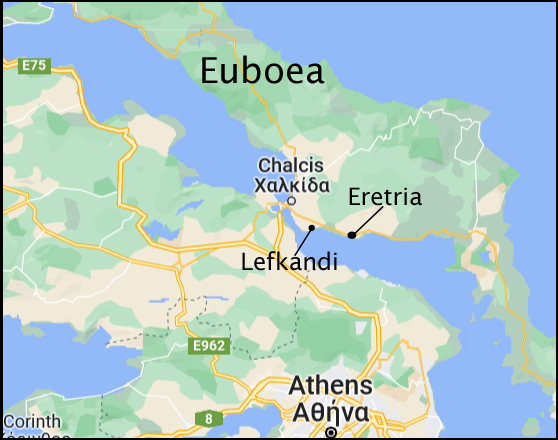
By the 8th century however, Greece comes alive once again. A major centre was on the island of Euboea, where a major site has been excavated at Lefkandi, lying between the two major towns of Chalcis and Eritrea. It was here that the first recorded war took place, the Lelantine war into which all the other major cities were drawn.
There must have been a major population increase, because settlements and burials suddenly become much more common. There is also a major change in ritual. Whereas at the beginning of the eighth century most bronze objects are found in burials, by the end of the century the fashionable thing to do was to dedicate bronze objects at some of the great shrines that were springing up, such as Olympia, Delphi or the Temple to Hera at Argos. In his pioneering book on Archaic Greece, Anthony Snodgrass argues that this must mark a major shift in belief systems – a change from individualism – taking your wealth to your grave – to a more collective belief that offerings should be made to the great shrines.
Homer
The new era is marked by the emergence of Homer. With Homer, Greece announces that it has become a major player on the world stage, capable of producing two of the greatest epics in the repertoire of world literature. In his two major works of the Iliad and the Odyssey, Homer looks both backwards and forwards. The two epics were set in the lost world of Mycenaean Greece, recalling the Trojan wars when the Greeks sailed to Troy to avenge the rape of Helen and spent ten years besieging and eventually capturing Troy. The siege of Troy is usually thought to have taken place around 1200 BC, but the Homeric epics were composed at least 400 years later. However they are set firmly in a heroic Bronze Age when heroes fought individual battles and the weapons were all of bronze. Occasionally Homer slips up and reveals he did actually know all about iron.
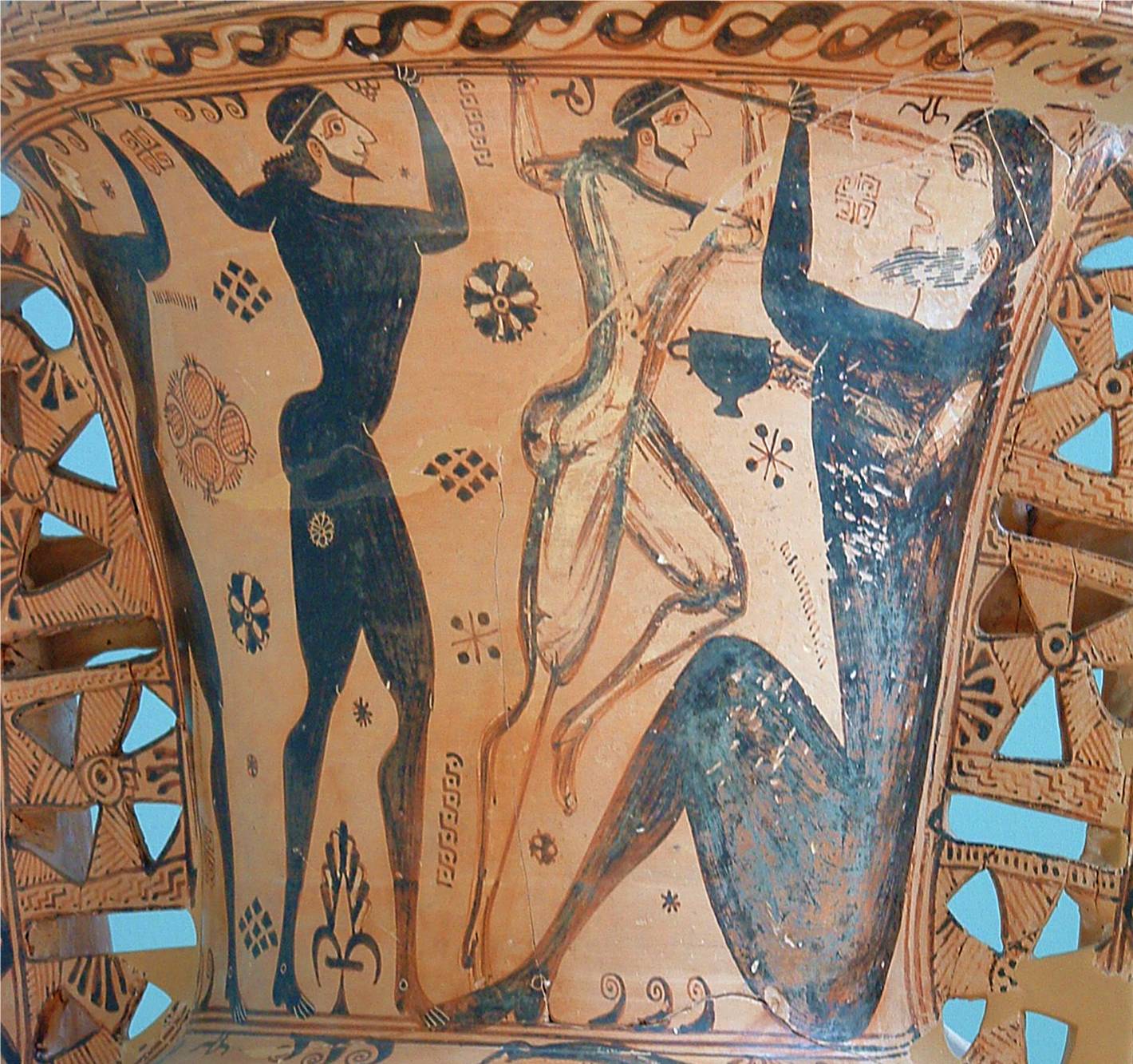
The classic example is in the Odyssey where Odysseus finally defeats the man-eating Cyclops by driving a stake into his only eye. The stake has been heated up and when it is driven into his eye, it hisses “as when a weapon is plunged into water to temper it” – and this is a technology of iron, not bronze.
But the geography is the geography of the Mycenaean era. The most boring part of the Iliad is the catalogue of ships in Book 2, when Homer lists all the ships that sailed from Greece to the siege of Troy. But when archaeology began to establish the reality of Mycenaean Greece, it was realised that the catalogue of ships was a catalogue of Mycenaean Greece and not of classical, or indeed of archaic Greece. It has become the classic example of how in the world of traditional epics, information can be transmitted over a period of at least 400 or 500 years.
But Homer also looks forward, not least in his mastery of dramatic style. The Trojan wars played out over ten years, but the Iliad is compressed into just a couple of weeks, with the story of the Anger of Achilles. Achilles was the foremost warrior of the Greeks, who quarrelled with the king, Agamemnon, over a girl. He goes off in a sulk, but is eventually lured back, and fights and kills the leading Trojan warrior Hector, and the story ends with Achilles giving the body of Hector back to his father, Priam. The Odyssey takes longer, following the journey of Odysseus from Troy back to his homeland in Ithaca, a journey which took ten years of prodigious feats. However the major section is again compressed into little more than forty days when he finally arrives back in Ithaca to find that his faithful wife Penelope is plagued by suitors and then in a James Bond style finale he slays all the suitors and is finally reunited with his ever-loving wife. In both epics, Homer displays a mastery of dramatic style which is far superior to most other ancient epics, compressing and organising the action into a firm drama. It is a brilliant foretaste of the feast that is to come.
Homer is surrounded by scholarly debates, one of the biggest of which is when was it written down: how far could two such vast epics be memorised by a single man? Much of the detail consists of formulas, but it is put together in a very coherent style. When was it first written down? Which leads us into another big debate – when was the Greek alphabet invented?
The Alphabet

The Greek alphabet was an invention almost as important as the invention of money, for the Greek alphabet was the first and with its derivatives remains the only true alphabet. As such, it marks a major step forward in producing a democratic system of writing: that is a system of writing that can be understood not just by professional scribes but by the whole population.
The great invention of the alphabet was that it has separate signs for both vowels and consonants. Writing can be divided into three different systems or levels: the earliest system, characterised by the Egyptian hieroglyphs or indeed Chinese writing, is where each individual word is represented by its individual sign. It is a complicated system and one that means that Chinese will never become a world language because its writing is too difficult. The average Chinese child does not learn to read until the age of ten because reading involves learning at least 2,000 different signs.
The next stage is the syllabary where each sign represents a syllable, that is a consonant and a vowel. The cuneiform writing of Mesopotamia is essentially a syllabary, though the best known example is now Minoan Linear B which has about 80 basic signs. The Greeks adopted their alphabet from the Phoenicians’ syllabary, but they improved it by adding separate letters for their vowels, thus producing an alphabet of between 20 and 30 signs from which the Latin Alphabet and then our own alphabet have both evolved. It was a great invention. With only 26 letters, it can be learnt even by a child of 5, and we can therefore expect that the whole population will be literate.
From this, two or rather three big debates emerge. When did Homer live? When was the alphabet invented? And how big was the gap between the two events? These are major scholarly debates into which I do not intend to enter. Suffice it to say that the balance of opinion seems to suggest that Homer (probably a single person) composed both the Iliad and the Odyssey sometime around 750 but they could not have been written down until about 100 years later. There must have been oral transmission for at least 100 years. Possibly the Athenian tyrant Peisistratos may have made an attempt to rationalise the different versions and write them down. The cynic might add that the texts of Homer that we read are those established by the librarians at Alexandria in the second century BC who collected all the many different versions of Homer in circulation, and produced an authorised version. However they emerged, the epics of Homer are masterpieces.
One might mention briefly that there was another poet, Hesiod who wrote the Works and Days, a farming manual later imitated by Virgil’s Georgics. This is a bit gloomy at times and definitely not heroic, but it gives an account of what life was like in archaic Greece. He is generally considered to be a little later than Homer, but he throws what is probably a more realistic light on life in archaic Greece.
Greek Colonisation
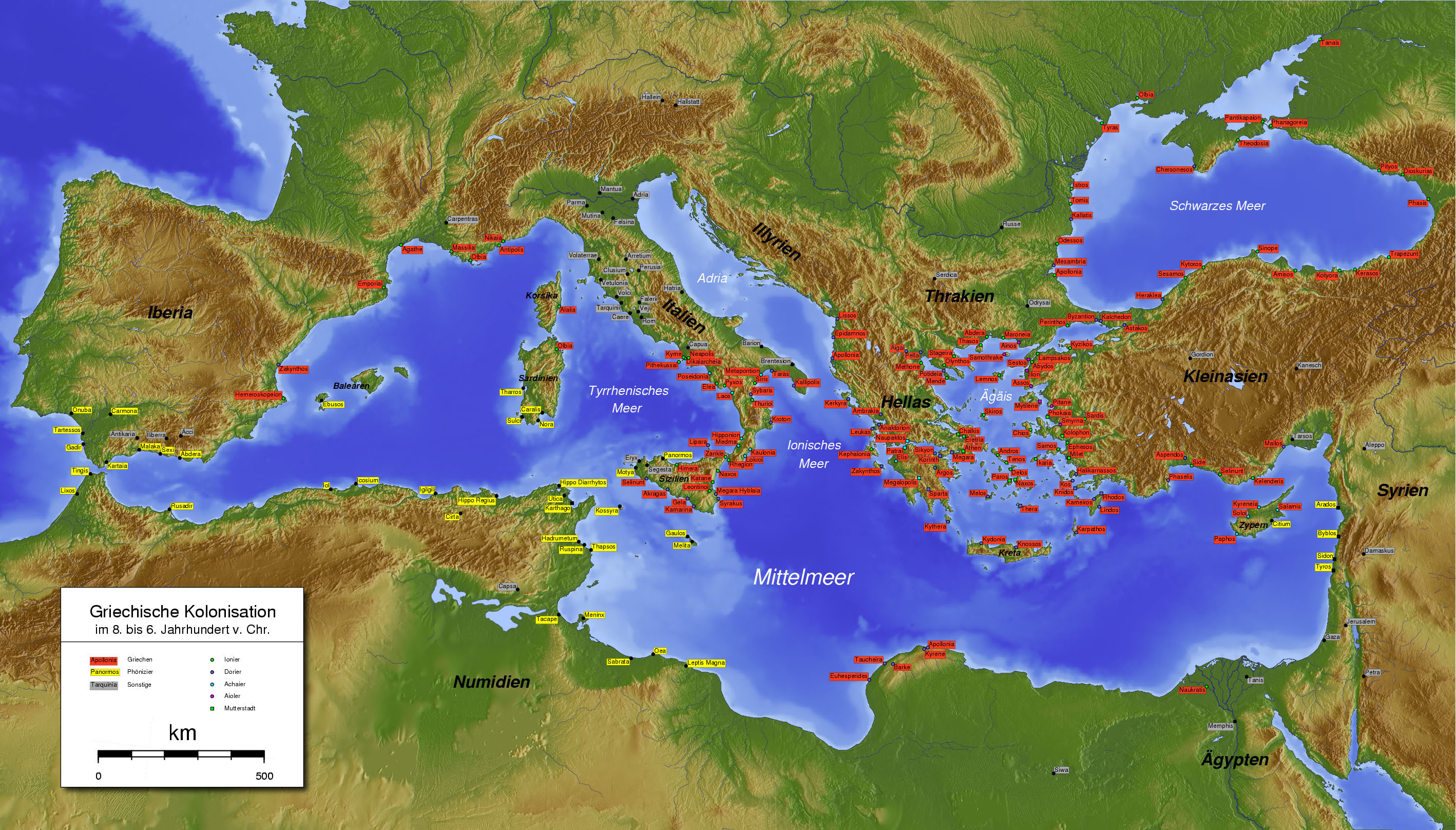
Another major episode in the story of archaic Greece is the strange phenomenon of Greek colonisation. For several hundred years, from around 750-500 BC, the Greek cities sent out colonies all over the Mediterranean and the Black Sea which in effect doubled the size of the Greek world; some of the earliest went to Sicily and south Italy where they founded towns such as Syracuse, Sybaris, Tarentum and Naples. A second surge sent colonies all around the Black Sea to Byzantium, Olbia, and Sinope; others were sent out more widely to Egypt (Naucratis the antecedent of Alexandria), to Cyrene in Libya which cultivated a plant called silphium which was valued as a contraceptive – the ‘pill’ of the ancient world which was harvested so extensively that it became extinct. Colonies were even sent out to France, to Massilia, modern Marseilles, and to Agatha Tyccche (“Good luck”) , modern Agde, notorious for its nudist beach – which the Greeks would have approved of. At the same time the Phoenicians were colonising along the north coast of Africa to aid their trade of copper from Spain to the Assyrian empire.
The reasons for this outburst of colonisation are difficult to determine. The first essay when studying Greek history at Oxford (“Greats”) is traditionally on the causes of Greek colonisation. This is a typical Oxford question because in the best Oxford style, it has no answer. I failed miserably because I tried to attribute it to trade, which is definitely the wrong answer. The sites may have been spied out by early traders – there is an early example of a possible trading centre at Pithekoussai, in the Bay of Naples – but apart from this, there is little evidence for trade between the colonies and their mother cities. The best answer, or one should perhaps say the least bad answer, is that it was a combination of push-me-pull-you. Population was expanding and there was a belief that there was not enough land in the homeland. There was also a major clash between rich and poor and the poor were suffering, and the idea of seeking a new life in a new country, free from debts and poverty seemed very attractive.
The colonies were sent out under a leader who was responsible for laying out the cities and allocating equal plots to all the colonists. They had to stay away for five years but if after five years the colony failed, they could return home, though they never did. By and large the colonies were very successful, some of them, Naples, Tarentum, Syracuse and Byzantium being great cities even today. One should perhaps realise that colonisation goes in spasms. One thinks of the migrations of the Germanic peoples that took place at the end of the Roman Empire, or the colonisation in the 15th – 18th century when Europeans, particularly the British, colonised the Americas, Australia, New Zealand and less successfully South Africa and India; or indeed the colonisation that is taking place today as peoples from unhappy nations seek to colonise Europe and America; while some prehistorians at least wonder whether the Beaker episode in the Bronze Age was an example of a similar migration.
But the big change that was about to overtake Greece was the advent of money and it is to this that we must now turn.