Troy – The Myth and the Town
We have been looking at the Minoans and their splendid palaces, and their economy so very different from ours. In the next part of this book we come on to Greece and the very different story of money and freedom. Between them we have a long, long Dark Age, when gradually everything changed, and a new story began to emerge. But between them, standing at the beginning of this Dark Age and casting a long shadow through the darkness, is the town and the myth of Troy.
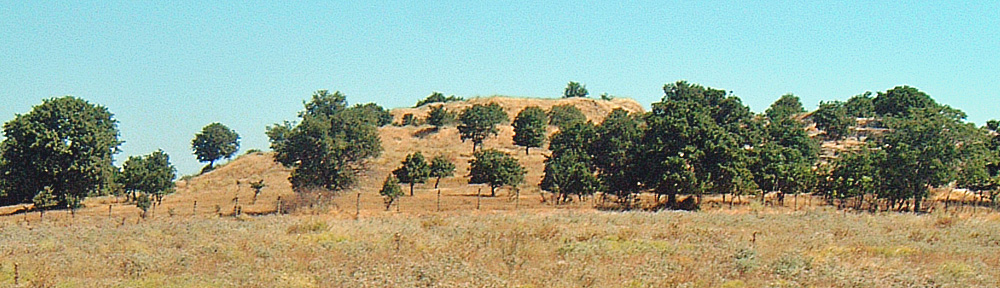
 The citadel of Troy with the walls excavated by Schliemann. Note in the top right the plain on which the battles were fought, and in the distance, the sea
Let us start by looking at the myth. The myth of Troy is a ten years long war that took place between the Greeks and the Trojans, which the Greeks eventually won by building a wooden horse in which Greeks were concealed, and thus broke into Troy. The myth came down through the Dark Age and emerged at the beginning of the new world of Greece, in the two great works of Homer – the Iliad and the Odyssey. Homer, whoever he was, was the successor no doubt of a long line myth makers, and was too clever to try to tell the complete story of the war, and the Iliad takes place over little more than a month at the end of the war. The Trojan War itself was told by later writers, notably the Roman poet Vergil who told the story of how one of the warriors, Aeneas, escaped from the sack of Troy and eventually went on to found Rome, which is an interesting piece of embroidery.
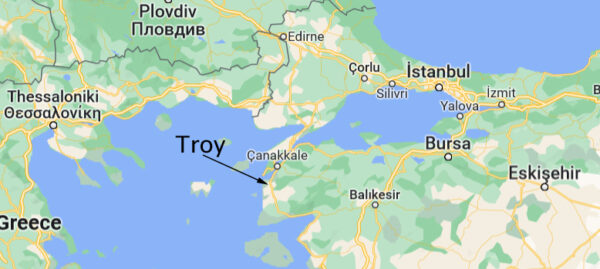
But Troy was not just a myth, it was also a town; it was a town situated in a highly strategic position at the mouth of the Hellespont, the narrow strip of water that links the Black Sea to the Mediterranean. It was a highly convenient position and ensured a wealthy living to whoever occupied it, whether as pirate, or traders, or a bit of both.
 The walls thought to be the walls of Homeric Troy
However the great sceptical German scholars in the 19th century, who doubted everything, doubted whether Troy ever really existed. But Heinrich Schliemann, a wealthy grocer who was considered terribly vulgar by all the scholars, took up the belief that the mound said to be Troy, really was Troy.
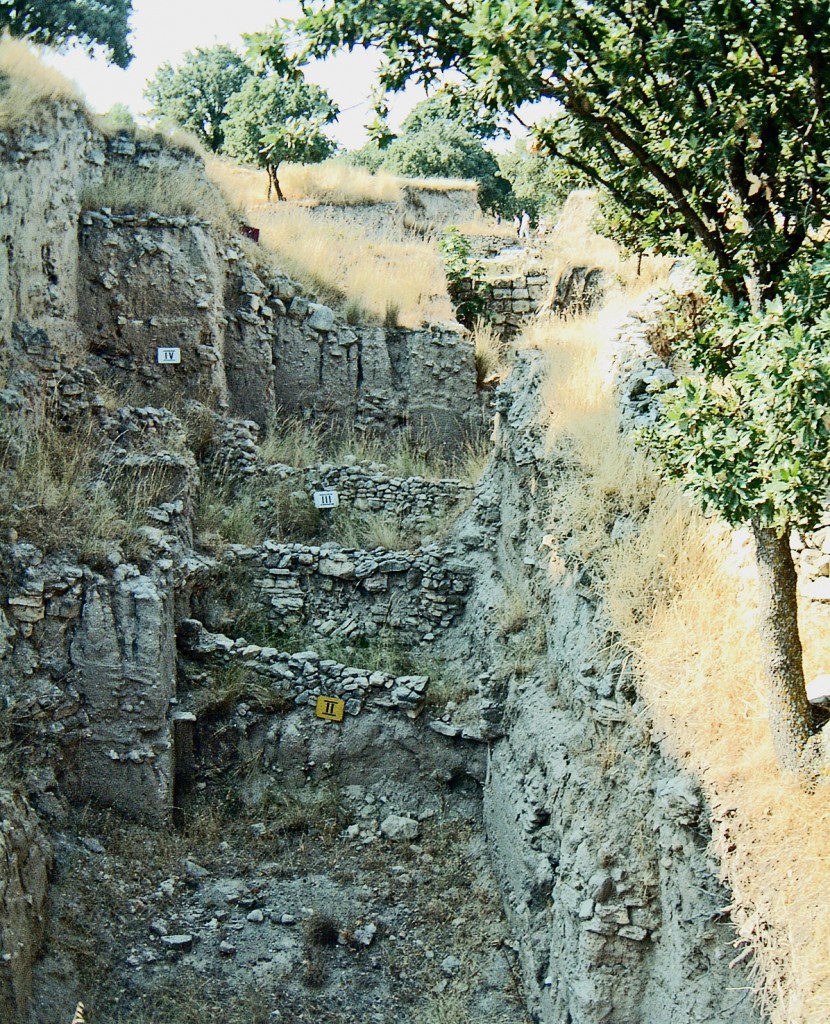
He succeeded beyond all expectation. He put a crude trench into the mound, and at the bottom found a treasure which he proclaimed to be the treasure of King Priam, the Homeric king of Troy. He was slightly out in his dates, – we now know that the treasure was 1,000 years earlier – but he triumphantly established that Troy was indeed Troy.
Perhaps fortunately for Troy, he then went on to dig Mycenae in Greece where Agamemnon, who led the Greeks against the Trojans was the king, by which time his archaeological techniques were slightly more sophisticated.
But archaeology has shown that Troy has a long, long story. It lies on the other side of the Aegean Sea in what is today the north western corner of Turkey. It lies in a crucial position at the entrance to the Hellespont, or Dardanelles, the narrow neck of sea that joins the Black Sea to the Mediterranean, thus throughout prehistory it was a crucial site.
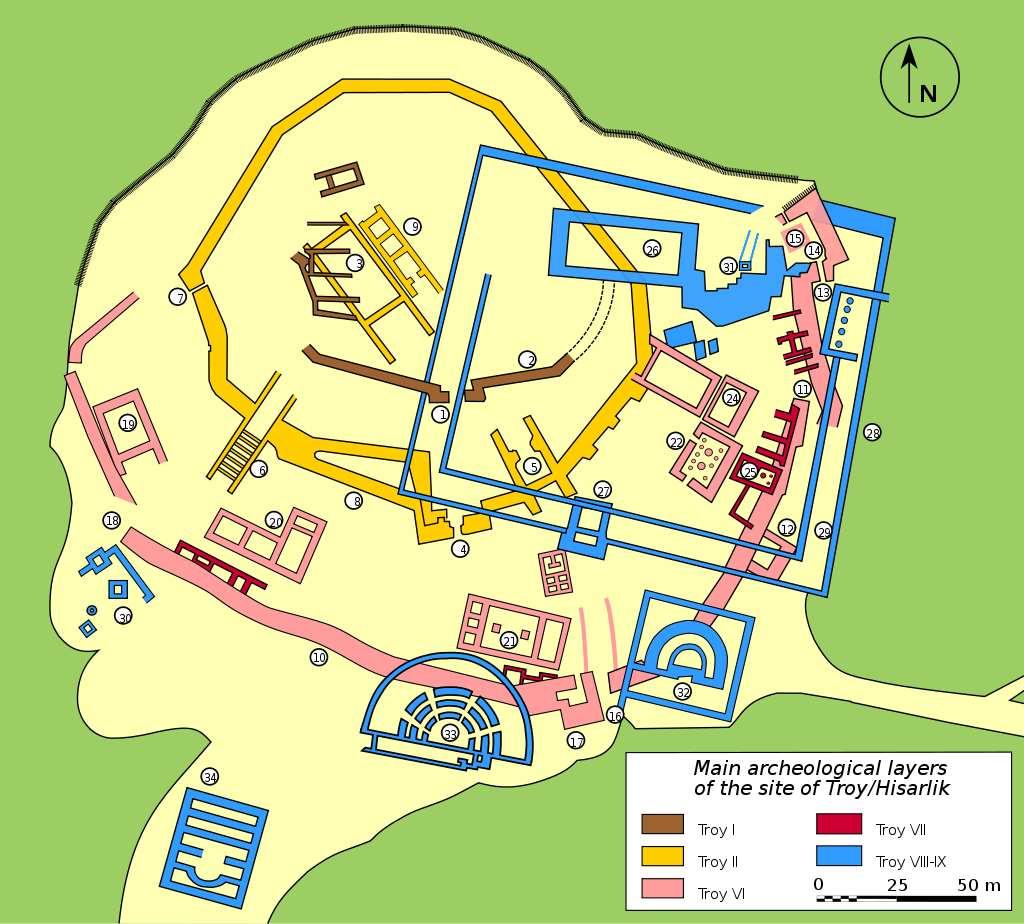
Troy was subsequently sorted out in the 1930s by the American Carl Blegen who established that there were nine successive cities in the mound, of which the 9th and uppermost was a Roman city catering for Roman tourists, while the Homeric city was Troy 7, and the treasure that Schliemann had discovered belonged to Troy 2, in the early Bronze Age. Subsequently it has been extensively excavated by a German team under Manfred Korfmann and American team under Brian Rose who was Blegen’s successor. They had been concentrating not on the mound that is usually considered to be Troy, but on the very extensive remains on the plain beneath where the extensive Roman town overlies an earlier town of Homeric date.

But how far was Troy in any way typical of the towns of the early empire? There are three major problems. Firstly, Schliemann’s huge trench through the mound destroyed a slice of the surviving evidence. Every archaeologist messes up on his first excavation: Schliemann excavated on a grand scale and messed up on a grand scale.
Secondly, the Romans decided to build a magnificent temple on top of the mound. The romantic scholars of ancient Rome always liked to believe that Rome was founded by the Trojans – Virgil’s Aeneid describes how the hero Aeneas left Troy and eventually arrived in Italy to found Rome, so they wanted to mark this by building a great temple and the foundations of this overlaid and destroyed whatever remained of the Homeric period palace.
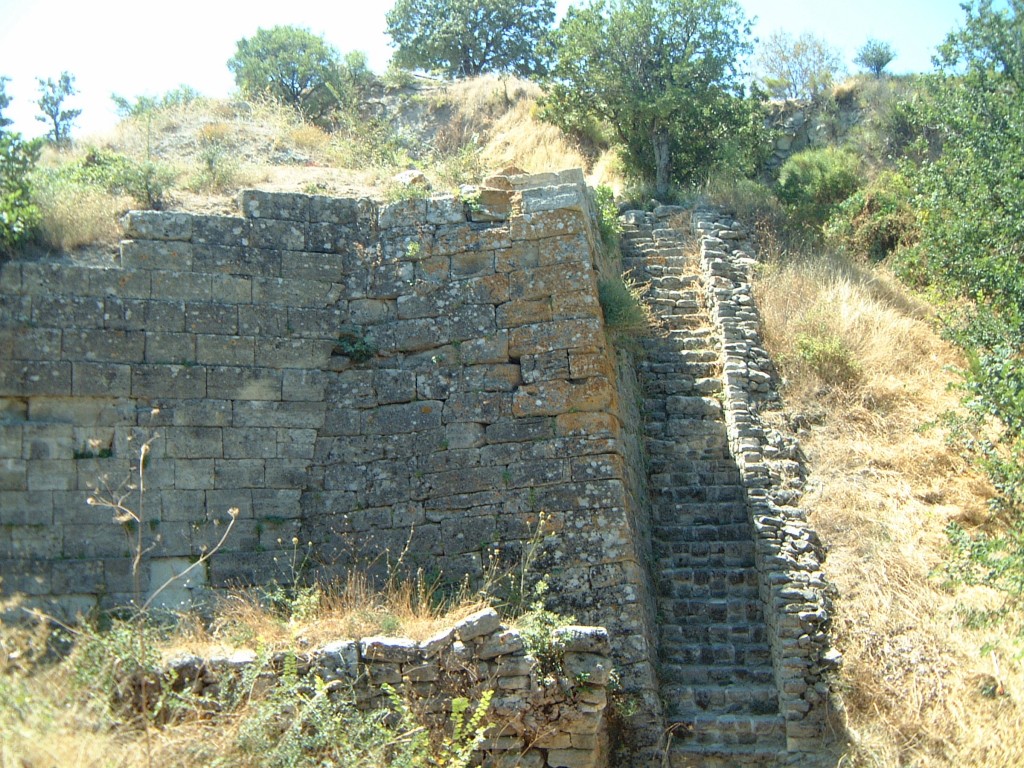
This staircase which runs incongruously down the outside of the ‘Homeric’ defences of Troy was built in Roman times to enable the priestesses, atoning for the sins of Ajax, to get into the city unseen by the statue of Athena.
And in any case Troy was not a typical Bronze Age town. It was perhaps somewhat grander than a mere pirate’s lair and it certainly grew up in a big way, layer after layer. But the Homeric stories have ensured that it has been one of the most extensively excavated and studied of all towns in the Eastern Mediterranean.
But the town of Troy is less important than the myth of Troy. How far there was a major expedition by the Greeks to exterminate their pirates there can never be proved. What is surprising was that the myth that arose lasted for 500 years. Much of the detail given in Homer reflects the world of 8th century BC, though the catalogue of ships which formed the expeditionary force showed the geography of the Mycenean world, so some at least of the Homeric classical story must have a base in the earlier world.
But Troy is a wonderful link between what archaeologists see as the late Bronze Age world of the Minoans and the early Iron Age world of the Greeks. It is the convenient point therefore to say farewell to the world of the Minoans and look forward to the new world of the Greeks – the world of money and of freedom.
On to The Greeks