
Religion
Compared to the other great empires of the Bronze Age, the Minoans were not keen on religion. Whereas in most of the other early empires, tombs and temples surpass in splendour the palaces, in Crete, it seems that much of the energy went into building the palaces. Nevertheless there was religion and we must consider the forms in which burials and temples took place.
Minoan tombs are miserable. Of course, Minoan tombs exist, but by comparison with other ancient societies, they are small and insignificant. The best are concentrated in the period before the palaces, when two different traditions developed. In the south, burials were made in small ‘tholos’ tombs, that is circular tombs often called bee-hive shaped tombs where the roofs curve in at the top. These are concentrated in the south, in the plain of the Mesara where between 1905 and 1918 some 15 tombs were excavated by the Greek archaeologist Stephanos Xanthoudides, whose findings still form the basis of our knowledge of these tombs. The main point to make is that they were used for collective burial, that is numerous burials were made one on top of the other. Possibly indeed the bodies were exposed elsewhere and it was only the bones that remained after exposure that were finally deposited in the tomb. But they seem to have been family tombs where generation after generation were buried in the same tomb.

In the northern part of the island however, burials were made not in circular tombs but in rectangular chests, rather like small houses, though again they were used for collective burial. Sometimes bodies were placed in a larnax, that is a pottery chest – such larnakes often form a fine display in museums devoted to Minoan archaeology. (Larnakes were also used for burials in Macedonia around the time of Alexander the Great, but that is a different story).
What is interesting is that the number of these burials seem to decline when the Minoan Empire was at its height in the period of the New Palaces. Grandiose burials only begin to reappear in the post-Minoan period, that is LMIII after the Mycenaeans had taken over and Mycenaean ideas with grand circular tholos tombs begin to be introduced and flourished briefly before both Mycenaean and Minoan empires collapsed into the dark ages. Archaeologists have sometimes wondered whether bodies may have been disposed of in another way, perhaps for instance by disposing of the body at sea. But it is only in the final period that rich burials resumed and these are of the Mycenaean type which is often taken to be evidence for the Mycenaean conquest of the Minoan Empire towards the end of its existence.
I sometimes wonder why it is that no-one seems to make the obvious speculation: does the emphasis placed on burials reflect the position of the ruler? Were the pharaohs in Egypt thought to be essentially gods and treated as such? And does the evidence of the Minoans prove the reverse, that their society was slightly more ‘democratic’? Democratic is the wrong word – but did the rulers of Minoan Crete remain human beings whose bodies after death were simply interred like other human beings in the family graveyard?
Minoan religion
Indeed what about Minoan religion generally? There are no temples as such in Minoan Crete, but who were their gods and how did they worship them? It is a question that can be approached in two different ways. On the one hand, Minoan gods did not live in temples but up mountains: at the top or near the top of many of the Cretan mountains, there are ‘peak sanctuaries’, where offerings were made and have sometimes survived. The most important of these peak sanctuaries is on Mount Juktas, 13 kilometres south of Knossos, and it is often thought that Mount Juktas must be associated with Knossos as its sacred mountain. Similarly at Phaistos, the dominating shape of Mount Ida, the tallest mountain in Crete lying twenty miles to the north west, lowers over the courtyard and everyone who visits the courtyard immediately comes to the conclusion that the courtyard must have been laid out so that Mount Ida can be seen behind the Ceremonial Apartments.
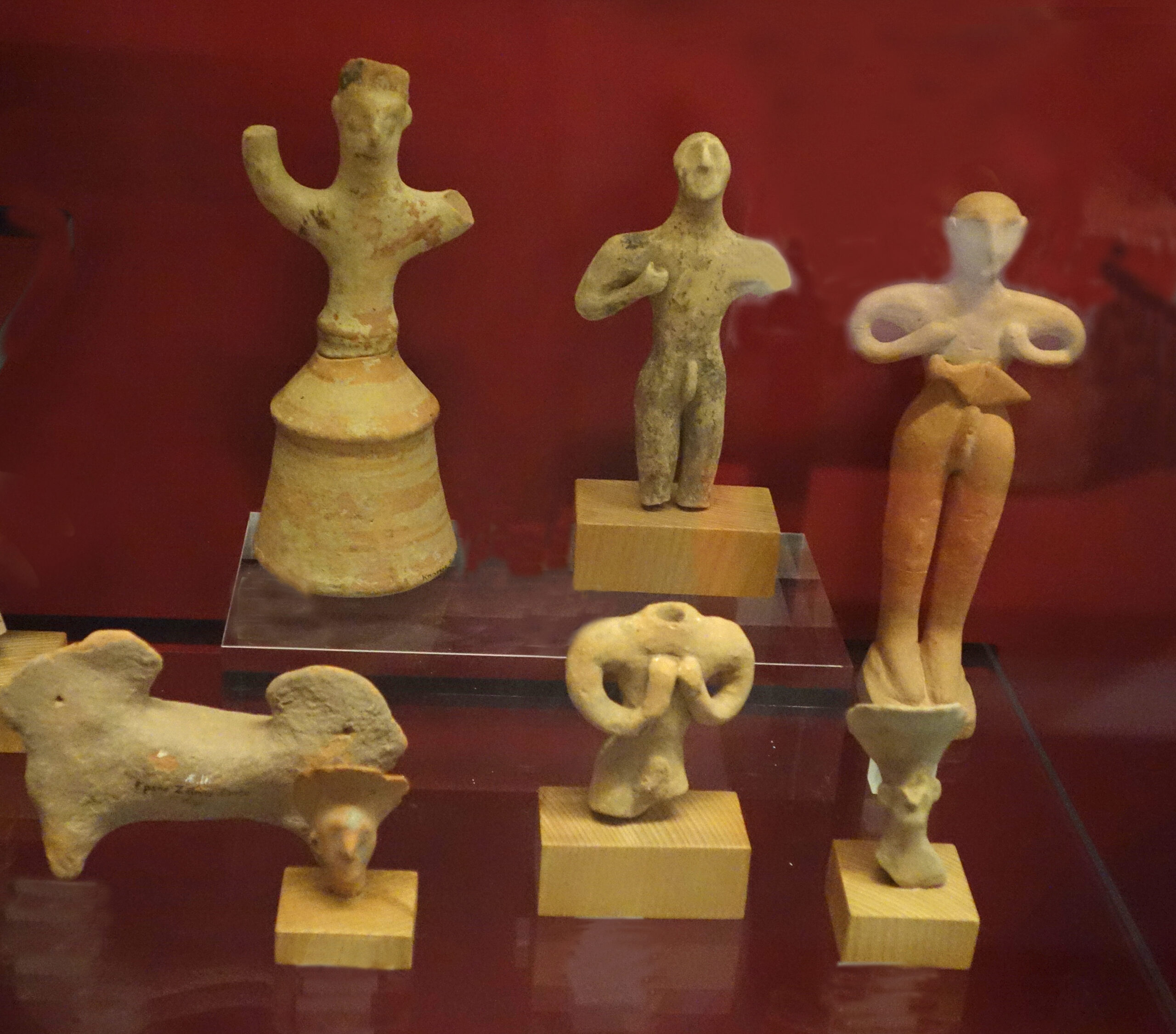
But the gods do not just live up mountains, they also live in caves, and in addition to the peak sanctuaries, there are also sacred caves. The richest of these is that at Psychro in central Crete, a very spectacular cave with stalactites and stalagmites galore. In 1896 – 1900 D.G. Hogarth and then Arthur Evans extracted many ritual objects, some of which are in the Ashmolean Museum. There are also two important caves high up on Mount Ida.
In a valuable little book on Peak Sanctuaries and Sacred Caves, Donald Jones lists twenty peak sanctuaries and eight sacred caves. The objects deposited there fall into four main categories: there are the human figurines, mostly made of clay, some of which have fancy coiffures and dress. Sometimes they are clay limbs, many of them legs, similar in a way to the limbs deposited in Catholic pilgrimage churches in thanks for the limbs being cured.
There are also numerous clay figurines of animals, particularly bovines, that is bull, ox or cow, as well as an array of other species: goats, birds, pigs, dogs, beetles and snakes. There are also bronze artefacts, notably bronze double axes and occasionally other weapons. There are also stone artefacts in the form of altars and offering tables, while ashes, presumably the remains of cooking fires, suggest that ritual feasting may have taken place. There is also pottery, both coarse cooking pots and sometimes the very exclusive pottery known as Kamares ware.
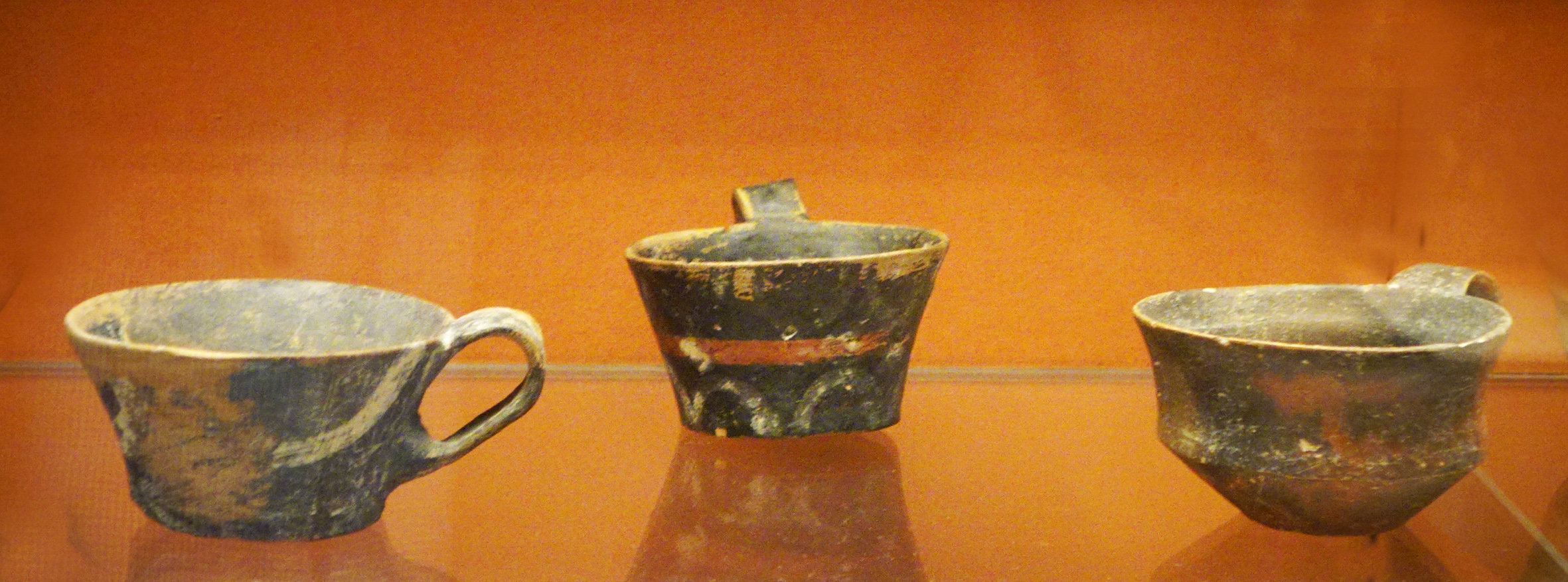
Two of the best-known caves are high up on Mount Ida, within sight of the Phaistos palace. One is the Idean cave which is sometimes claimed to be the birthplace of Zeus, where offerings were made right down into Hellenistic times. The other is the Kamares cave where a large number of ritual cups were found which have been named Kamares ware after the cave. They were made in the Early Palace period, and are very distinctive being covered in a black glaze with red or white decoration. But they are very small, sometimes not much bigger than a big egg cup: I am reminded of the tea ceremony in Medieval Japan where similar sized cups were used of a similar thinness. It is often thought that Kamares ware pottery must have been made in the imperial workshops at Phaistos and were then distributed to the other palaces, presumably in a gift exchange cycle and were then used in some elaborate drinking ceremony – probably wine rather than tea.
Of course the major evidence for religion, or should we say ritual comes from within the palaces themselves. There are sufficient small figurines to confirm that bull leaping played a major role in Minoan ceremonies and so too do the bare breasted ladies, and if the bull leaping really did take place in the central courtyard, then it would have been observed from the upper floor – which Evans called the piano nobile in the restorations at Knossos.
A big change in the interpretation of Minoan ritual comes with the recognition of the ‘Minoan halls’ and the recent re-interpretation of the ‘King’s megaron’ as being ‘Minoan halls’. Then there is the fascinating theory that the pillar and door stones represent sliding partitions and that this may give an explanation for the origin of the labyrinth as being places where visitors were taken in by one route, and then the partitions were changed and they came out by an entirely different route. It’s a very nice theory and I like it.
.
And then there are the Lustral basins, so-called by Evans, which are found consistently as part of the ceremonial rooms and presumably represent a purification ritual, though they are very small, and it must have been a very private ritual.
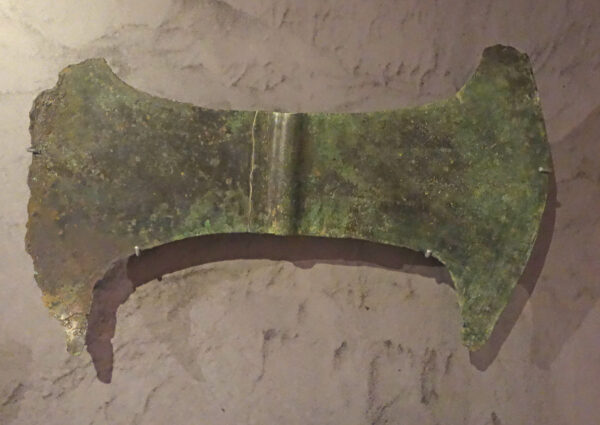

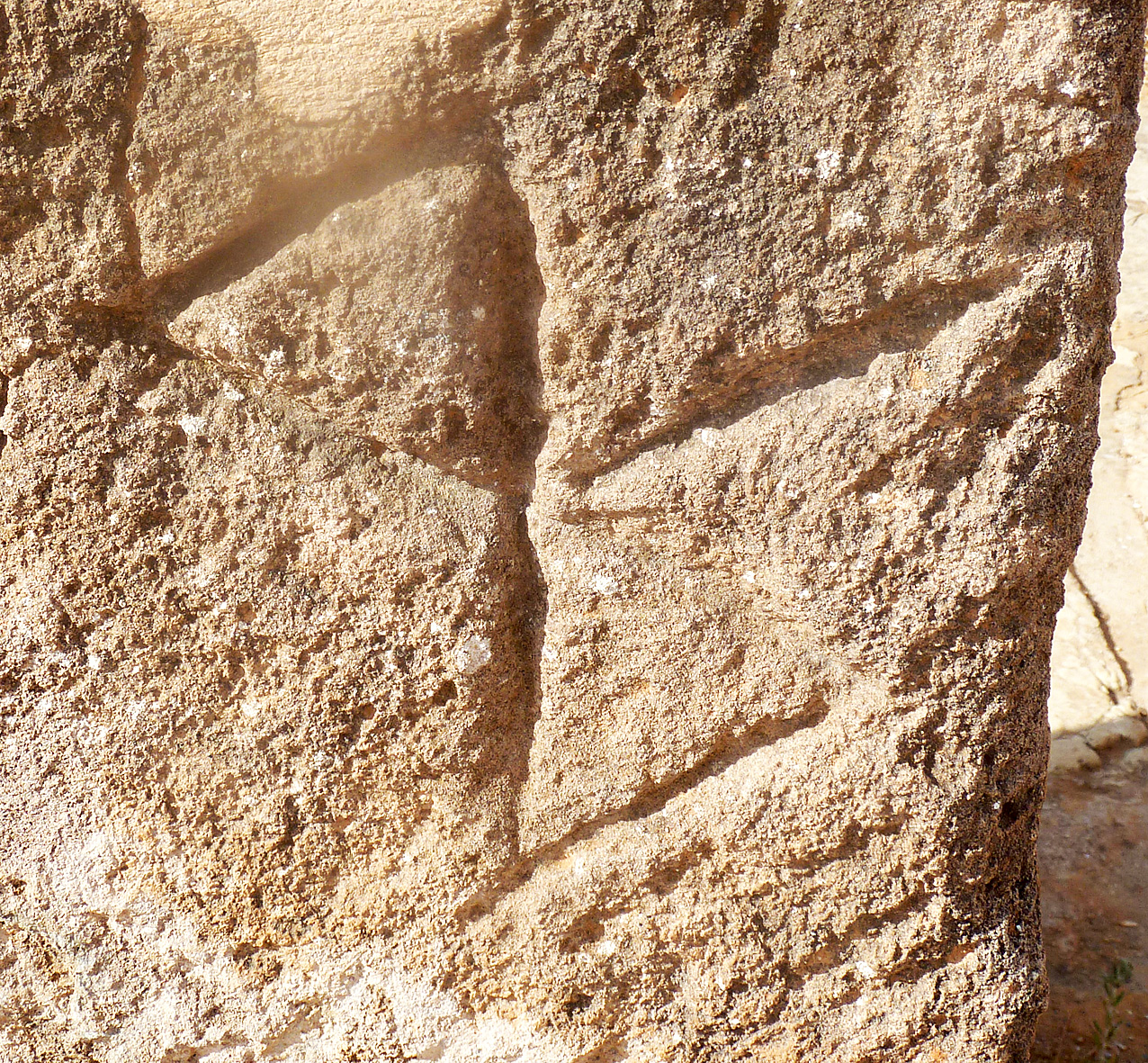
Two more features may perhaps be noted, firstly the pillared halls, or crypts, with one or two or more pillars at the centre. There is a good example at the Palace at Malia. Finally mention should be made of the various symbols that are found scratched in the ritual places. The most notable is the double axe symbol, which to us cynically looks like an egg timer, but real double axes have been found and it is clear that the double axe was a major focus of ritual or ceremony and perhaps even served a grim function in the ceremonies.
There is thus a fascinating collection of material from the peak sanctuaries and caves, and from the palaces themselves, though it must be admitted that when all added up, there is miserable evidence for Minoan religion, particularly when compared to the pyramids of Ancient Egypt or the ziggurats of Mesopotamia. Perhaps in our atheistical 21st century, this is a plus point for the Minoans, in that they did not waste too much time and energy on religion; or is it just that the evidence has just not been preserved, or that we are looking in the wrong places?
Minoan Art
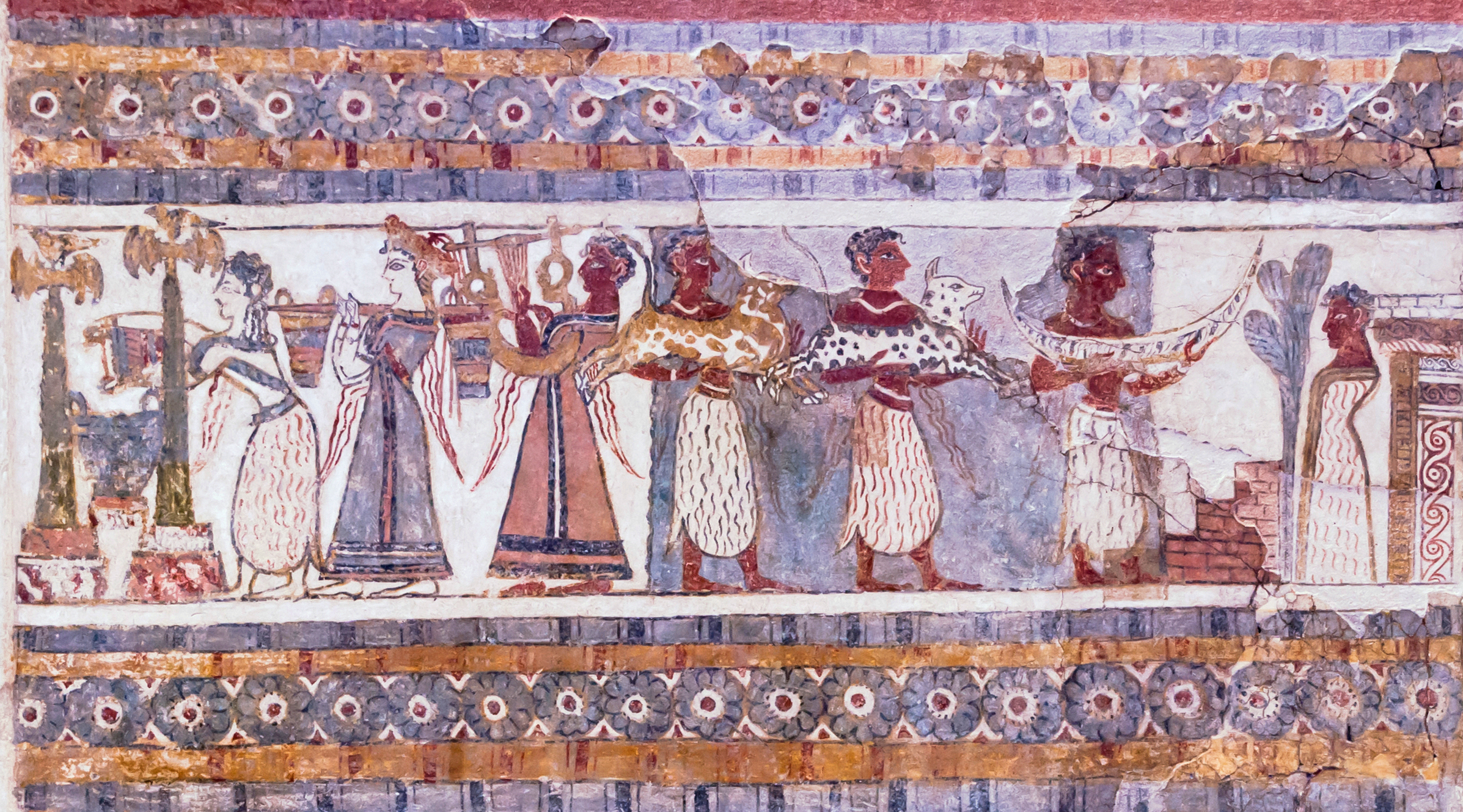
The Hagia Triada sarcophagus
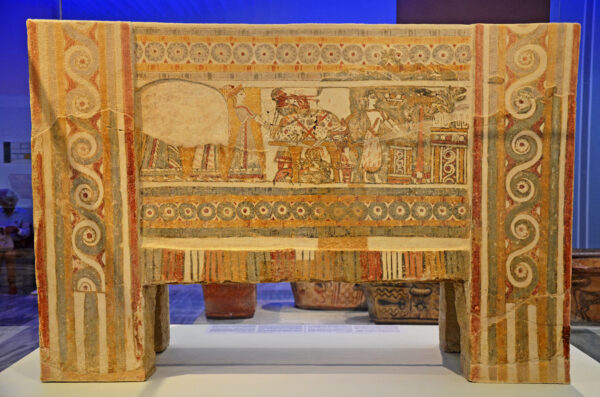
The finest example of Minoan artistry is the Hagia Triada sarcophagus – often spelt Ayia Triada. This was found in 1903 in the vicinity of Hagia Triada and was made up of limestone coated with plaster and painted in fresco.
It is dated to around 1400 BC after Crete had been taken over by the Mycenaeans, and combines the Minoan style with those of the Mycenaeans and Egyptians
This shows on the right, the owner of the tomb standing in front of his tomb and receiving a model of the boat which will take him to the next world – Egyptian influence here – and two animals, presumably bulls to be sacrificed.
Then on the left is a woman pouring from a bowl into a tripod set between two pillars surmounted by the ritual double axe. Behind her, two more women bring vessels presumably containing bull’s blood to be poured as sacrifices. At the centre is a musician playing a lyre: the whole ceremony is accompanied by music.
And now, having considered the archaeology that made up the Minoan civilisation, it is time to move on to the other remarkable source of evidence about the Minoans, that is their script, Minoan Linear B and find out how it was deciphered and what it tells us about Minoan society.