Trajan and Hadrian

The 2nd century AD is dominated by four ‘good’ emperors: the first was Trajan who came to power nominated by the short-lived Nerva as being a rising young man with a good military background: Trajan did not disappoint. The trouble with Trajan was that he was a military man who still believed that it was the duty of an emperor to expand the Roman Empire, even though Augustus had more-or-less said that the Empire should not be expanded. And his main effort was expended on conquering Dacia.
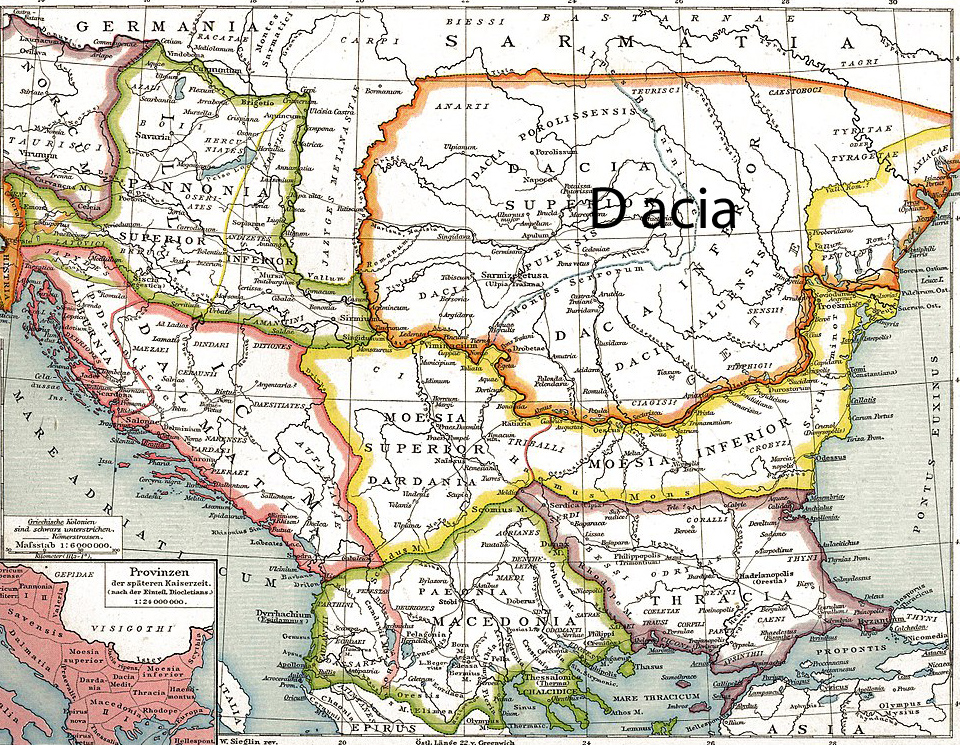
Dacia is modern Romania, but the main thing to know about it is that it was north of the Danube, and the obvious boundaries of the Empire were formed by the rivers Rhine and Danube. But in Dacia, the Dacians under their king Decabulus, were forming a very successful proto-nation with rich gold mines: artistically the Dacians come between the Celts and the Scythians and have some very nice art too.
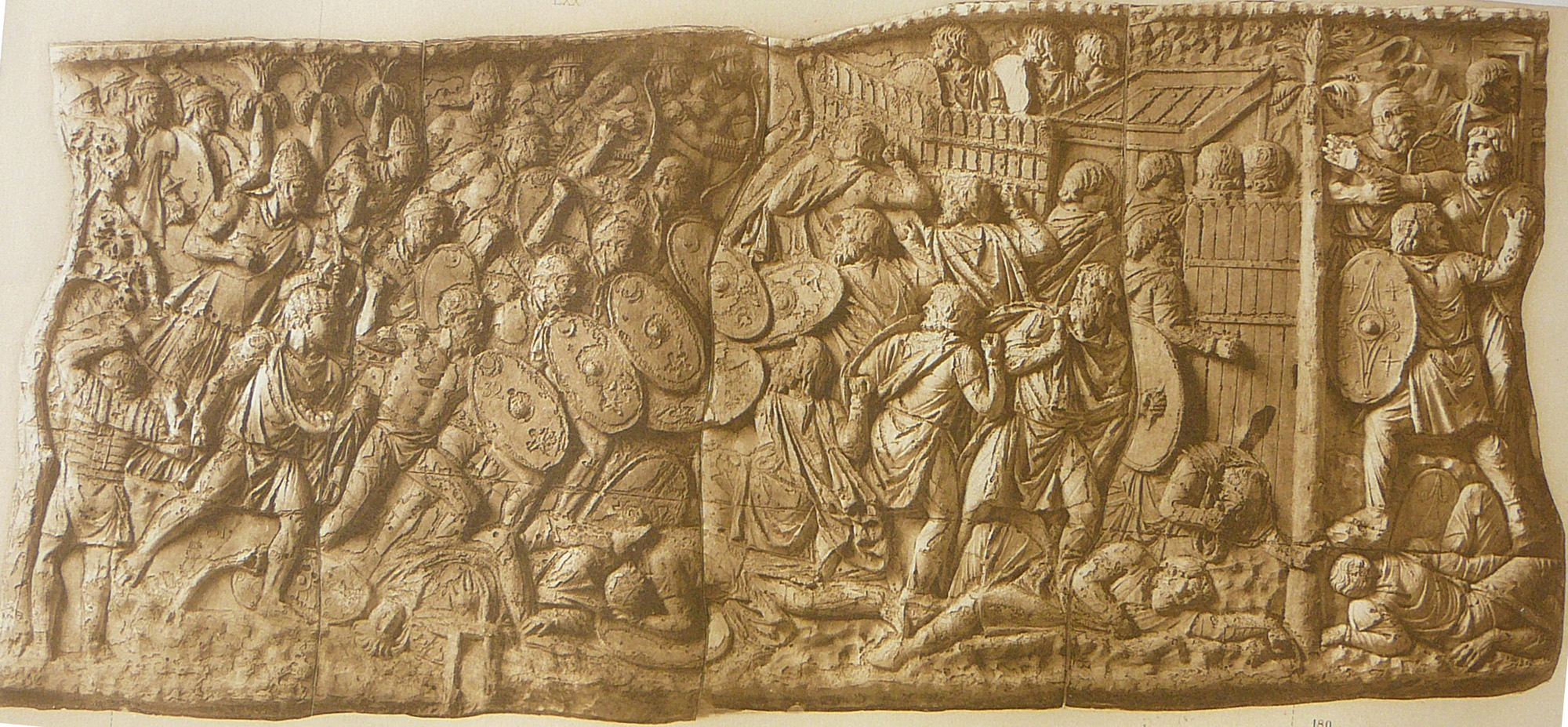
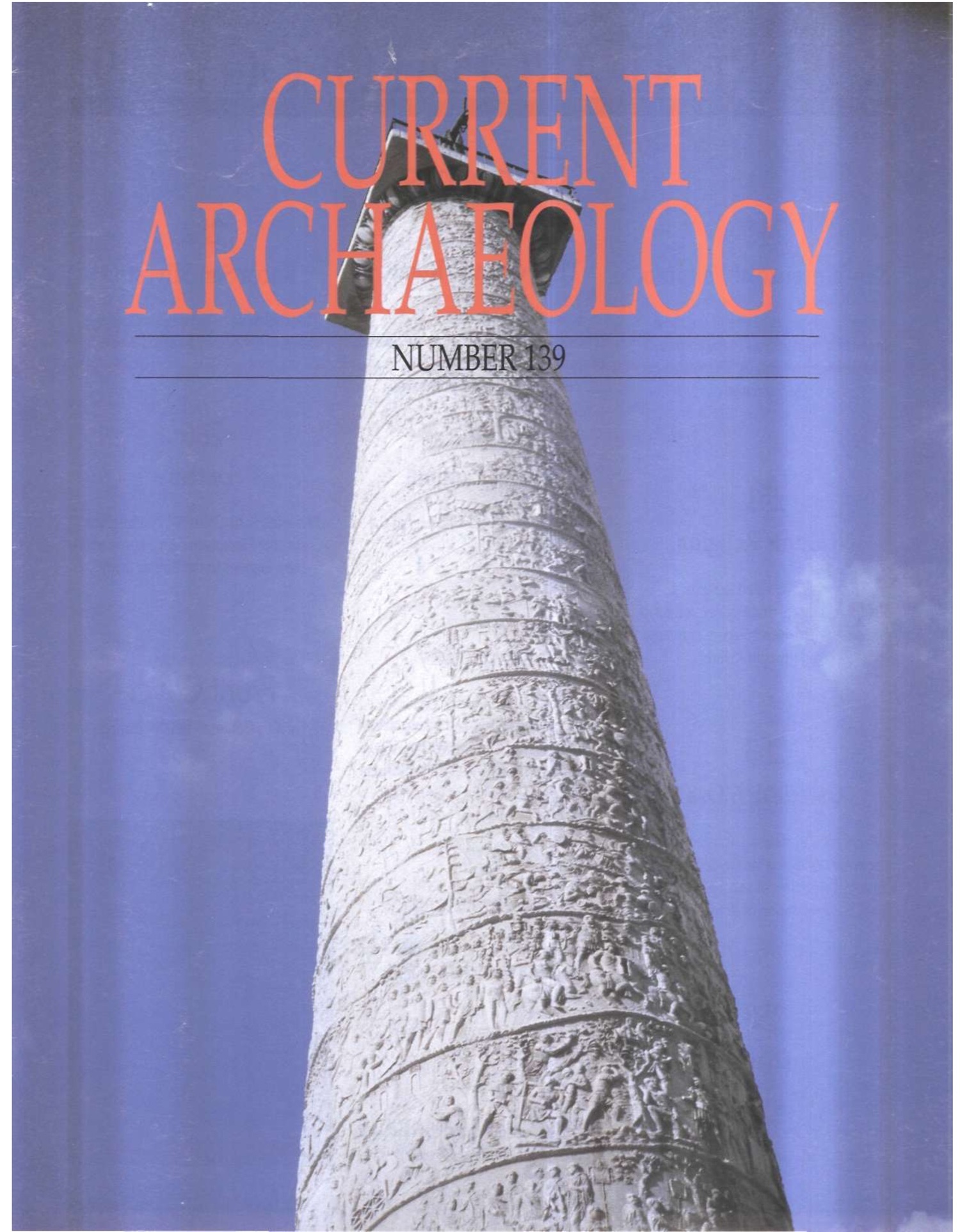
But Trajan decided to conquer them and eventually in two mighty campaigns, he succeeded. He erected a column in Rome on which he recorded his exploits. It still exists and forms the basis of much of our knowledge of the Dacian wars, and indeed of how the Romans waged war.
And then there are Pliny’s letters. Pliny the Younger is one of the great Roman authors of the 2nd century AD. His uncle Pliny the Elder was the great encyclopaedist whose natural history forms the basis of our knowledge of so many of the oddities of the Roman world. He died trying to rescue the inhabitants of Pompeii from Vesuvius, and being childless he left his wealth to his nephew Pliny the Younger. The younger Pliny was an aspiring politician and author who left behind him ten books of his letters of which the most interesting is the tenth book consisting of his correspondence with the Emperor Trajan.
Pliny was in many ways the opposite of Trajan. Trajan was a military man, Pliny was a civilian man who dutifully ascended the cursus honorum, the ladder of posts that led up the Roman civil service, and he duly ended up as being governor of Bithynia, a minor Roman province in modern Turkey, just beyond Constantinople. He kept all his correspondence with Trajan and Trajan’s replies, which he published to our great edification. Mostly Pliny asks dutifully ‘Sir, this town wants to build a new theatre. Should they be allowed to do so?’ and Trajan replies slightly exasperatedly ‘ my dear Pliny I leave this up to you. See that they can afford to do so, but do not stand in their way’.
The most famous letter concerns some Christians who had been brought up before him, and he wasn’t certain what to do. He had interrogated them and given them the opportunity to renounce Christianity three times. If they still persisted in their beliefs, he ordered them to be executed, believing that, whatever the nature of their creed, their stubbornness surely deserved to be punished.

He then went on to say that the substance of their error was that they were accustomed to meet on a fixed date before dawn, when they sing hymns and bind themselves not to commit fraud, theft or adultery. And when this was over, they assemble again to partake of ordinary and innocent food. He went on to say that the contagion of this superstition has spread not only to the cities but also to villages and farms, but as a result of his actions, the established religious rights are being resumed and that the price of sacrificial animals was increasing.
Trajan replies briefly that Pliny had observed the proper procedure and as if they are proved guilty they are to be punished, though they can nevertheless obtain pardon through repentance. He concludes by saying that anonymous accusations are a dangerous precedent and are out of keeping with the spirit of our age
This is the first reliable reference to the Christians, so the letter is much studied. But the letters as a whole form a wonderful treasure trove of how the Roman system actually worked.
Hadrian
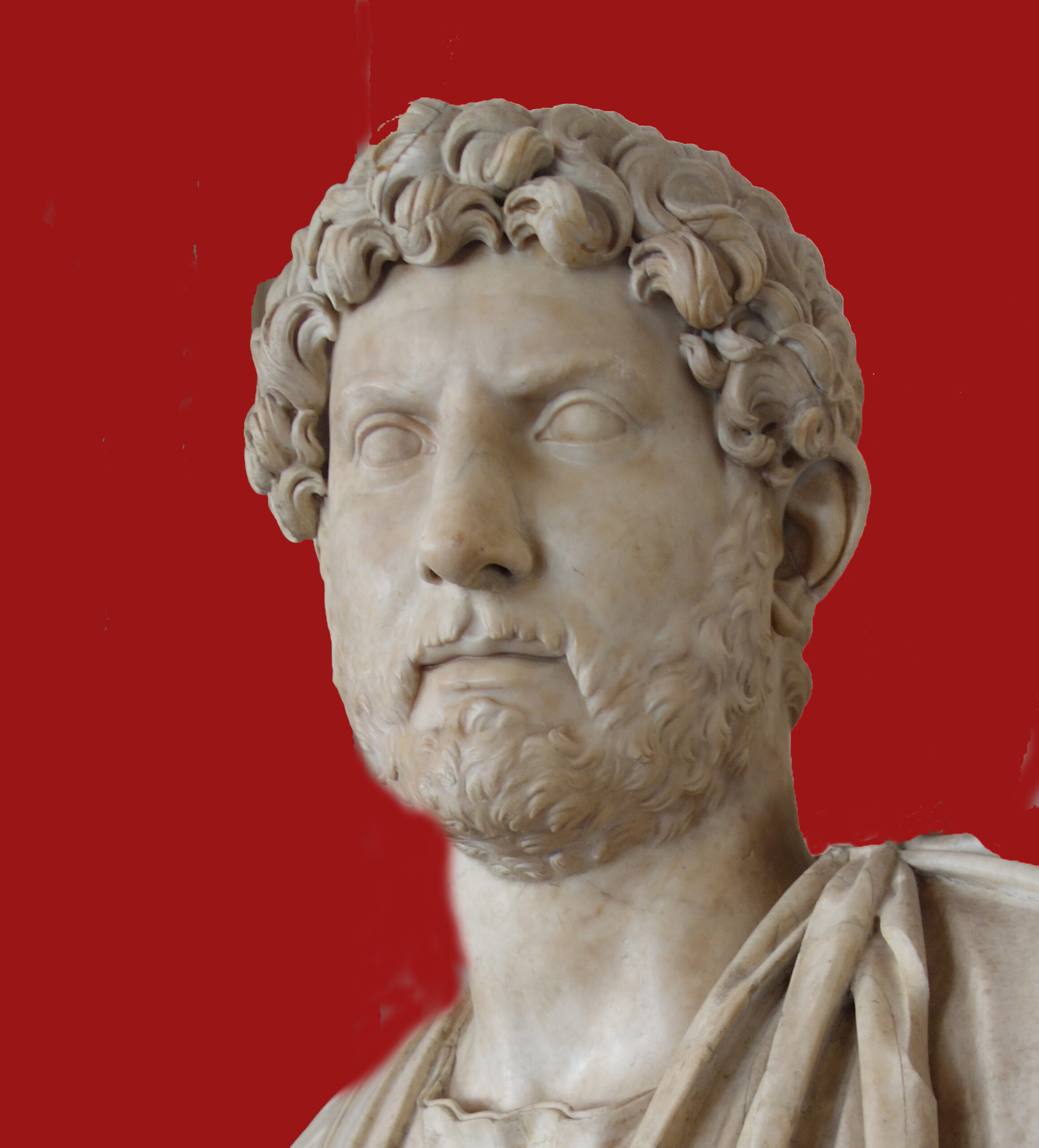

Trajan was childless and died somewhat unexpectedly at the age of 63, having adopted another up-and-coming Spaniard called Hadrian as his successor. Hadrian is in many ways the most impressive of the Roman emperors after Augustus. He was a man of frantic energy, always on the move, travelling and building. There is a little piece of Latin doggerel addressed to him by a friend:
Ego nolo Caesar esse,
Ambulare per Britannos,
Scythicas pati pruinas …
I would not want to be Caesar, trudging my way through the Britons, suffering the Scythian frosts.
However he got off to a bad start when he had four senators executed who were suspected of being his rivals. The senate was appalled, fearing that there was going to be another reign of terror, but Hadrian assured them that he would not put any senator to death without the approval of the senate. But subsequently, Hadrian and the senate never got on very well.

But he had frenetic energy and was always travelling. Indeed, he made two long journeys when he was away from Rome for two or three years. The first was between 121 – 125 when he began by going north to see the armies in Gaul and in Germany. He had already proved himself as a fine general under Trajan, but he enjoyed being with the soldiers, camping with them and sharing their food and reorganizing their exercises and drill. He then went north to Britain where he organised the construction of Hadrian’s Wall. He had been overseeing the construction of a timber wall in Germany, but Hadrian’s Wall was to be built in stone as the prestige project it has remained ever since. He then went to Spain where he spent the winter at Tarragona, and then went via Africa to the East Mediterranean to Syria and Asia minor, and went to Greece. He loved Greece, he was a philhellene and was known as Graeculus – the ‘little greekling’ and while in Greece he was initiated into the Eleusinian mysteries.
From 128 – 122 he made a second long journey to Africa, Greece and Syria, and then to Egypt where he went down the Nile, and where his lover Antinous was drowned. And then back home via Greece again.
In his foreign policy he revived Augustus’s policy of accepting that the empire had reached its maximum sensible size, and he should not try to expand it. Indeed he began by sorting out the East and giving up Armenia and Mesopotamia to the local rulers. It was a move that was unpopular to some of the military men in Rome, but it proved to be very far looking. He followed this up by establishing boundaries, as in Germany, and most notably in Britain, while a defensive line was also established in Africa.
However the end of his reign was marred by an exceptionally fierce and bloody war in Judea. In 132 there was a major revolt led by a messianic leader, Bar Kokhba, who proclaimed himself the ‘Prince of Israel’ and issued his own coins, indicating that he intended to be the ruler of an independent kingdom. He began by massacring a whole Roman legion and it was clear that he had to be put down. Hadrian went out himself in 133 but eventually a huge force of at least six or more legions was established together with marines and auxiliaries, and eventually Roman might prevailed and the Jews were exterminated: according to Dio Cassius, 580,000 Jews died. They were expelled from Jerusalem which was renamed Aelia Capitolina and they only managed to get back to Jerusalem in the 20th century. It was for Hadrian an unwelcome and bloody episode.
Hadrian the Builder

Hadrian was also a prolific builder – everywhere he went, buildings were constructed on his inspiration or orders. He fancied himself as an architect and designed new buildings everywhere. The biggest and most extensive is that at Tivoli, 20 miles east of Rome. Hadrian decided he didn’t like using the buildings on the Palatine as the seat of administration, so he decided to build a new palace from which he could run the empire. It is tempting to call it a Palace, but it is interesting to note how very different it was from normal palaces.
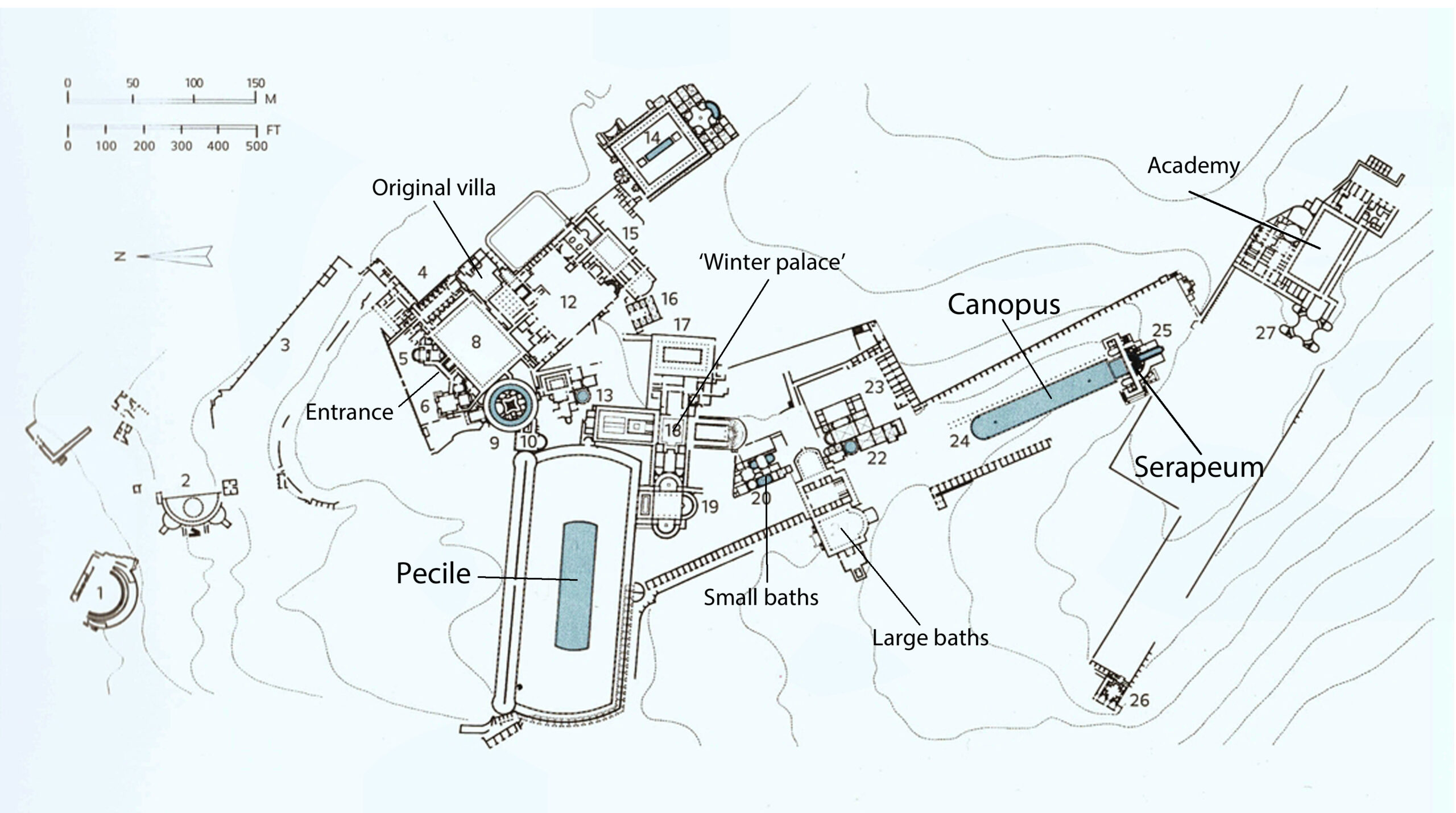
To modern eyes, it seems a complete jumble, with buildings laid out on at least four different alignments, but it appears to have been carefully designed. It began with elaborate underground passages through which the hundreds of bureaucrats and slaves could flit unseen from one building to another. He began by adapting the villa that was already there, which became the more private part. The entrance appears to have been in the north west, with a Greek library to one side and the Latin library on the other, Hadrian showing off his learning. This section was probably where Hadrian lived and had his offices.
Just beyond it was the first of the big spectacular structures, the Pecile, a vast rectangular court with a huge pool at the centre. The name, Pecile is a corruption of the Greek Poikile, from the Painted Stoa at Athens which became the art gallery of Athens. Hadrian’s version was surrounded by copies of all the most famous Greek statues. In practice, it seems to have been a sort of exercise area, a good place to go for your early morning trot, surrounded by Art. On the same alignment was an elaborate building that is often called the Winter Palace – no one quite knows what it was — perhaps overflow offices.

The most spectacular building – again on a different alignment – was the Canopus, a long canal which was meant to recall the River Nile, surrounded by Greek statues. At the far end was the Serapeum, the temple to the Egyptian god Serapis, which is interpreted as being a dining room where Hadrian could serve intimate dinners to thirty or so of his friends.
Adjacent were one of the central features of any Roman villa, the baths, the small baths which were huge, and the large baths which were even larger. At the far end, on yet another alignment, was a series of buildings known as the Academy which appear to be in effect a hotel, able to accommodate hundreds of guests at a time: it was said that the whole Senate, up to 300 people, could be invited for a meeting.
But how far was this a Palace? Many of the crucial features of a palace were absent. There is no grand reception room where a real Emperor would hold ceremonial meetings: that would only come two centuries later with Diocletian who introduced this sort of ceremonial pomp. There are no granaries where food could be redistributed, there was no jewellery quarter where jewels could be crafted to be given out in gift exchange. No, this was a vast chaotic villa where a country gentleman might show off his landscapes to his friends. Rome was not yet an ‘Empire’ but simply an overgrown – ‘Commonwealth’? By looking at Hadrian’s buildings with an archaeologist’s eyes, one can perhaps take a fresh view to the historical account given by Syme.
The Tivoli palace was, and is, a spectacular building, but in the end it was a failure. Though Hadrian lived and worked there in the closing years of his life, his successors preferred to live and work in Rome on the Palatine: the Tivoli villa lived on as a ghost, the plaything of a once-great Emperor.
The Pantheon
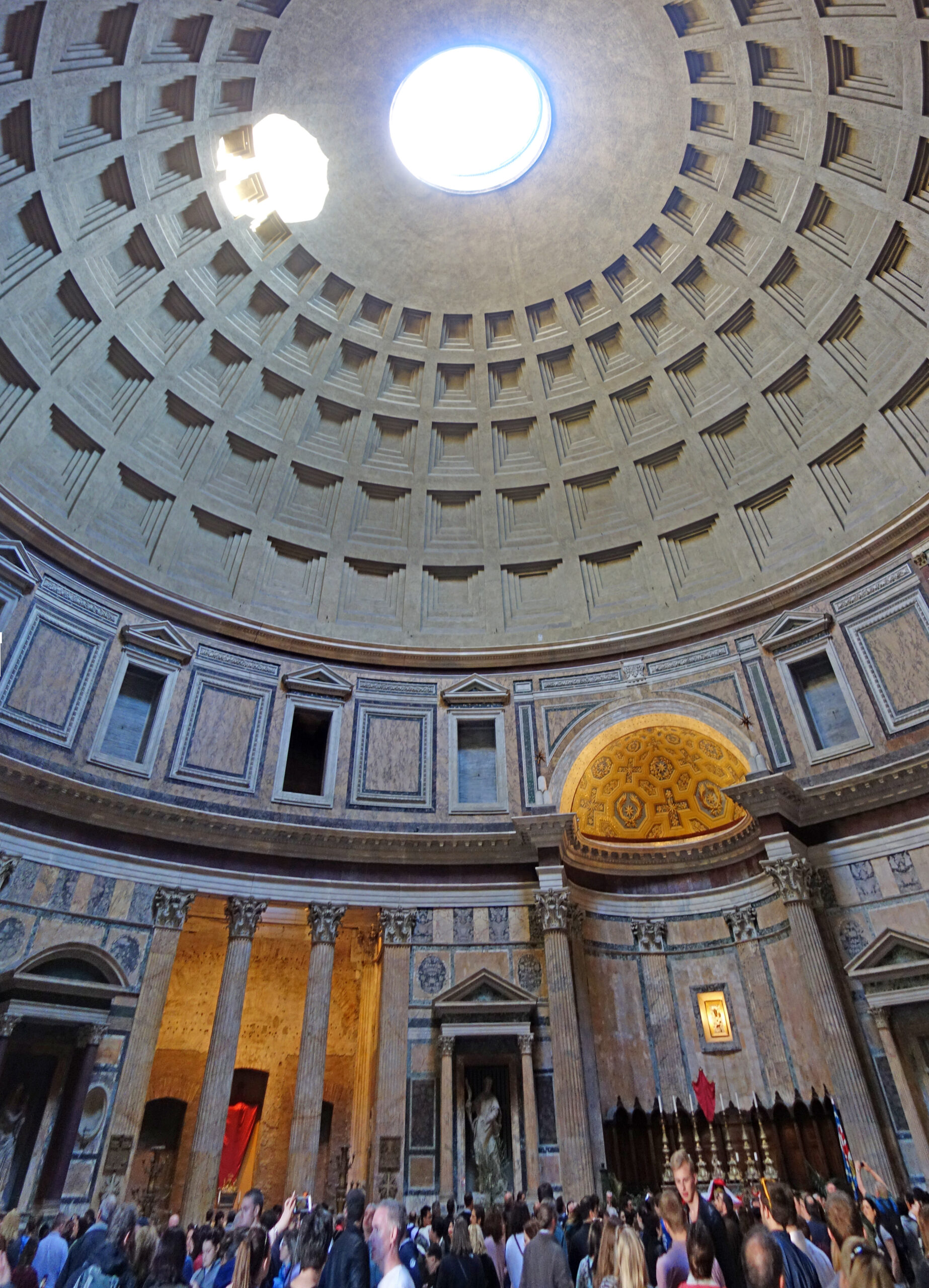
He also built a number of buildings in Rome itself, notably rebuilding the Pantheon, with a huge vaulting arch with an opening at the centre which is still perfectly preserved as a Christian church.
The Pantheon was originally built by Augustus’s friend Agrippa, but the building we see today was that rebuilt by Hadrian

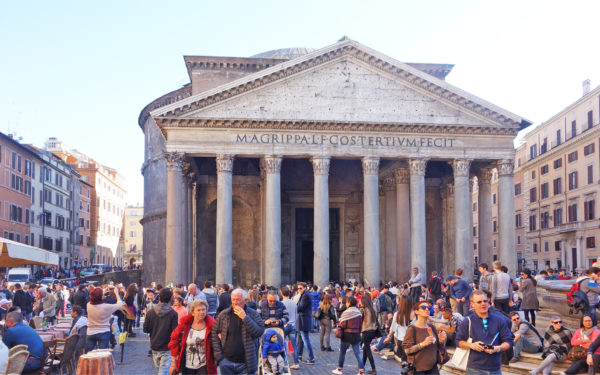
From the front, it appears to be a perfectly normal temple. But this is really a front to the rotunda behind.
The rotunda (right) has an opening at the centre which would challenge a structural engineer to reproduce today.
Hadrian’s tomb

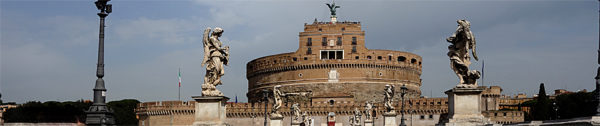
And then there was his own tomb, which was so big that in the Middle Ages it was used as a castle — the Castel Sant’Angelo.
But there are buildings of Hadrian throughout the Empire: wherever he went he left buildings behind. There is a notable one at Athens where he completed the enormous temple to Olympian Zeus; and in far-off Britannia, he built the greatest building of all, Hadrian’s Wall, 80 miles long, to divide off the Barbarians from the Romans.
Sex

And then there is the problem of Hadrian’s sex life. All well-bred Romans were bi-sexual, and delighted in introducing young boys to the delights of sex. But Hadrian went rather further than most, falling madly in love with a young Greek called Antinous, who accompanied him everywhere. Eventually when travelling down the Nile, Antinous drowned. He was only 20, but Hadrian was distraught, proclaimed that he was a god and named a city after him. Numerous statues survive to attest to his beauty. Of course, Hadrian was also married – coins were struck in the name of his wife Plotina, but there were no children and the marriage seems to have been a cold one: Hadrian was more homosexual than bisexual.
In conclusion Hadrian is difficult to assess. He was undoubtedly one of the greatest of the Roman emperors, perhaps second only to Augustus. He had many virtues but there was something about him that was a little flawed. Gibbon summed it up in his usual lapidary way:
‘Under his reign, the empire flourished in peace and prosperity. He encouraged the arts, reformed the laws, asserted military discipline, and visited all his provinces in person. His vast and active genius was equally suited to the most enlarged views and the minute details of civil policy. But the ruling passions of his soul were curiosity and vanity. Hadrian was, by turns, an excellent prince, a ridiculous sophist, and a jealous tyrant. The general tenor of his conduct deserved praise for its equity and moderation. Yet in the first days of his reign, he put to death four consular senators. The senate doubted whether they should pronounce him a god or a tyrant; and the honours decreed to his memory were granted to the prayers of his successor, the pious Antoninus.’
On to Antoninus and Marcus Aurelius
8th July 2020