Athens invents democracy
In the sixth century, Athens established itself as the leading state in Greece, and at the end of the century, it introduced democracy. It would be nice to say that democracy came with the introduction of coinage, but the story is rather more complicated. In fact, in the latter part of the sixth century Athens was controlled by a tyrant, Peisistratos, who was responsible for much of the growth, and also for the introduction of the first coins.
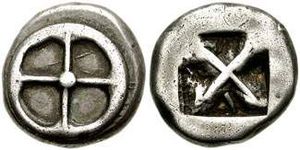
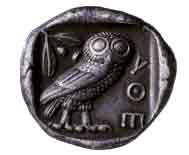
The earliest coins were the Wappenmunze stamped with a heraldic sign, but they soon adopted what became the great Athenian symbol of the owl, the bird of wisdom and also the bird associated with their patron goddess Athene. The Athenian coinage was also helped by the discovery of a new vein of silver in the mines at Laurion, a hillside not far from Athens, which meant that throughout the first half of the fifth century Athenian coins increased so much in number that they became the dominant coinage of the Greek world. The one town that did not adopt coins was Sparta which must have done so quite deliberately – but that is another story.
Peisistratos
But – and say this very quietly – coinage was not introduced by a democratic Athens but when it was under the control of a tyrant, Peisistratos. Peisistratos had a chequered career. He established himself as a tyrant on three successive occasions beginning in 561 BC and was twice driven out, but on each occasion, things went badly, so he was able to make his return as a tyrant. But in many ways, Peisistatos was quite a good thing: according to Herodotus he ruled fairly and well. He was a populist whose support came from the poorest section of the community as against the aristocrats. He beautified Athens and established the great Panathenaic Games, and more usefully, he laid down the sewers for Athens.
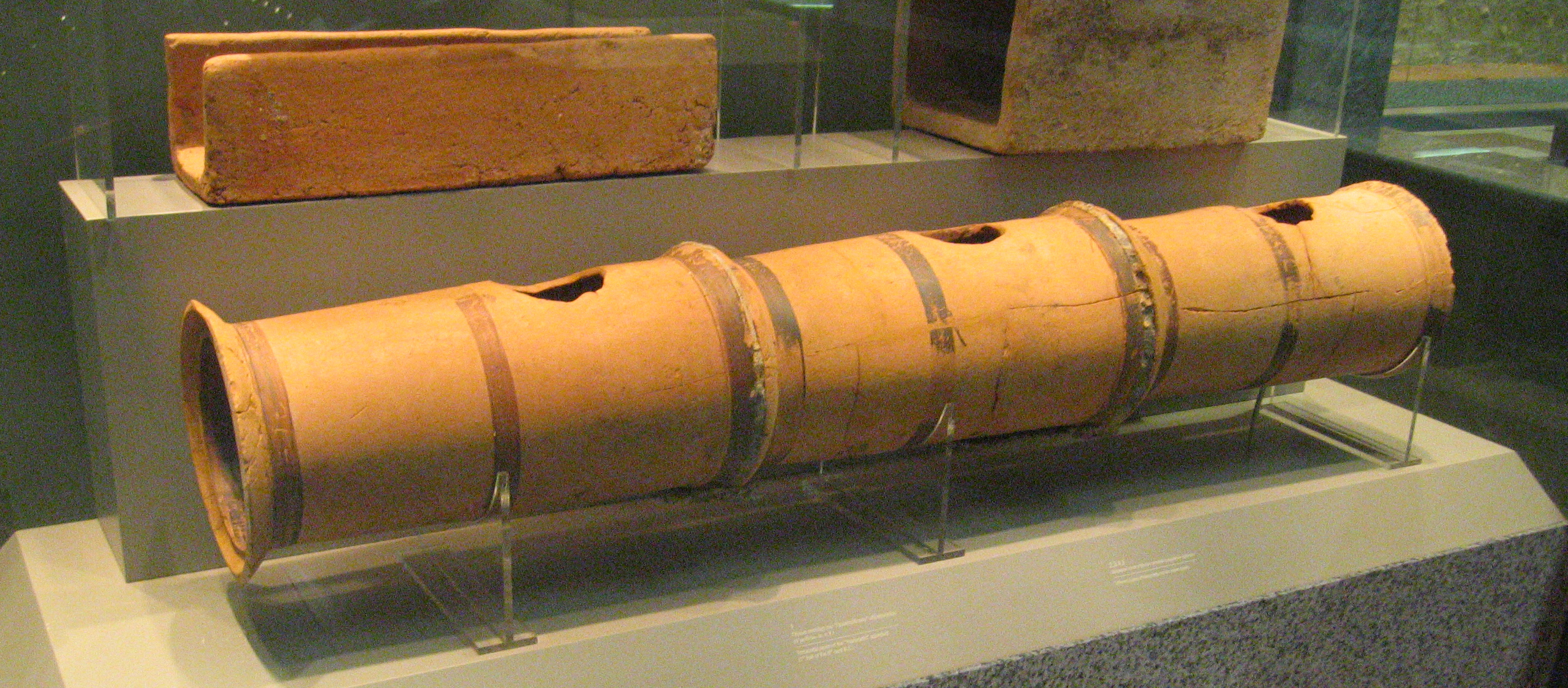
(I remember visiting Athens and going on their new Metro system and seeing a display of some of the objects that had been excavated while building the metro stations; and there in the centre was a large pipe discovered in the excavations).
Peisistratos died in 528/7 BC but his sons Hippias and Hippocrates were less successful. A plot to assassinate them was only half efficacious, as only Hippocrates was killed, though the assassins Harmodios and Aristogeiton were later honoured as tyrant slayers. Hippias limped on, ruling by himself and becoming ever more unpopular until in 510 BC he was ousted with the help of the Spartans. His expulsion led the way to the introduction of Athenian democracy under Cleisthenes.
The concept of democracy had been around for some time – but it is under Cleisthenes that it received its best known form and we need to consider it in some detail. As any anthropologist will tell you, one of the big differences with primitive societies is that they are kinship based, and one of the key reforms of Cleisthenes was to break-up the kinship basis of Athenian society. Hitherto the great families had considerable power and influence. If someone wanted to make himself a tyrant he could always rely on family support. Cleisthenes himself came from the poshest family of all – the Alcmaeonids, but he was determined to break the power of the old families and he reorganised the social structure which previously had been based on four tribes with a family basis.

He reorganised the state into ten new tribes on a geographical basis, depending on where you lived and your name was given as being a member of your new tribe rather than being the son of your father. In practice the new naming system went off at half cock and people never quite gave up their patronymic. Thus the great historian Thucydides who should have become Thucydides of Halimous, tended to be called Thucydides son of Alorus. But the new tribes were given the names of mythical heroes, whose statues were carved on a prominent base in the marketplace. The new system successfully broke up the influence of the great families.
The new constitution
In the new constitution, major decisions were made in the general assembly which met once a month on a low hill, known as the pnyx, where 5 or 6,000 people could assemble. There were probably at least 20,000 and maybe as many as 50,000 citizens, and all had the right to vote in the assembly. However not all could attend – they had their farms to look after – but when the assembly met, a quorum of 6,000 was sometimes needed.
In practice however much of the work was done by the boule, or council. The council was chosen annually by lot – and the Greeks believed that choosing people by lot was the basis of democracy. This somehow is anathema to modern political theorists but was considered to be one of the hallmarks of democracy, as indeed it was in Venice where the Doge was chosen in a long procedure which included the lottery in several stages.

The council was made up of 500 citizens, 50 chosen by lot from each of the 10 tribes who then served for a year. Within the council there was a steering committee known as a prytany of 50 members, again chosen by lot, who served for 36 days at a time when they were housed and fed in the tholos – the prominent circular building in the agora or market place. One of them was chosen each day to be the president and if you happened to be president on one of the days on which the assembly met, you might find yourself as president of the assembly.
It has been estimated that the average Athenian would expect to serve on the council once or twice in his lifetime and there was one chance in ten that when he was on the council he would serve as the president. This was real democracy in practice. Of course some things are too important to be left to the chance of the lot: generals were elected, ten at a time, one from each tribe. War is too important to be left to chance.
The law courts were also organised on a similar basis. By our standards, the juries were huge: juries in private law suits numbered 201 and for public law suits 501. Again they were elected by lot and later, payment would be introduced of a day’s wages – and all lawsuits had to be settled within a single day. In practice the activities of the law courts and the assemblies tended to overlap and the law court acted as a sort of upper house where the decisions of the assembly could be revised.

Perhaps the biggest oddity was the system of ostracism. The paramount fear of the legislators was the fear of tyranny, and ostracism was invented to avoid this. Once a year, the assembly would vote on whether an ostracism should be held – a quorum of 6,000 was needed. Then two months later the voting took place and you had to write on a potsherd the name of the person you wanted ostracised. The votes were then counted, and whoever had the most votes was banished from Athens for ten years so he could not make himself a tyrant. His property was left intact, there was no other penalty involved and after ten years he could return. The pot sherds were the rough writing paper of the ancient world, they were called ostraca, hence ostracism, and they have occasionally been found in excavations. In one famous hoard found down a well next to the Acropolis, 190 ostraca were found written in fourteen different hands, and all with the name of Themistocles, who was in fact ostracised in 471 BC. Clearly his opponents had prepared a stack of votes for illiterate citizens to vote against him – not unlike the use of postal voting today.
There is a story of Aristides the Just who was asked by an illiterate citizen to scratch his ostracon for him. ‘Whose name shall I put on?’ he asked, ‘ Aristides’ was the reply. ‘Why is that?’ he said, ‘because I am fed up with him being called ‘the Just’. Aristides being a just man, dutifully scratched his own name on the potsherd.
The system was not altogether a success: the first ostracism was not held until 487 BC and the last recorded one was in 416 BC, and between those dates twelve people are recorded to have been ostracised, though of course there may have been others who do not appear in the literature. It was an experiment that was tried and found wanting.
What is democracy?
It is interesting to try to draw up an assessment of Athenian democracy because the assessment of today is very different from the Greek assessment. Some historians always hold up their hands in horror at the narrow basis for democracy in Athens. Slaves, who may have made up half the population, were of course excluded, and so were foreigners: no immigrants were allowed to vote, and there were no women, which removes another half of the remaining population. Still there were probably at least 20,000 people left, which was a much larger electorate than the one-man rule of a tyrant, or a council of 30 ‘elders’.
Indeed over time the Athenians even narrowed the electorate by insisting that the citizens should have Athenian parents on both sides – a restriction that would have removed Cleisthenes whose mother came from Sicyon where her father had been the tyrant. An Athenian might point out that the great achievement of Britain was the Industrial Revolution in 18th and 19th centuries, when Britain was ruled by a very narrow electorate – and very successfully.
Ancient criticism ran on entirely different lines, complaining against the demagogues, the orators who led the common people astray. The classical example was the death of Socrates, mandated by popular vote, – and how stupid can you get if you put to death your greatest philosopher? One of the purposes of the study of history is to ask the awkward questions as to whether our contemporary practices are out of step, when practices in the past say something very different. Who is right: the classical Athenians, or us?
The interesting thing – to me – is that democracy comes so soon after the introduction of money. At Athens, money was introduced in two stages. The first stage, the wappenmunze, appears to have been introduced during the reign of Peisistratus, and the images stamped on the coins may be the crests of the leading families. The second stage was the introduction of the owl coinage which came later – it would be nice to say that it was the coinage of the new democracy – though the dating of this is controversial. But certainly the introduction of coinage was followed by the advent of democracy. But in the ensuing century, democracy and money marched side-by-side: Athens became a market-based economy and a democratic society, and the spirit that animated the one also animated the other. But before we look at Athens in its greatest period, the fifth Century, we must first consider the most traumatic episode in Greek history, the invasion by the Persians and its triumphant repelling by the Greeks.