Thera: the Gods are laughing

Let us enjoy the biggest joke in archaeology. Let us consider the problems of the dating of Thera, otherwise known as Santorini. Here we have a site where we have a precision date – or so we thought. But the trouble is, we have two precision dates, and these dates are more than 100 years apart. It is a fascinating story, so let us investigate. There is much to learn and much to admire, so prepare to delve into the depths of chronology; but in the end, we will find that the gods are laughing at us.
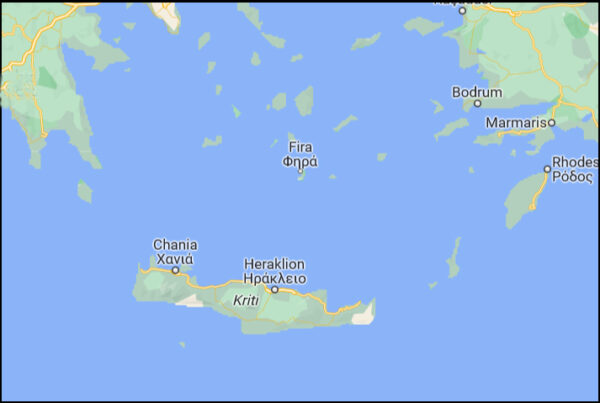
Thera, or Santorini, is an island 60 miles north of Crete. Today it is a wonderful holiday isle, with lots of sandy beaches, lots of pretty girls (or so I’m told), and quite a lot of fascinating archaeology. To the modern tourist it is the southern most of the Cyclades islands and the end of the tourist boats from Athens. To the archaeologist, it is an infrequent boat journey north from Crete – an outlier of the Cretan story.
Thera is the remains of a huge volcano and in 1628 BC it exploded in great style, sending tens of thousands of tons of dust into the atmosphere, causing colourful sunsets and considerable climatic cooling round the world. Thera today consists of the top part of the volcano, the central part of which is submerged, and today the steamers sail into this central part and hover inside the volcano, while the tourist buses then crawl up the zigzag road to the present day rim on which the idyllic modern tourist resorts are situated.
The eruption of Thera was enormous, and would have had an effect not only on Thera itself, but far wider. A huge amount of volcanic ash would also have been ejected high in the sky and this would have caused bad weather worldwide. The nearest event we know, the explosion of Krakatoa in Indonesia in 1883 produced vivid sunsets around the world for several years, and Thera was a bigger explosion than Krakatoa, and would have had a worldwide effect reaching even as far as Ireland and Greenland. There would have been a major effect on Crete, just 70 miles south where at the very least there would have been a huge tsunami, a wave of water that caused destruction all along the north coast of Crete, particularly at Amnisos, the port of Knossos.
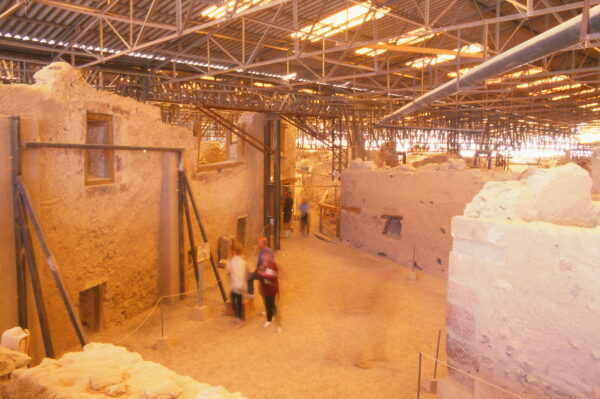
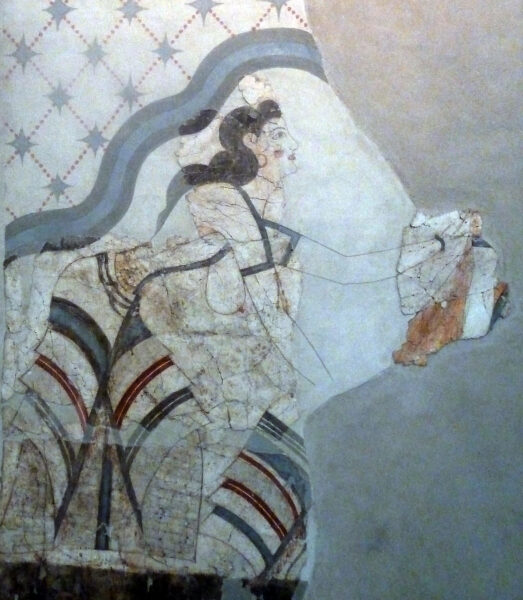
In the Minoan period, there was a substantial town on Thera known today as Akrotiri which was buried beneath the eruption and thus preserved like Pompeii and has recently been excavated. The culture of the settlement was very like that of the Minoans, and it has often been considered to be a Minoan ‘colony’ — indeed the wall paintings from Akrotiri provide some of the best examples of Minoan art.
Major volcanic explosions can be dated by various scientific means, and this is where the trouble begins. Two scientific methods have been used to date the explosion of Thera. The most popular is tree-ring dating (dendrochronology). Tree-ring dating is based on the annual growth of tree rings which can give an exact date. Occasionally there are bad years when the trees did not grow and tree ring specialists argue that these may be the results of volcanic explosions. A number of tree-ring sequences have been built up, notably that by Mike Baillie at Belfast based on the Irish bog oaks and he noted a major blip in the tree ring sequence in 1628 BC which he argued was due to the clouds of dust from the Thera eruption which caused bad weather even as far away as Ireland. A similar blip was noted in the Californian bristlecone pine sequence, though this was dated a year later to 1627 BC.
Then there is radiocarbon dating. This is the technique where the discrepancy was first noted, and there have been a number of datings, notably on an olive branch buried beneath the lava flow which has been dated to between 1627 and 1600 BC. None of these techniques is perfect, but they do provide a sort of consensus that the eruption occurred sometime around 1600 to 1650 BC.
The Egyptian dating based on astronomy
However, there is another means of dating, that is cross dating from Egypt. A lot of Egyptian material is found in Crete and a lot of Minoan material is found in Egypt. Indeed an annex to the palace at Tell el-Dab’a appears to have been built by Minoan workers in the Minoan style. When Arthur Evans set up the original Minoan chronology, he did so by cross-dating with Egypt, so that Early Minoan corresponds to the Old Kingdom, Middle Minoan corresponds to the Middle Kingdom, and Late Minoan corresponds to the New Kingdom. Thus all the Minoan dates depend ultimately on Egypt.
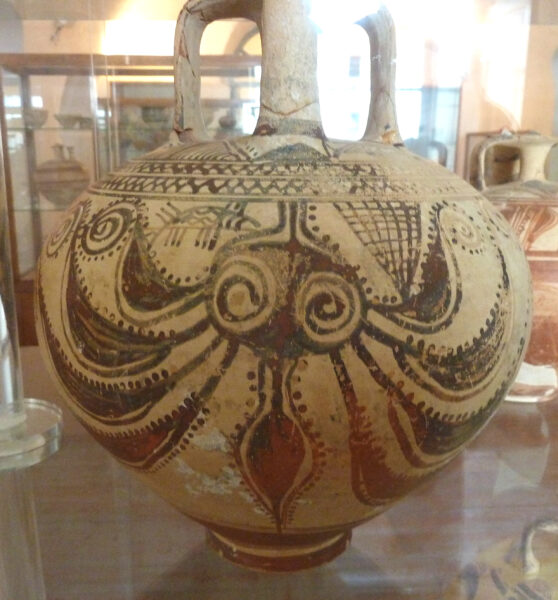
In 1939 Spiridon Marinatos, the ‘Mortimer Wheeler ‘ of Greek archaeology, and the excavator of Akrotiri wrote an influential article arguing that it was Thera that brought the palace civilisation to a close. This was soon seen to be wrong: the pottery found in the ruins of Akrotiri comes in the middle of the pottery sequence in the Palaces. In terms of pottery chronology, in LMIb, a ‘marine’ style comes into fashion, when pots are decorated with marine creatures, but this marine style is not found in Akrotiri, so the eruption must have occurred sometime towards the end of LMIa, while the Palaces did not collapse till the end of LMIb. And in the conventional dating, the end of LM1a comes out at somewhere around 1500 BC.
But what is the basis for the Egyptian dating? This too is based on science, though in the Egyptian case, the science is astronomy. The Egyptians had a sacred star,Sirius, which is the brightest star in the sky. However, for half the night, Sirius is invisible and the date it first appeared above the horizon became an important date in the Egyptian calendar, the beginning of the Egyptian year. Originally it coincided with the beginning of the Nile inundation, but unfortunately the Earth wobbles on a 1460 year cycle, so gradually the reappearance changed, till suddenly it reappeared in 1517 BC which was the ninth regnal year of the pharaoh Amenhotep.
Astronomers can reckon backwards to when this happened. The only problem is, where did the Egyptians take their measurements from: Thebes (in the south), or Memphis (in the north)? If it was from Thebes, then the year was 1517; if it was from Memphis, the year was 1537: 1517 is generally preferred. Amenhotep was the second Pharaoh in the New Kingdom, succeeding his father Ahmose, so the New Kingdom began in 1550.
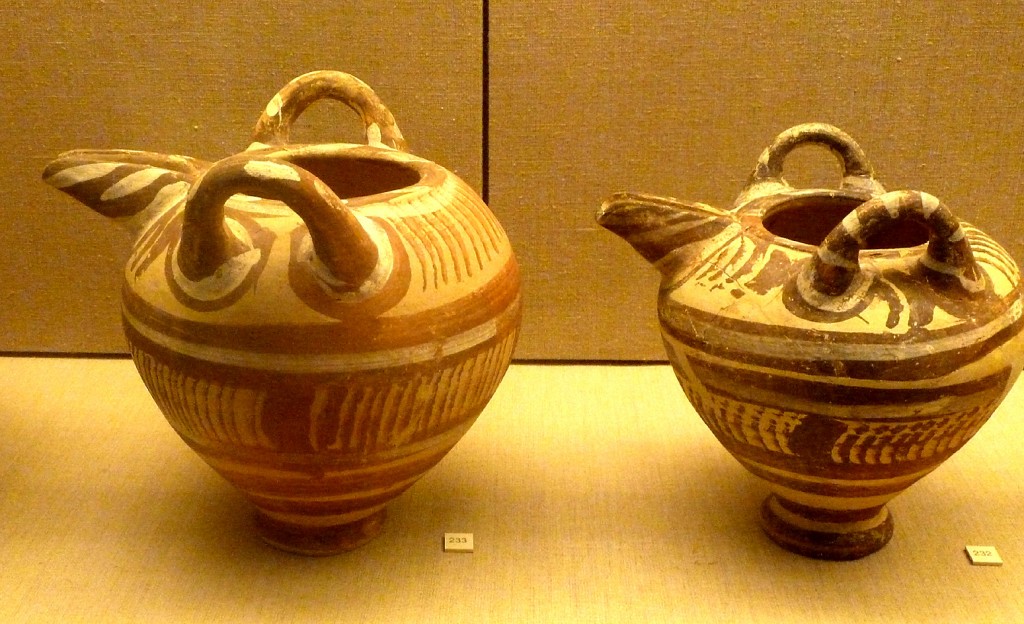
The explosion of Thera, as dated by the pottery found under the volcanic ash on Thera, came in just at the LM1a to LM1b interface: in pottery terms, LM1b is characterised by the ‘Marine’ style, which is not found on Thera. In 1989, the links with Egypt and the rest of the Near Eastern world were examined in detail by Peter Warren and Vronwy Hankey and they concluded that the LM1a/LM1b interface, that is the date of the eruption of Thera was 1500 BC and that is more than a hundred years different from the tree-ring date of 1628 BC.
So which is right: the volcanic dating, or the astronomical dating? Both sets of dates can be juggled, but the gap of at least a century cannot be juggled away. It is not for me to arbitrate so I fear that on the whole, I have taken the line of least resistance and use the traditional account, – which means I can at least offer a coherent and consistent story.
The trouble is that if the volcanic dating were to be adopted, not only would the whole of Egyptian history and Minoan history have to be revised, but also the whole of Near Eastern history and indeed the whole of European Bronze age prehistory would have to be revised.
The gods are laughing at us. There is no solution to the problem – at present. Let us laugh with the gods.
The Minoan Empire is one of the most interesting and most attractive of all the ancient Palace empires. But it finally fell to the Mycenaeans, and it is to the Mycenaeans that we must now briefly turn.
24th August 2016, 27th January 2021