
Augustus
Augustus was the crux, the fulcrum on which the history of Rome turns. Before Augustus, Rome was still, at least nominally, a democracy, — albeit an increasingly chaotic democracy. He turned it from a democracy into a monarchy: in the terminology of the classicist, Republican Rome was changed into Imperial Rome.
Yet the change was extraordinarily successful. Not only did he bring peace, but he also brought prosperity, and the next two hundred years were one of the world’s Golden ages; indeed the prosperity continued albeit in a changed form for a further 200 years in the West and 400 years in the East, and even beyond that in Constantinople; indeed the political vestiges of it remained as a spectre and source of inspiration throughout the Middle Ages and became the driving force of the Renaissance that followed and which continued to inspire almost down to our present day.
Yet it raises troublesome questions: the Romans saw it as being a loss of ‘liberty’; today we see it in terms of a loss of democracy. But it was a loss that worked. We need first to study the story of Augustus, to see how he achieved the stunning transformation; and secondly we should examine our own concept of democracy to see what lessons can be learnt from the successful usurpation of democracy; and to see how the result brought many of the benefits that today we associate with democracy. What do we really mean by ‘democracy’?
Augustus is always hard to evaluate, because there is no good source for the history of his reign. The historian Tacitus began his great history with the death of Augustus in AD 14, and for the next 100 years we have — on and off — the views of the great historian, sometimes direct, but even where it has not survived (and much of it is lost) it is nevertheless reflected in later writers. We therefore have to work out the history of Augustus from minor sources and in particular from the most dangerous source of all, that is his own autobiography. Towards the end of his life, Augustus wrote an account of his own achievement –his res gestae – or things I have done, which he had engraved on various walls throughout the empire: the inscription at Ankara in Turkey has survived almost complete. It is a masterful account. But whereas one can be virtually certain that everything it says is true, it is certainly not the whole truth, and there are major omissions and everything is presented in the best possible light. Modern historians vie with each other to try to find out what really happened.

Modern interpretations of Augustus have always been controversial but can be divided between two of the greatest historians of Rome. At the end of the 19th century the great German historian, Theodore Mommsen believed that Augustus established what he called a diarchy, that is a rule of two, with power being split between Augustus and the Senate.

However in the 1930s this view was challenged by Sir Ronald Syme, the Professor of Ancient History at Oxford from 1949 – 70, who established ‘prosopography’, the study of elucidating history by working out the biographies of all the minor and not so minor figures who played a role in it. Syme wrote his most famous book, a study of Augustus called The Roman Revolution, in the 1930s, during the rise of the dictators and he tended to cast Augustus as being a dictator with analogies with Mussolini. His view was even then controversial, and much too cynical, so here we need to adjudicate between the two views of Mommsen and Syme, and consider how far the constitution that Augustus set up kept the Roman Empire prosperous and successful for at least 300 years.
Augustus: Climbing the greasy pole
Augustus was born in 63 BC to a family of ‘new men’ — provincial nobles who were making their way in Rome. His main claim to distinction was that his grandmother on his mother’s side was the sister of Julius Caesar. As a teenager therefore he set out to Caesar’s camp in Spain and there he clearly impressed Caesar so much that he made him his heir —though without telling him. On Caesar’s assassination, Augustus made his way to Brindisi in the heel of Italy, where some of Caesar’s troops were stationed and there he learned that he had been made Caesar’s heir which meant that not only did he have a body of troops at his disposal but also a great deal of money. (His original name was Octavius, and then following Caesar’s death, he became Octavian, and he only became Augustus when he was given the title by the Senate in 27 BC ).
The 19-year-old Octavian clearly impressed the troops, who decided to follow him. It was important for troops to have a leader who would not only win battles (and get them plunder), but more importantly, when they came to retire, would settle them as colonists on a suitable plot of land. Augustus had charisma, and the troops followed him.

Augustus faced two major problems: what to do with Caesar’s assassins and how to deal with Mark Anthony. The assassins were the easier, for their vision that it would somehow be possible to restore the ancient republic clearly would not work. Mark Anthony was a bigger problem. He was 20 years older than Augustus and like him a relative of Caesar and had been Caesar’s friend and ally and his best general in his conquest of Gaul, and the subsequent civil war and he quite reasonably expected that he would be named as Caesar’s heir. He was no doubt put out that the unknown youth Octavius was named Caesar’s heir and the recipient of his enormous wealth. The subsequent decade consists of the rivalry between Augustus and Anthony.
Mark Anthony was a complex character: he was a good general – much better than Augustus, who tended to allow his friend Agrippa to fight his battles for him. His private life was dissolute — which probably did not count all that much against him in Rome; but his political skills left much to be desired. Whereas Octavian was always seen as a safe pair of hands and the person to follow, Anthony was somehow never quite safe. But in 44 BC the two of them got together with another of Caesar’s colleagues, Lepidus, and formed a triumvirate whereby the three between them had supreme power for five years: the original five years was later extended for a further five years.
Early in the course of the triumvirate they carried out a mass proscription of 300 senators and over 1000 knights who were declared enemies of the state. Some were assassinated, others forced into exile. Many of them were personal enemies but in many cases too, the triumvirate wanted to seize their property to build up their own wealth which they needed to pay the troops who supported them. Syme described it as being ‘a levy on capital’. The most significant victim was the great orator Cicero who had rashly attacked Mark Anthony; at the time he was trying to act as a reconciliator and his death has been widely condemned. Some authorities suggest that Octavian did his best to restrain his fellow triumvirs, though others suggest that he was as keen as they were to lay his hands on the money and wealth of those proscribed. But in such situations, leaders cannot survive without occasional acts of cruelty — sometimes disgraceful cruelty.
As the triumvirate came to an end, relations between Octavian and Mark Anthony worsened. It was arranged that they should split spheres of responsibility: Octavian would take the west, while Anthony went out to supervise the East. Here he met up with his fate, in the form of Cleopatra the Queen of Egypt. Cleopatra had already had an affair with Caesar by whom she had a son, and soon Anthony succumbed to her charms and her intellect and fell madly in love with her. The full truth of it will never be known, but Augustus seized on this as an excuse to blacken his name and to make out that this would lead to Rome being subjected to Egypt. Augustus’ propaganda worked, indeed even Shakespeare and Hollywood have fallen into line and have glamourized the affair.

Eventually both gathered fleets and a great naval battle took place at Actium, off the north-west coast of Greece. Octavian delegated most of the fighting to his trusted lieutenant Agrippa, and after considerable maneuvering, during which some of Antony’s troops deserted, Anthony and Cleopatra were defeated, and fled to Egypt, where one after the other they committed suicide. Augustus was left as the undisputed master of the Roman world.
He has climbed the ladder, he is now ruler of the world – how is he going to consolidate his power?
The Constitution
But how was Augustus to rule? Power in Rome had traditionally been shared between the two consuls, elected annually who after their period of office were expected to go out and govern a Province; and the Senate, the House of Lords of the Roman world which by continually bringing in new men had long succeeded in being the centre of power and influence. Augustus was keen to maintain the structures of the past.
The Senate was the source of advice and more particularly of people to be sent out to govern the provinces because this had become the main task of the ruling classes at Rome. His reforms therefore consisted of giving back at least some power to the Senate,
It took Augustus some eight years after Actium to work out the new formula for governing the Roman Empire. The first dramatic event came on 3 January 29 BC when the doors of the Temple of Janus were ceremoniously closed. The doors of the Temple of Janus were ceremoniously opened when Rome was at war and closed when it was at peace, and having been open for so many years, this was the sign that the troubled times were at an end and peace was at hand. Later that year he celebrated a grand triple Triumph for the battles of Actium, Spain and Syria.

It was found at Meroe, in the Sudan, outside the Roman empire, where it had been brought as loot captured from the Romans, and buried under the steps of the temple so that everyone going up into the temple could stamp on the image of the hated Roman emperor.
The next major change came two years later on 13 January 27 BC when dramatically he announced that he was giving the ‘Republic’ – in Latin the ‘res publica’ or the public ‘thing’ back to the Senate and People of Rome, and that he would in future rely on his position as commander-in-chief and his ‘Auctoritas’ , his ‘authority’ to guide the affairs of state. He was simply ‘Princeps’, the first citizen, and no more. The people begged him to do more, so reluctantly he agreed to take on the three most troubled provinces of Spain, Gaul and Syria for a ten-year governorship. He was also given the title of Augustus.
He then conveniently went off to Spain, where he spent most of the next three years trying to civilise the troublesome and warlike tribes of the North and West. Each year he was elected Consul, but an absent Consul. Then in 23 BC there was a big crisis. At the beginning of the year there was apparently a plot against him to be put down, though this was hushed up, but in the middle of the year Augustus fell gravely ill and thought he would die: he handed over his signet ring to Agrippa as a sign that he was to be his successor. But he recovered, took the signet ring back but clearly decided that he should take things easy for the future, and introduced what proved to be the constitution that served Rome for the glorious centuries that were to come.
He gave up the idea of being Consul every year and only became Consul twice in the future, both times in order to introduce a potential successor as a junior Consul. Instead he took on a new modest power, of a Tribune of the Plebs. The Tribune of the Plebs had been a position first introduced in 494 BC, to represent the Plebs, nominally the lower classes, and they had the power to veto laws in the assembly, so this was a very clever move. Indeed ever afterwards the ‘Tribunicia potestas’, the tribune’s power became the main title of the Emperor, and the normal way of dating affairs was based on the ‘Trib Pot’ of the relative Emperor.
Combined with this, he divided up the provinces into the troublesome provinces, of which he reluctantly took control, and the nice provinces where there was not likely to be any trouble, which were handed over to the Senate. Of course, the Army was concentrated in the troublesome provinces, so the Emperor had the all-important control of the army.
Many have said – with Sir Ronald Syme leading the attack – that the new constitution was a sham. I believe not. In any business, the most important aspect is the art of delegation, of giving one’s subordinates not only a very significant degree of power, but also the feeling of power and control, so that one can attract and hold the very best subordinates. This is what Augustus did, and the system continued for several centuries to come, in what proved to be the most glorious epoch of the Roman Empire. I believe that every aspiring politician and indeed every aspiring businessman would do well to note, and imitate.
This was the last major constitutional change by Augustus: he spent the next 40 years consolidating the position of the Roman Empire. A major concern was his successor for it soon became clear that the Empire was here to stay and the biggest problem was to find the next Emperor.
Finding his successor
The task of a successor would not be easy, for there would be many who would want to revert to the old system of two consuls, elected annually. Augustus was convinced that a reversion to the ‘bad old days’ would not work and that a single long-term Emperor was needed. The obvious solution was his boyhood friend Agrippa who was a brilliant general who had the backing of the Army to put down any possible revolt – and who was also an administrator second only to Augustus himself.

Unfortunately however he died in 12 BC and this left Augustus with a big problem. The easiest solution — and indeed the normal solution was to look to members of his own family (It only seems strange to us because we are so strongly opposed to nepotism. Yet this has been the norm in virtually all societies throughout the ages: it is the beliefs of the 21st century that are out of step). The trouble was that he only had one child, his daughter Julia by his first marriage, so he married her off to Agrippa. They had five children so his first choice was to look to his two grandsons, Gaius and Lucius. However fate struck again, for both died young, Lucius in AD 2 at the age of 19, and his elder brother Gaius 18 months later at the age of 24
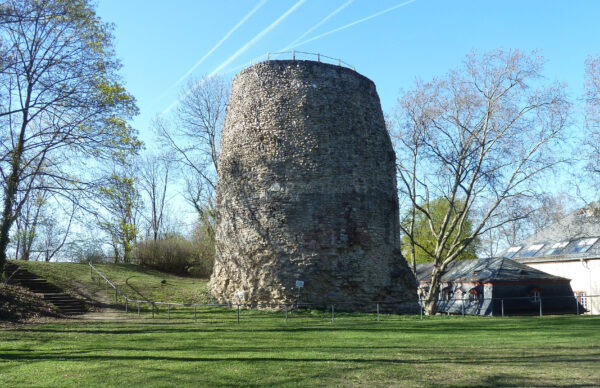
In the Middle Ages it was used as a watch tower, and steps were tunnelled out inside it.
So he had to look yet again and he looked at his two stepsons. Livia, his second wife already had two sons by her first husband, the brilliant Drusus, and the dour but capable Tiberius. However Drusus died in 9 BC at the age of 29, so he was left, somewhat reluctantly with Tiberius, who eventually succeeded him: he proved to be a wise choice, for it was Tiberius who took over on Augustus’s death with dour competence and effectively confirmed the concept of the Roman Empire.
Augustus’s methods – keep the choice within the family, but then define the family widely, and adopt as successor whoever seemed the most competent – were often adopted by his successors, and in the second century, the great line of Emperors, Trajan, Hadrian, Antoninus Pius and Marcus Aurelius, were all adopted, and it was only when Marcus Aurelius was succeeded by his son, the neurotic Commodus, that the Golden Age of the Roman empire was broken. One wonders whether a similar system might not work with the British Royal family
Administration
Augustus was clearly a brilliant organiser and administrator: there were few aspects of Roman life that he did not reorganise — the Senate, the lawcourts and particularly finance. Here he was particularly successful, finding Rome bankrupt, but leaving it rich. He introduced some modest new taxes – a 4% tax on the sale of slaves, 5% death duties on large estates, and a 1% sales tax. (It is amazing to modern eyes how low were the taxes in the ancient world; though it was not the taxes but the occasional levies that were disastrous when a ransom had to be paid or a tribute was levied: but it was one of the great advantages of the Pax Romana that such irregular impositions became rare).
Augustus was particularly successful with the administration of his own estates which formed a considerable part of the overall economy of the empire. The imperial estates were very extensive: not only had he inherited Julius Caesar’s estates but also those of Mark Antony and Cleopatra. Indeed Egypt did not become a province at all, but rather the personal property of the emperor, ruled over by a procurator, so the very considerable income went into the Emperor’s private purse: Egypt would become a major source of income for the Emperors in the future.
A good example was his reorganisation of the currency. This had become in a chaotic state with all the members of the triumvirate issuing their own coins. Mark Anthony’s coinage was particularly bad as he allowed it to be debased, and consequently the huge numbers of Antony’s coins continued to be found in hoardes down to the second century A.D.

Augustus introduced a completely new system. Gold and silver was to be produced by the Emperor, and he set up a new mint at Lugdunum (Lyons) in France for this purpose. However coins of smaller value, of copper and bronze was to be produced by the senate, and was stamped SC, that is Senatus consulto. The coinage maintained its purity for at least 50 years until Nero in A.D. 60 began the first stage long stage of the debasement which would ultimately ruin the Empire.
He even tried to reorganise morals: there were laws against adultery (which were not very successful) and the ius trium liberorum, the law of three children, which gave privileges to those who had more than three children: in particular women were no longer subject to the tutela, the guardianship of their fathers or husbands, and could receive inheritances in their own right, and could thus own their husband’s estates after his death.
The Altar of Peace
Augustus was a great builder. According to Suetonius, he found Rome brick and left it marble. Much of his work however was reorganising and rebuilding – he rebuilt three major aqueducts. His biggest single new building was the forum of Augustus which he erected next door to the forum of his predecessor Julius Caesar, although today both are rather overshadowed by the forum of Trajan built a century later.
He also built three major temples, including the large temple of Mars, but many of the new buildings in Rome were either done in the names of his family or done by wealthy citizens, encouraged by Augustus. (Interestingly, he rather boasts about this in the Res Gestae, his autobiography, i.e. he boasts about his own modesty. This to me rather typifies Augustus who was inside a mass of contradictions which he managed to sort out on the surface. Yes, he was modest, but yes he boasted about his modesty). However there is one particular building which was very much his own, the Ara Pacis, or the Altar of Peace.

This is a comparatively small building erected in the Campus Martius – the field of Mars – at what was then the edge of the city. The dedication is significant – the altar of peace. Of course Syme and his followers will say that this is all purely propaganda and point out that Augustus’ reign was occupied almost continuously by war in one province or another. But I think this view lacks a comparative viewpoint – did any of the pharaohs in Egypt ever erect a temple to peace? Indeed is there any earlier temple to peace anywhere in the world? This was Augustus’ message. This was what he wanted to believe and the reason why he was so popular, and why henceforward the Romans themselves talked about the pax romana – the Roman peace.
The temple itself has been splendidly reconstructed of hundreds of small fragments, so one can see it as originally intended. From the front a flight of stairs led up to a small single room. The Ara Pacis was built on a low-lying part of the Campus Martius down by the river, and it soon suffered from flooding, so eventually it was overthrown and smashed into numerous small pieces which were buried under deep layers of silt. In the 16th century a few fragments were recovered while building the foundations for a later palace and more fragments were recovered in the 19th century. Eventually in the 1930s Mussolini ordered that all the fragments were to be recovered. The foundations of the 16th century palace above were to be shored up and the ground was frozen in an amazing display of the wonders of fascist technology. The fragments were all reassembled and a new site was chosen.

Not far away was another major Augustan site, the Mausoleum of Augustus, a huge circular structure built as a tomb where Augustus and the members of his family were buried. In the Middle Ages it became a castle, but then it became ruined so Mussolini decided to make it the centre of a grand square – the Piazza Augusto Imperatore. Fine buildings were erected round three sides and on the river side, the Ara Pacis was restored and re-erected in a grand new cover building. This was to the design of Vittorio Morpurgo, who was one of the leading Fascist architects until 1940 when Mussolini linked up with Hitler, and it was discovered that Morpurgo’s father was a Jew, so he had to shrink back and take a very low profile. After the War he bounced back and became the Professor of Architecture at Rome University.
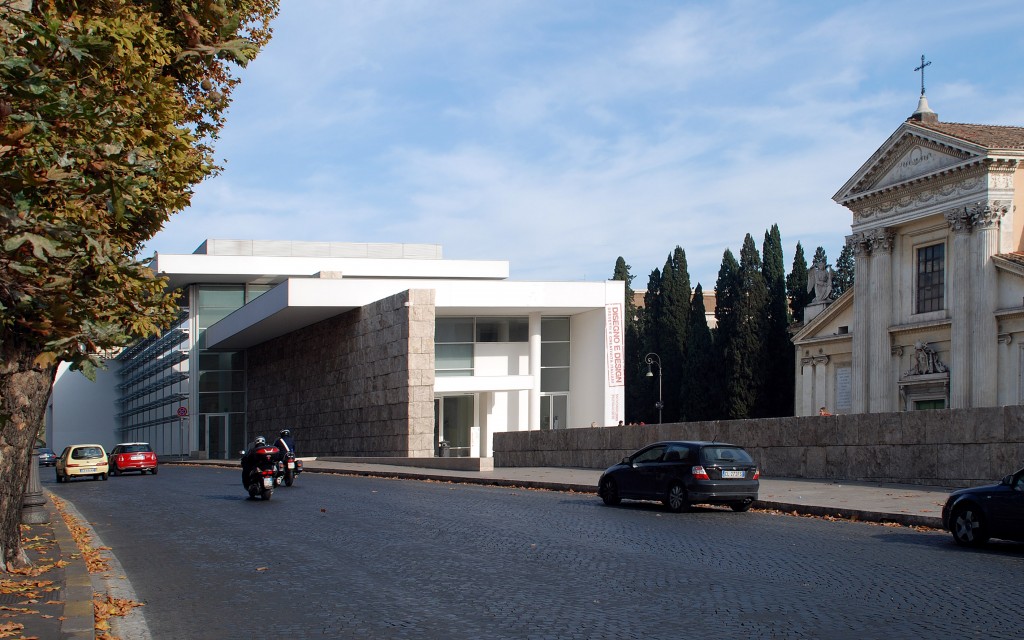
Unfortunately however with the prospect of war ahead the actual cover building of the ara pacis was shoddy in construction and by the 1980s it was leaking badly and needed major renovations. Rome by this time had a communist mayor, so he decided that it was all to be pulled down and be replaced by a grand modern building designed by an Italo-American architect Richard Meier. This too was controversial, and when the communist mayor was succeeded by a right-wing mayor, he proclaimed that it should all be pulled down and rebuilt again. However, economic reality has intervened – the building does not leak, and it provides a light and airy ambience for the Roman remains. It seems likely to survive.
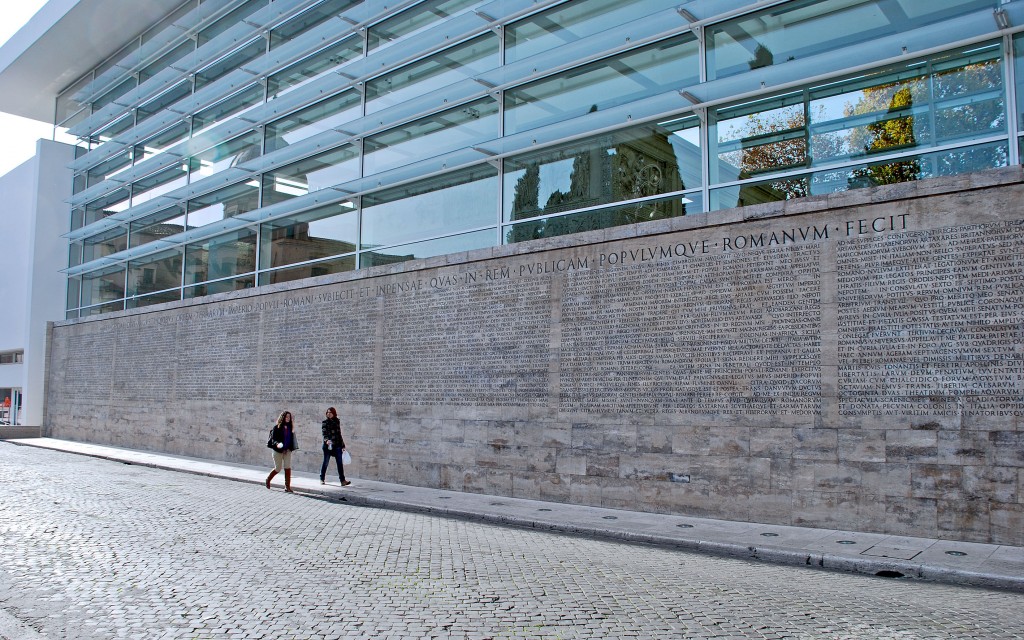
On the side of the modern cover building a copy of the Res Gestae – his autobiography, has been inscribed. The original, the most complete copy, is in Ankara in Turkey. But seeing it inscribed on the wall gives some idea of the length of the inscription. Augustus wanted to record his own version of history and he did so in style and at considerable length. .
Augustus’ Marriages
Augustus was a complex man and his complexity can well be seen from the extremely complex story of his marriages. In the latter part of his reign, Augustus became concerned with morality and even passed a law against adultery, which was not something that the Romans were worried about and had certainly not concerned him in the past. Indeed, the strangest of it was that his eventual successor, Tiberius was not a blood relative at all, but the son of Augustus’s third marriage by her first husband.
Indeed, Augustus’s marriage record is one of ruthlessness and disregard for the feelings of others – though this was not unusual among the Roman upper classes. His first marriage was to Claudia, step-daughter of Mark Antony, but he soon divorced her ‘intact and a virgin’ according to Suetonius. Then in 40 BC when he was 22, he married Scribonia, who was several years his senior, but she was well connected to the Pompeian faction, which may have been reason enough for marriage. The marriage was not altogether happy (Suetonius said that she nagged Augustus)

But then Augustus fell in love with Livia, who was beautiful, intellectual, but cold: however she was well-connected, being a member of the Claudian family. Both were already married but Augustus promptly divorced Scribonia, and ordered Livia’s husband, Claudius Nero to divorce her, which he dutifully did. However Scribonia was already pregnant by Augustus when he decided to divorce her, and on the day of the actual divorce, she gave birth to what proved to be Augustus’s only child, his daughter Julia.
Nevertheless Augustus remained married to Livia until his death, though sadly there were no further children. However Augustus, rational if unromantic as always, realised that her children by her previous marriage were very bright, so he promptly adopted them. We thus have the strange situation that Augustus’s successors, the Julio-Claudians, were drawn jointly from the grandchildren of his daughter Julia and from his stepsons by his second wife’s previous marriage.

The story gets curiouser and curiouser. Augustus’s daughter Julia proved to be beautiful, intelligent, and promiscuous. At the age of 14 she was married to Marcellus, her cousin, just three years older than she was. Marcellus was thus designated as Augustus’ possible successor, but he died two years later in 23 BC when Julia was 16. But she was a good pawn in the marriage stakes, and in the rather more important business of finding a successor, so two years later, at the age of 18, she was married off again, this time to Augustus’s great friend Agrippa, who at the age of 43 was 25 years her senior – indeed, he was the same age as her father. However they were good breeders and had five children, of whom Gaius and Lucius appeared to be capable, so Augustus adopted them as his own children and designated them as his successors, though unfortunately both disappointed him by dying young. It was their daughter, Agrippina, who was to be the more influential, being the mother of the emperor Caligula, and grandmother to the emperor Nero.
After Agrippa died in 12 BC, Julia was married yet again the following year, this time to Tiberius, who was the son of Augustus’ third wife Livia by her first husband. Augustus never really liked Tiberius, but he was capable and a good general, so eventually he was designated as a possible successor, and indeed eventually he became Augustus’s successor, the second emperor of Rome. But the marriage was unhappy, and Julia’s promiscuity increased and she began sleeping around – five nobles were named, but there were said to be many others. However Augustus by this time was preaching morality and had introduced a law against adultery, so when his daughter began committing adultery left right and centre, he felt she was letting down the side, so he banished her to a small island. Her mother, Scribonia, (Augustus’ second wife) who was still very much alive, went with her, and she remained in exile until her death shortly after the death of Augustus himself
There was one other victim of the new morality – the poet Ovid. Ovid was one of the greatest poets of the Augustan age, but he was banished to Tomis, on the Black Sea. The causes of his banishment are uncertain: he said he was banished because of ‘a song and an error’. It is widely assumed that the song was his Ars Amatoria, the Art of Love, though this had been published six years before his banishment; scholars have wondered whether his error was to be among Julia’s many lovers.
And yet in many ways, Ovid has the last laugh. His Ars Amatoria – the Art of Love that apparently led to his exile, today seems merely mildly titillating; two books of advice to the boys on how to catch a girl, and a third book of advice to the girls on how to catch the boys. This is the sort of thing that is the staple of many women’s magazines today and offers an image of marriage that to us is quite normal, where boys set out to catch the girls and girls set out to catch the boys – and it is their choice – and not the choice of their parents. It is Augustus’s behaviour, seeing marriage in terms of dynastic policy, ordering people to get divorced or to marry that seems to us harsh: a relic of a barbaric age still surviving in the sophistication of Rome.
Indeed his law against adultery went quite against the grain of ancient Rome where adultery was quite accepted in the upper classes – indeed even today, though adultery is disapproved of, it is not a crime. Indeed Augustus himself had a very normal, that is very adulterous youth. Suetonius records a letter written by Antonius to Augustus: “What has changed you? Because I ‘enter’ the Queen? (i.e. Cleopatra: the implication of the verb inire, to enter, is quite explicit). She is my wife, and has been so for nine years. But do you only enter Drusilla? When you read this letter are you not entering Tertulla, or Terentilla, or Rufilla or Salvia Titisenia, and all the rest? Does it matter where or with whom you get your erection? “
Augustus’s two great supporters
But we should not leave Augustus on this negative note, but rather realise that in these tumultuous times, he was remarkably sane. We should instead consider the remarkable way in which he attracted and maintained the best talent throughout his life: he had charisma and he attracted the best.

He had two supporters in particular. The first was Agrippa, a friend from his boyhood days and his supporter and military commander throughout. Indeed Agrippa would have been his successor had he not died at the age of 51. Admittedly there was an episode after 23 BC when on his near death, Augustus handed his signet ring to Agrippa but took it back again when he recovered. Soon after he married off his daughter to his cousin Marcellus, a callow youth of 20, indicating that he intended him and not Agrippa to be his successor, so Agrippa took himself off to the east for a couple of years, whether in dudgeon, or simply because the East needed reorganisation, is still a matter for dispute. However when Marcellus died two years later, Julia was married off again, this time to Agrippa, indicating that this time he really was to be his successor.
Agrippa was not just a soldier, he was also a builder and organiser. Several years after he had been consul – the top post in the government – he was elected to the office of Aedile, which is a junior officer with responsibility for the buildings in Rome.
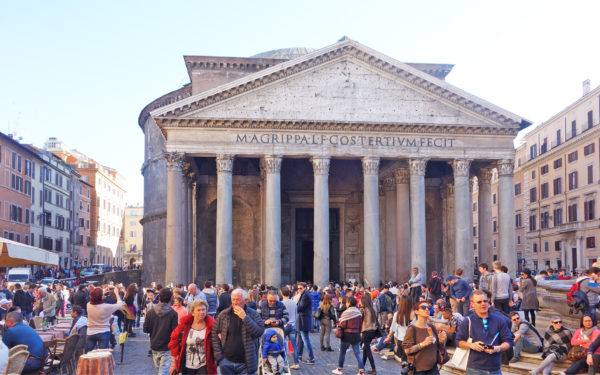
In this position he set about rebuilding Rome, the aqueducts and the roads. It was said that Augustus found Rome of brick but left it as marble – but this was really Agrippa’s doing. Indeed the greatest surviving building in Rome, the Pantheon, has on its front an inscription saying that it was built by Agrippa, though it was rebuilt by Hadrian.
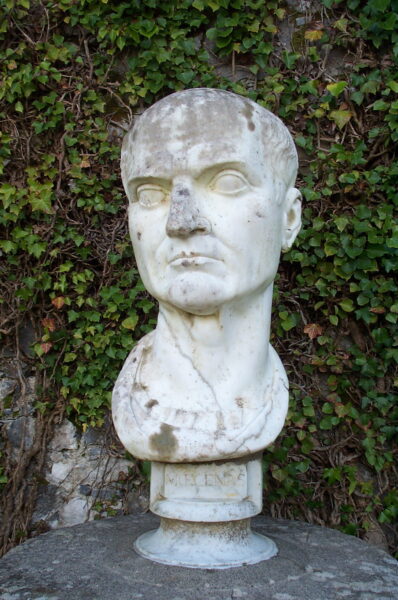
The other great supporter was Maecenas, who acted as his ‘Minister of Culture’ or, for the cynical, his chief propagandist. In the early days, he was a very wise political advisor constantly urging clemency and reconciliation with his enemies.

It was Maecenas who supported and indeed paid the two great poets, Virgil and Horace and persuaded Virgil to write the great epic poem The Aeneid. (I always used to be rather put off by the Aeneid, seeing ‘pius Aeneas’ as being rather ‘wet’ but seeing it in context, with Aeneas being a sort of model for Augustus, it makes more sense, seeing Augustus trying to do his best for Rome but being forced at times to be rather ruthless. And then there was the historian Livy, who wrote a patriotic history of Rome from the origin down to the time of Augustus in 142 books, of which only 35 survive: he wrote wonderfully unobtrusive prose –and was a pretty good historian.
Augustus may have been ruthless at times – he had to be to survive – but what is remarkable is that his enemies were so few and that he succeeded in bringing so many brilliant and talented men to help him build a new and long-lasting Roman Empire.
Conclusion
There are two different views on the assessment of Augustus. In the late 19th century the great German historian Mommsen described the Augustan system as a ‘diarchy’, a system where power was shared between the Emperor and the Senate. Sir Ronald Syme on the other hand in the 1930s took the opposite view that this was all a sham. For my own part I feel that Mommsen was nearer the truth than Syme. Admittedly Augustus kept a tight grip on the ultimate Power that is the control of the armies. Nevertheless the Senate had real power. All rulers tend to have some form of counsel of advisers whether formal or informal, but Augustus set up a system whereby the Senate was rather more than a mere counsel of advisors: indeed for the next two centuries the Senate met regularly and its debates were reported by Tacitus: they had real importance. The Senate was still the main law making body – laws were known as senatus consulta – the consultations of the Senate, and it was still the supreme court where the major criminal trials were carried out.
Indeed from the point of view of modern business practice, the secret of running a successful business is delegation, delegating powers to the individual parts of the business, whether individual countries or individual factories: you will not get a good performance unless you get the best people and will not get the best people unless you give them responsibility to make their own way and to enjoy their own success. And this surely is what Augustus achieved with his reforms. Augustus is a model for all businessmen to follow.
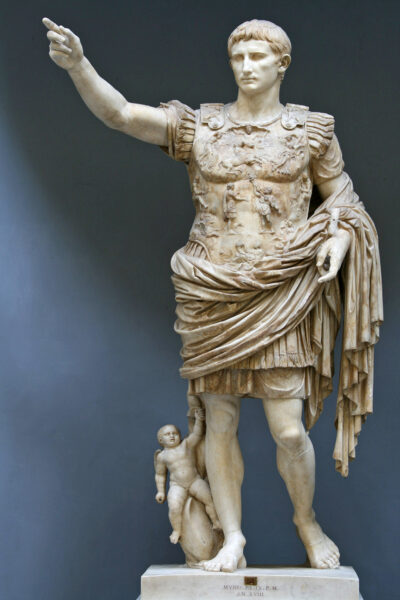
The crux of his efforts lay in the Senate, and he took great care to reform the Senate. The Senate was an
inherited body but there was a constant election of new members and occasional purges of the unsuitable – Augustus reduced the number from 900 to 600. Within the Senate a cursus honorum, or a course of the honours was adapted or invented, going through Quaestor (finance), Aedile (public buildings), Praetor (law) to eventually Consul and after that often going out to govern a province as proconsul. My favourite post is that of the moneyers, the tresviri aere argento auro flando feriundo, the three men for the blowing and beating of silver and gold which sounds very basic but no doubt gave a good training in finance: they were among the ‘Twenty Men’ at the lowest level of the cursus honorum. At the top level after one had been a consul, one went out to govern a province and this in the days before modern communication was a position of very considerable power where major decisions had to be taken
And for the middle classes, there was a flourishing local democracy as can be seen at Pompeii, where elections were in progress when Vesuvius erupted: the election posters can still be seen on the walls. The politically ambitious, when elected, could erect new buildings, build aqueducts, put on games – at one’s own expense but nevertheless it all brought prestige and satisfaction. The process can best be seen in the letters of Pliny the Younger. Pliny left behind 10 books of his letters, of which the 10th and final book consist of the letters he sent to the Emperor Trajan when, at the height of his career, he was sent out to be governor of Bithynia, a rather small province in what is now Turkey. They are a fascinating collection, for they also include Trajan’s replies. They tend to say: this city wants to erect an aqueduct — should I allow them to do so? Trajan then replies, My dear Pliny, please don’t trouble me with such minor matters – just see that they have enough money to complete the aqueduct and let them go ahead.
But the real secret of the success of the Roman Empire is surely that it allowed the market economy to take off and flourish. In a properly functioning market economy, decisions are made at the lowest level, and the rulers take no part in the provision of food and shelter. Government becomes minimal government, and most people can ‘do their own thing’. The best evidence of this is the existence of villas, self-supporting farms which have nothing to do with the political system, where the inhabitants pay their way and only interact with the system in the payment of taxes: the number of successful villas is surely a testimony to the success of the Roman Empire, while outside the villas were a variety of villages . I am sure that consciously, Augustus was totally unaware of the concept of the market – this is a concept of the 20th century; but if something worked, he left it well alone. The underlying economy worked: he left it alone and it flourished.