
Constantinople
The rise and fall of Constantinople is one of the most dramatic stories in the history of Western Civilization. Constantinople was founded, or rather re-founded, by the Emperor Constantine and was one of his most significant successes, for not only did Constantinople became a great city, but one that lasted a very long time.
Not only was it the last part of the Roman Empire to survive, but after its conquest by the Turks, it became the capital of the Ottoman Empire, which in its turn became one of the world’s greatest, even if today under-rated empires. And if today its importance is diminished though being stuck halfway between Greece and Turkey, it nevertheless vies with Athens and Alexandria for being the queen of the east Mediterranean.
Like so many of Constantine’s innovations, it really began as a result of Diocletian’s reforms. It was Diocletian who decided that the Empire was too big, and should be divided into four with two senior emperors, the Augusti, and two junior emperors the Caesars. One of the Augusti was inevitably to be stationed in Rome, but the other should clearly be in the East. From the military point of view that was obviously right – Rome by this time had become rather peripheral: the main enemies were the Persians to the east and the Germans to the North and Constantinople was halfway between them. Administratively too, the East was where all the intellectual excitement was, with the rising intellectual dominance of Alexandria and the still powerful influence of Athens – to say nothing of the rising power of Christianity.

But Diocletian’s first choice was not quite right – he chose Nicomedia, which was at the far end of the Sea of Marmora, lying 70 miles to the east of Constantinople, and by-passing the Bosporus, the entrance to the Black Sea. It was indeed the capital of the Roman province of Bithynia, and the seat of the governor of the area. But in retrospect one can see that it was not quite right. Constantine made a far better choice when he decided to found or rather relaunch a new capital at the mouth of the Bosphorus. It became known as Constantinople.
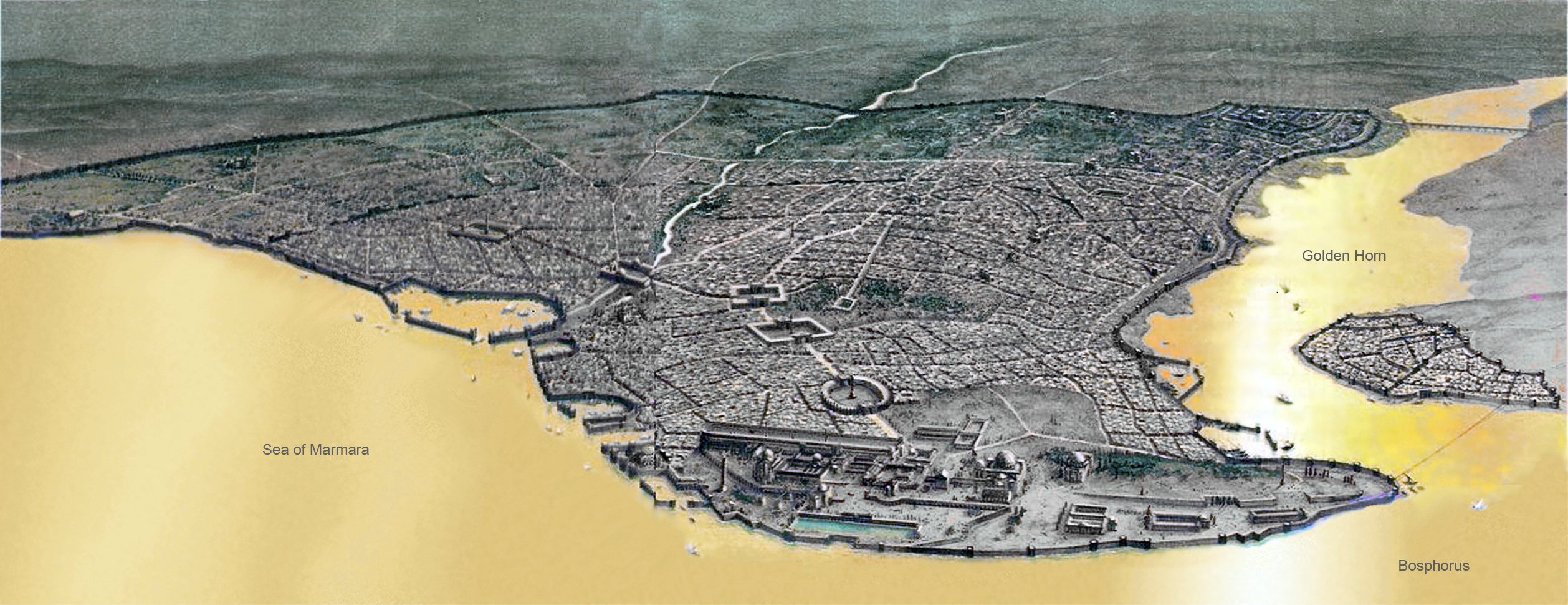
There was in fact already a town there, Byzantium. This had been founded as a Greek colony in 657 BC and had prospered modestly. But somehow it had never quite taken off. The site had three big advantages. Firstly, it was at the mouth of the Bosporus where shipping had to go through to the Black Sea. Secondly, it had good harbours on both sides. And thirdly it was superbly defensible. Hitherto defence had not been a major consideration – Nikomedia, being on flat ground was quite indefensible. But Constantinople being on a peninsula, all you had to do was to cut off the peninsula by a single wall and you are defended on the other two sides by the sea.
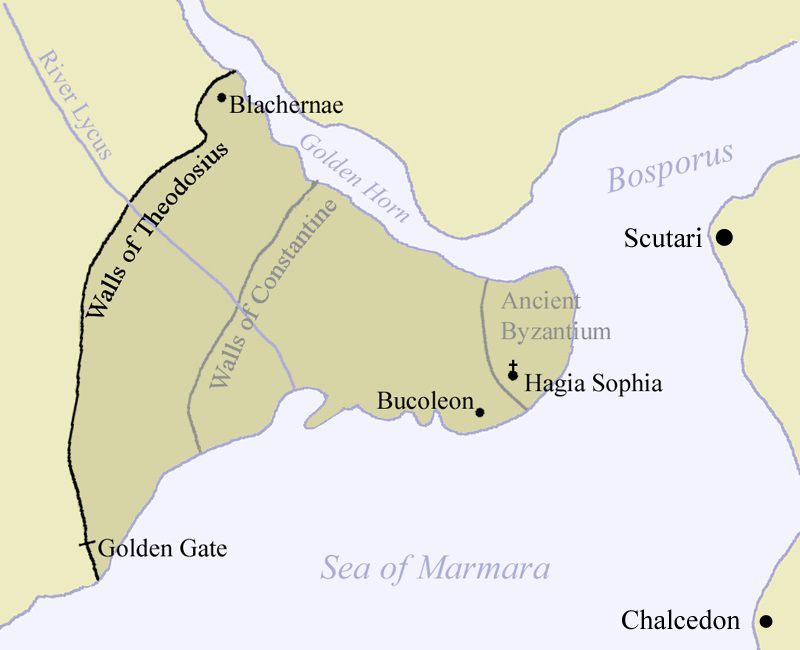
What made the site really special is the fact that the corner between the open sea and the Bosphorus is bisected by a sunken valley known as the Golden Horn, which left a very defensible peninsula on the south-western – that is the sea side. But it took a long time for its position to be appreciated. Although the site was extensively occupied in the Neolithic period in the third millennium BC, the first Greek settlement was not there at all, but on the other side of the Bosporus on the site of the Scutari hospital made famous by Florence Nightingale. Here the colony of Chalcedon was founded in 685 BC, which was subsequently known as the city of the blind because they so obviously missed the splendid site on the opposite shore. However, 20 years later, Byzantium was founded, at first a small settlement on the hill at the tip of the promontory that is today occupied by the Topkapi, the Palace of the Turkish sultans, and here it slumbered for 800 years, producing a fine wine much appreciated by the inhabitants – but little else.
Then in AD 220 it had the misfortune to back the wrong side when Septimius Severus was making his bid to become emperor and was therefore besieged and sacked. But having sacked it, Severus saw what a splendid site it was, and so rebuilt it twice the size, covering both the hills that formed the tip of the peninsula. But it continued to slumber until another 200 years later – precisely 997 years after its original foundation – Constantine decided that it would be the ideal site for his new city. He may have been influenced by the fact that on the opposite shore, near the city of Chalcedon, he won the crucial battle against his rival emperor Licinius and finally became master of the whole Roman Empire. But unlike the original colonists, he was not blind, but realised that the site on the opposite shore was the one for his new city.
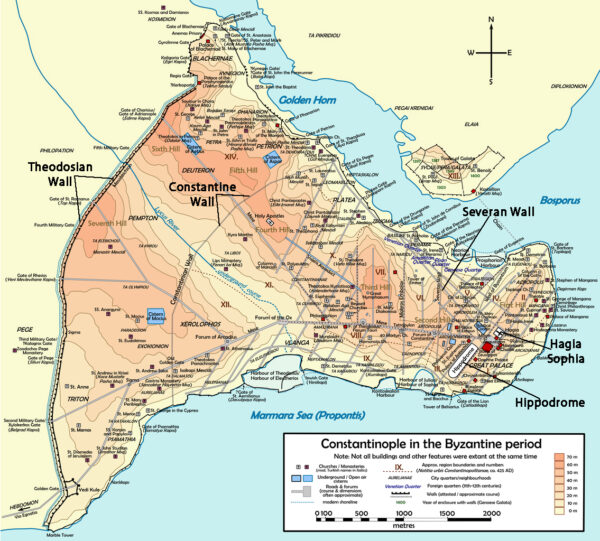
He therefore laid out a new town with new defensive walls three miles long, enclosing an area five times that of Severus, and occupying five of the seven hills. His new town filled up quickly and a century later, Theodosius II expanded it yet again and built the superb fortifications which enclose two more hills and remained impregnable for 800 years. Then in 1204 the city was captured by the Crusaders in the infamous Fourth Crusade, and finally it was captured by the Turks in 1453, bringing the Roman Empire to an end. The walls survive to this day, over-restored, but forming a very impressive monument.
The Hagia Sophia
The church of the Holy Wisdom

The Hagia Sophia, or the Church of the Holy Wisdom, was built by the Emperor Justinian 200 years after Constantine, and was completed in A.D. 536
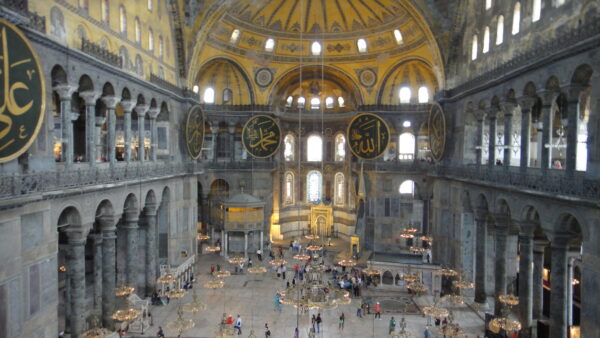
For nearly 1,000 years it was the biggest cathedral in the world, and it had a widespread influence, notably on Muslim architecture. The Blue Mosque next door, and many other Muslim mosques were influenced by the Hagia Sophia
But how do you design a new capital city, the capital of the world? Well the first and most important thing is the Palace, which should be a shocking thing to say in classical Greece or Rome, which both thought of themselves as being democratic; but by this time Rome was no longer a democracy and therefore by our usual definitions Rome had ceased to be civilised. But it seems that the Palace was the most important part of the ‘New Rome’. It lay on the tip of the peninsula on the western side, that is the opposite side to the Topkapi Palace of the Turkish sultans. Today it has vanished, as it was derelict at the time of the Turkish conquest and so it was demolished and the Blue Mosque was built over it. Much of it lies under a rabbit warren of small hotels and restaurants – indeed the best remains of the Palace can be seen underneath one of the restaurants where the owner has, quite illegally, burrowed under his restaurant and then continued going along a suite of arched cellars until eventually he came up in another restaurant on an adjacent street.

It was here that the real government took place. True, a new Senate was established, at least nominally, with two rather small meeting places. In the third century, the Senate in Rome had largely declined as the main action took place on the frontiers where the emperors or would-be emperors won or lost their battles and the victor was proclaimed emperor by his troops. Some then made their way to Rome for their formal confirmation by the Senate, – but some did not. The Senate fell into obscurity and it was the knights who ran the Empire – and all too often those who were not even knights. To some extent the senate revived under Constantine, and a new Senate was even founded at Constantinople, though the senators were not quite as grand as the Senators in Rome, who were known by the title of Clarissimi– very famous. The Senators in Constantinople were merely called Clari – famous. Their role in government was minimal, but it was a useful step before going out to be governor of a province.

Adjacent to the Palace was the second most important building in Constantinople – the Hippodrome or chariot racing arena. By this time, amphitheatres were going out of fashion– chariot racing was all the rage. There were two major factions, the Greens and the Blues, and the enmity between them frequently cause riots which gave the emperors their biggest headaches. The Hippodrome was adjacent to the Palace, and was the place where the Emperor could come out and be seen at least in the distance by the populace. The site of the hippodrome is now a long narrow public park in the middle of which are three of the monuments that survive from the Spina, the central spine of the racing track.

Most important is the bronze Serpent column, which was originally erected in Delphi by the Greeks, to celebrate their victory over the Persians at the Battle of Plataea in 479 BC. It was looted from Delphi and brought to Constantinople, where miraculously, it still survives, though as the ground has risen it is in a pit several metres deep. The other two main features are later. There is a column had been brought from Egypt and was set up by Theodosius I on a base which preserves some of the finest carving from late antiquity. The date of the third column, known as the column of Constantine Porphyrogenites is uncertain.


And there were of course great baths, an essential part of a Roman city. They were known as the Baths of Zeuxippos, and have completely disappeared. The water supply was always a problem in Byzantium and aqueducts were built, bringing water from the Thracian hinterland. The first was built by Hadrian, but the most impressive surviving aqueduct is that of completed by Valens in the mid fourth century, part of an aqueduct over 150 kms in length. However traces of numerous other aqueducts have been found in the Thracian forests, one nearly 250 kms long, and it has been estimated that over 400 kms of aqueducts in all were constructed. Within the city many cisterns and reservoirs were built to store the water. The finest was the so-called Basilica cistern that supplied water to the Palace. This was lost and then rediscovered and has recently been restored for visitors with only a small depth of water in its base, so it makes a majestic even slightly intimidating visit.
The other feature one would expect are churches and Constantine put great emphasis on building churches. However, the greatest church of all, the Hagia Sophia, or church of the Holy Wisdom, which still survives as one of the great attractions of Constantinople was built by Justinian, a century later. Constantine’s great church, dedicated to the Holy Apostles, was built more than a mile away from the centre of the city near the northern defences on the fourth hill. Here or in a mausoleum adjacent, Constantine himself was buried, as were many of the succeeding Emperors. But by the time of the Turkish conquests it was dilapidated, so it was demolished and today the site underlies the great Fatih mosque. But why did Constantine build his great church so far from his Palace?

The one surviving monument that was definitely built by Constantine is Constantine’s column. This was erected in the middle of the great forum surrounded by buildings. It consists of seven great porphyry drums standing on an impressive base, and was originally crowned by a statue of the Emperor as Sol Invicta, the unconquered Sun – for although he was a Christian, Constantine still like to present himself as being the supreme pagan god. Nearly a century later, it was damaged in an earthquake in 416 and iron hoops were put around it to stabilise it. It suffered many vicissitudes, and in 1779 was badly scorched when the whole area was destroyed in a vast fire. But it still survives – just – though all traces of the forum have vanished, and today it is known as being at the south-eastern corner of the Great Bazaar. It was here that on 11th May 330, Constantine dedicated his new city as the capital of the Eastern Roman Empire, so it is perhaps only right that it should be the one building of Constantine that still survives.

Constantinople expanded yet once again when in the early fifth century Theodosius built another set of walls half a mile out from those of Constantine to enclose the suburbs that had expanded beyond the original walls. A double wall was eventually built with very strong gates, and they became the strongest of all defenses in the ancient world; indeed they kept the city safe down to 1204 when it was captured and looted by the ruffians of the fourth Crusade. It recovered once again as a Christian city and a bastion against the Muslims and it was not until 1453 that it was eventually captured and became the capital of the Ottoman Empire where the architect Sinan built many of the fine mosques which adorn the city today.
The success of the city was perhaps surprising. Byzantium had survived for 997 years in inconspicuous somnolence but then suddenly when picked out by the Emperor Constantine it became the huge success that it has been ever since. Rome on the other hand declined. By this time Italy had become something of a backwater and the new imperial towns were further to the North, in Ravenna and Milan, nearer to where the action was on the frontiers. Constantinople was in the centre, able to watch over the attacks of the Germans in the North and the Persians to the east and bearing intellectual substance from Alexandria in the South and perhaps even from declining Athens to the South West, Eventually the Persian threat was replaced by the much greater threat from the Muslim invaders, while Slavs and Franks pushed down from the north. But it survived until 1204 when it was captured and sacked by the ruffians who made up the Crusaders of the fourth Crusade. But it recovered again, only to decline once more until eventually it was conquered and taken over by the new invaders, the Turks, who made their capital city so that it became once again a great city, full of splendid mosques, some of them designed by one of the greatest of all architects, Sinan. However following the Greek disaster of 1923, little remains of the Greek traditions and even though it is on the periphery of modern Turkey, it still remains, as Constantine intended, one of the world’s greatest cities.
25th October 2013