Diocletian
The Emperor who both saved and destroyed the Roman empire

At the end of the 3rd century, everything changed. Two great emperors – Diocletian (284 – 305) and Constantine (306 – 337) restored the empire to something like its former glory. However, there are two ways of looking at them. It could be said that they were the two emperors who restored the Roman Empire, who realised that the chaos of the later 3rd century meant that drastic reorganisation was needed, and carried out this drastic reorganisation so successfully that Rome continued to thrive throughout the 4th century. On the other hand, it could be said that the reforms of Diocletian and Constantine mark the crucial change when the civilisation of Rome collapsed into barbarism and that many of the features that made Rome so uniquely attractive were replaced by features more at home in the great barbarian empires of the east. The reason that Constantinople survived so long was because it had the rigid framework that had given strength to ancient Egypt and to the Bronze Age states of the Near East, and which indeed had its echoes in the empires of India and China.
Diocletian, like most of the emperors in the late 3rd century, came from Dalmatia, the area that we used to call Yugoslavia and which today is Croatia or Serbia. Diocletian was born around 244 at Salona, near modern Split, where he built the palace to which he retired. Little is known of his early career and his rise to power; one suspects that he took care when Emperor to draw a veil over his early life, but he was clearly a first rate soldier and a charismatic leader.
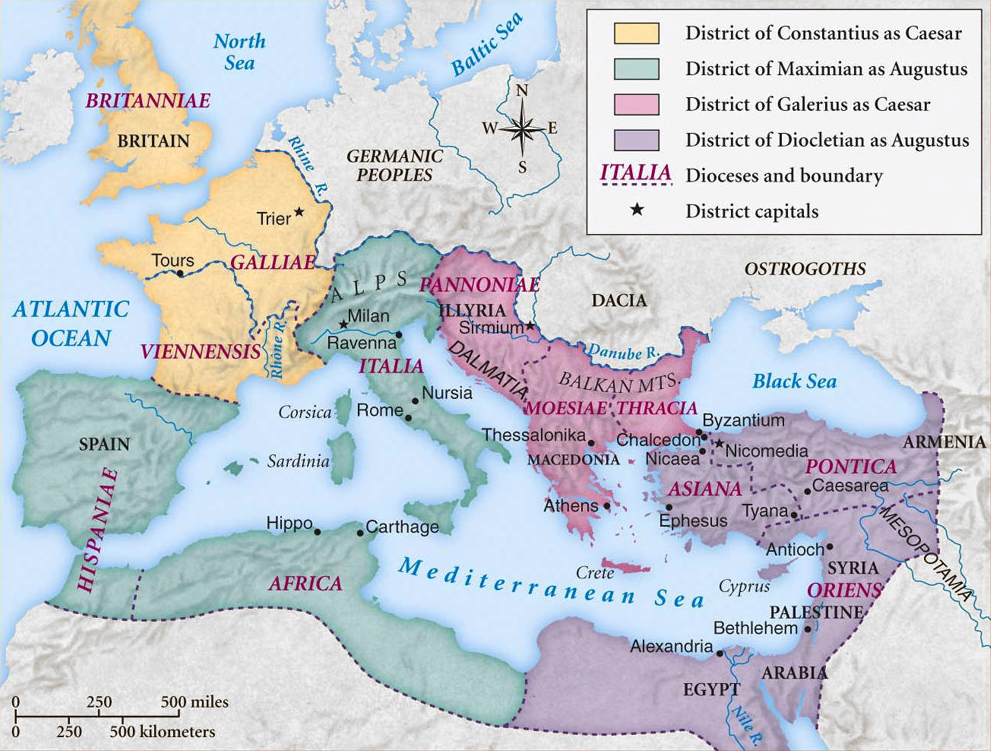
It is difficult to know where to begin in describing his many reforms. Perhaps the most momentous was that he divided up the role of the emperor. There were to be two chief emperors who were called Augusti. This began soon after he had established himself as Emperor, when he invited his friend Maximian to join him as co-emperor. If Diocletian had the brains, Maximian had the brawn. Maximian had already put down the rebellion of the Bagaudi in north west France, and had joined him in a successful attack at Alemanni in Germany; so he left him to look after Gaul and the western empire while he went on to look after the east, where he fought the Persians and then concluded a successful peace.
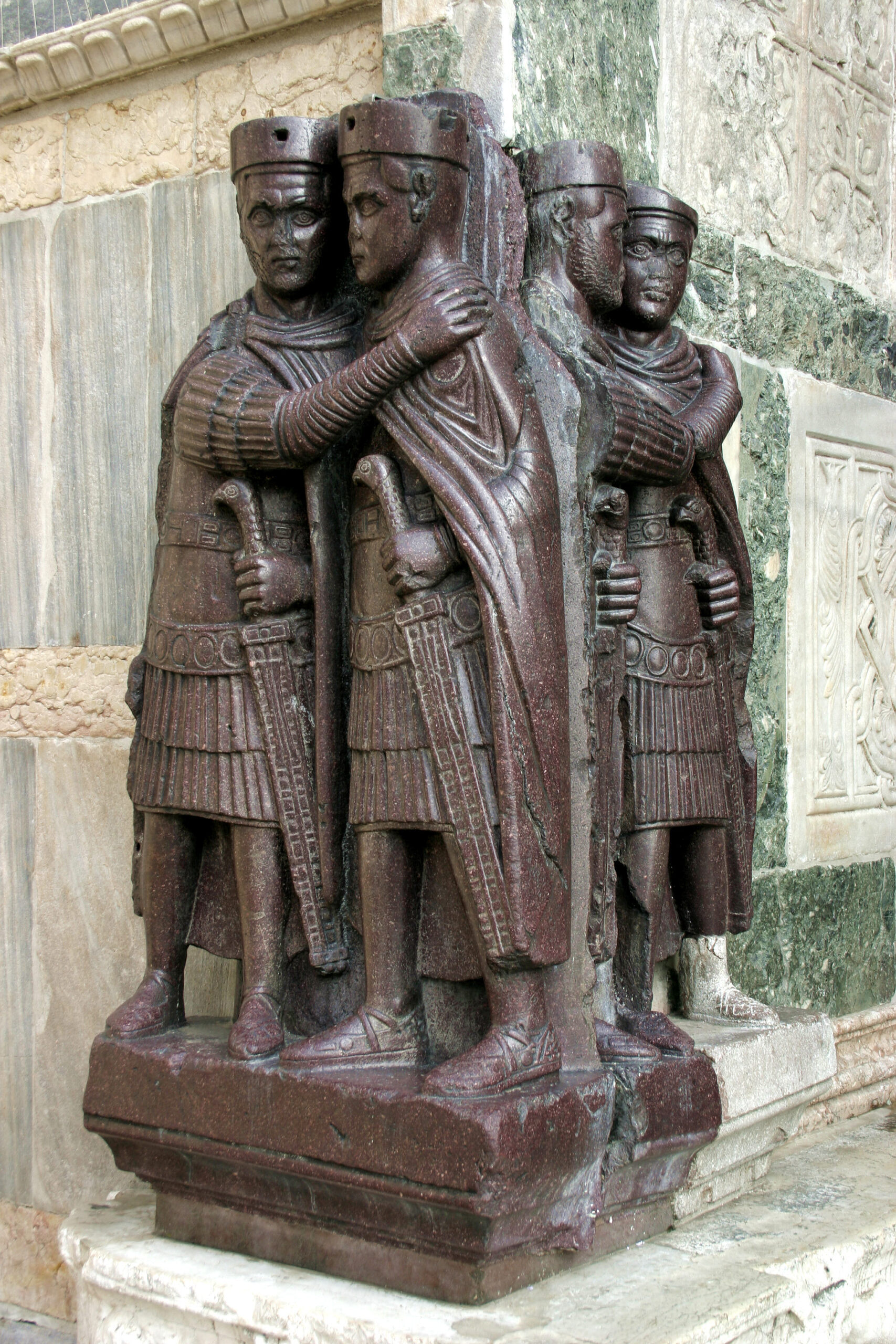
However in 293, he divided the rule further by appointing two junior emperors who were to be called Caesari. In the East, he appointed Galerius who took control of the Illyrian provinces, but then spent much of his time fighting the Persians. In the West however Maximian was left in control of Italy and Spain, while Gaul was allocated to a new Caesar, Constantius Chlorus, who successfully brought Britain back into the Roman Empire and whose son Constantine was to become Constantine the Great. The Tetrachy was a half success: when Diocletian was in control it worked, when he retired, it broke up. But the idea of dividing the empire in half was a great success, and when his successor Constantine founded Constantinople as the counter balance to Rome, it proved to be a great achievement.
However Diocletian was not just a successful soldier, he was also a most successful, one might indeed say dangerously successful, administrator. The story is a complex one which began in the efforts to collect taxation. In many ways Diocletian’s reforms can be presented as the tidying up of the old system, and many aspects of the new system were the regularising of changes which had already been partially made before in the chaos of the Third Century. But in the reforms of Diocletian, the temporary arrangements were made permanent, and in the interests of the efficient collection of taxation, the freedom of a large part of the population was lost.
But taxation runs into problems at the time of inflation. Inflation at first is indeed a great benefit to the state as it enables more money to be collected at no cost. But it soon runs into the problem that taxes are paid in the debased coins at amounts set in the old coinage. And by the end of the third century, a smaller amount of real value was being raised: how could it be replaced?
The answer was to revert to the pre-money or non-money economy and to replace money tax by tax in kind. The old taxes continued to be levied: there was the poll tax and the old land tax known as tribute. But both were overshadowed by a new tax called the annona.
Annona was originally a goddess of the harvest and in times of crisis a special emergency tax would be levied to feed the army. But during the third century, such emergency taxes were levied ever more frequently and ever more heavily. Diocletian systematically organised the annona. The supply of provisions – corn, oil, wine, salt, pork and mutton – necessary to feed the soldiers for a year, was calculated and called the annona. In the course of the fourth century the principle was extended, and even civil officials received salaries in kind. This was the crucial break: taxes were now collected in kind and not in money, and this marked the conversion to a non-market economy.
The problems of collecting taxes lead to another reform which proved in the long run to be even more harmful and to be even more destructive of freedom, for it meant that the peasants, and indeed much of the population was tied to the land and became serfs. A census was taken regularly to assess the basis on which the tax was collected: it was assessed on the basis of the amount that one man and his family could be expected to produce. Once the census had been established the taxation to be levied, then that became one’s legal place of residence. One could not move away from it, and furthermore your children had to continue to cultivate the land and provide the taxes. This completely broke the right of migration that had been granted so many years before by the Ius Latinum. True, the Latin Rights had long been a dead letter, and had been replaced by the Ius Italicum , but that too was swept away by Diocletian.
But this is the classic definition of serfdom. A serf is someone tied to the soil and who cannot move away. It is sometimes remarked that Communist Russia still remained a serf society, because permission was need for travel and you could not move away from your place of residence. It was the right of travel that had been one of the core features of Latin Rights.
Running the empire
Diocletian also carried out a thorough reorganisation of the running of the Roman Empire, though how much it was simply a tidying up of previous arrangements, and how much it was actually carried out by his successor Constantine is not always clear. He was all too well aware that a major source of instability had come from the governors of provinces who found themselves in charge of very large fighting forces, which tempted them to break away and revolt. He tackled this therefore by doubling the number of provinces from around fifty to nearly a hundred. Britain for instance was divided into four provinces.
A further change was made by separating out the civil administration from the military. The military command was grouped under a leader, or dux (plural duces) from which the modern term duke is derived, while the civil government was placed under a president or praeses – the title varied. It all becomes very complicated and it seems to have led to a considerable expansion in the size of the administration. Presumably the governance of each province needed to have a considerable office. Does the doubling of the number of provinces imply or involve the doubling of the number of civil servants? This is a lovely matter for debate, but certainly the administration increased under Diocletian.
The structure of the administration was also changed. The senate lost most of its function as an advisory body, and instead there was a council of advisers, the consistorium, which was divided into two main parts: a legal division and two finance ministers. By now Rome was no longer the centre of administration, but the emperor moved round between various cities taking his entourage, the comitatus with him. And the legal rescripts – answers to problems given out by the emperor – were issued from wherever the emperor was staying; and much of the history is reconstructed from an examination of where the rescripts were issued. And presiding over it all was the praetorian prefect who by now had lost most of his military position and was essentially an administrator. The praetorian guard itself had become too dangerous and was disbanded by Constantine.xxx
At first, the new regime was widely welcomed as people accepted that there was now a strong and stable system of rule. But the stresses of the new control began to jar, and Diocletian responded by becoming more autocratic. Inflation was an ever growing problem, so he decided that this was the fault of the merchants, so in AD 301 he promulgated an edict of maximum prices that were to be charged throughout the empire. Fragments of this have survived from which the relevant prices can be reconstructed – see the next chapter. It did not work, and by 305 it was a dead letter.
Diocletian then looked around for further causes of decline, and decided that the Christians were a major cause of the problems. The Romans were generally very tolerant of strange religions: Egyptian gods had spread widely as had the worship of Mithras, who was particularly popular among the soldiers. But Christianity in its rejection of Roman traditions had been spasmodically persecuted, particularly when the problems of the empire became overwhelming. There had been two major episodes of persecution: one under Decius from 249 – 251, then ten years later under Valerian (259 – 260). However despite this, Christianity had been expanding and a number of large churches had been built and Diocletian decided they were the root of the problem and therefore in 303 he launched the last and most thorough of the persecutions – churches were to be pulled down, the Holy books were to be confiscated and burnt, and where imperial freemen had gone over to Christianity, they were to returned to slavery. Perhaps to Diocletian’s surprise,the persecution was not a success, but led to huge resentment, for Christianity had penetrated more widely than he realised. And barely a dozen years later, his successor Constantine would adopt Christianity.
One final stage should perhaps be recorded that may indicate a turning point in the descent from civilisation to barbarism and this was in the increased formality of court life. Hitherto the emperor had merely been the princeps, the leading member of the senate who dressed the same as everyone else and could be spoken to with no more than the slightly increased formality that one uses in addressing someone who is your boss. But Diocletian introduced adoratio – obeisance in place of the customary salutatio. He became the Dominus – the lord and master, and began living in seclusion and only rarely appeared in public, and then in stage-managed occasions, dressed in gorgeous robes and a diadem. Access to his presence was restricted and those who entered his presence were expected to bow. It was generally felt that he had introduced ceremonial from the Persian courts – and the Persians were, after all, the archetypal barbarians.

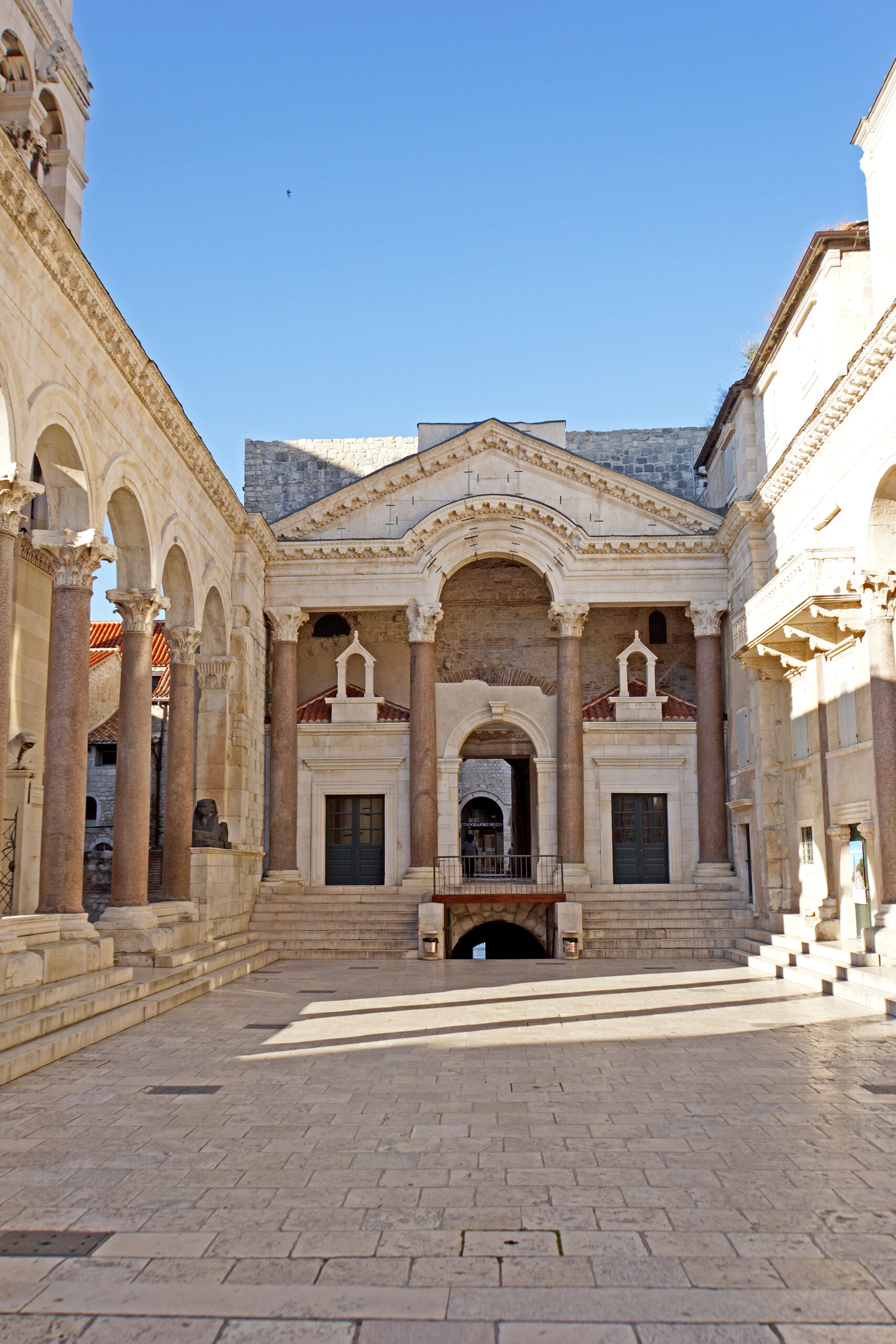
But by 306 he had had enough and he decided to retire. This was something that no emperor had ever done before, not indeed did again. Every other Roman Emperor, both before and after, carried on until he either died or was assassinated. But in 306 Diocletian retired, and made all his fellow emperors retire too. He built a huge palace by the sea at Split, in modern Croatia, not far from his home town at Salona. Miraculously much of it, including the facade on the seaside, has survived as a splendid tourist resort. But here he lived for five years cultivating, so it is said his kitchen garden; and trying, not altogether successfully, to keep his former co-emperors in their unwilling retirement.
(One might note that it was in fact a Palace, even if in the planning it was essentially a legionary fortress. But if we define the difference between barbarism and civilisation as being between palaces and markets, then his building of a deliberate Palace. Surely marks that the Roman civilisation had indeed turned an important corner).
Was Diocletian a success? He was in effect the person who introduced centralised management into the Roman Empire. In the great days, the running of the empire had been amateurish, run as an old boys’ network with a minimum of bureaucracy, and as so often, amateurism worked. Diocletian changed all this. The number of bureaucrats rose enormously, and thus taxation had to be raised enormously to pay for all the bureaucracy. The new professionalism certainly gave the empire a new lease of life in the 4th century, but it also carried with it the rigidity and inflexibility that carried the seeds of the decline and fall in the fifth. And most important of all it marked a change from the open society that made the Roman Empire great, to the closed kinship-based society, typical of `the great empires of the pre-market age. There was a loss of freedom: was it worth it?